


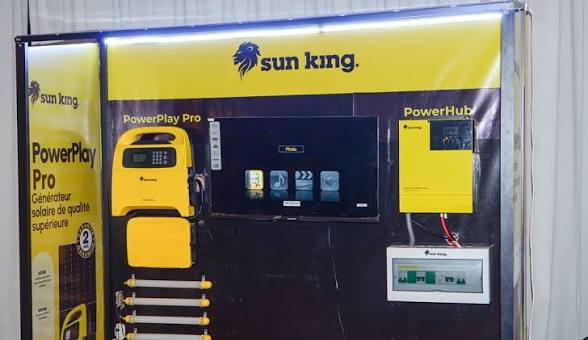
Sun King has expanded its range of solar-powered products with the introduction of a new solar-powered freezer, as the company continues to develop energy solutions designed to help households and small businesses access reliable electricity.
The new product adds to Sun King’s growing portfolio of solar appliances and reflects the increasing demand for alternative sources of power in markets where unreliable electricity supply and high energy costs continue to affect consumers and businesses.
For many households and small businesses across Africa, access to dependable electricity remains a major challenge.
Frequent power interruptions often force consumers to rely on petrol or diesel generators, which can be expensive to operate because of rising fuel prices and maintenance costs.

Solar-powered appliances offer an alternative by using energy generated from the sun to provide essential services without depending entirely on conventional electricity or fuel-powered generators.
Sun King has built its business around providing solar energy products to consumers who need affordable and accessible power solutions.
The company’s expansion into solar-powered cooling equipment is particularly significant because refrigeration is an important requirement for many businesses.
Small retailers, food vendors, restaurants, pharmacies and households depend on refrigerators and freezers to preserve products and reduce losses.
However, operating conventional cooling equipment can be difficult in areas where electricity supply is unstable.
The introduction of a solar-powered freezer could therefore provide another option for customers looking to preserve goods while reducing their dependence on traditional power sources.
DDM News reports that the new product comes at a time when energy costs have become a major concern for Nigerian households and businesses.
The increase in petrol and diesel prices has made generator-powered electricity increasingly expensive.
For small businesses, the cost of fuel can significantly affect daily profits.
A business owner who spends a large portion of daily revenue on fuel may have limited money available for restocking, expansion or personal income.
Solar technology can help address part of this challenge by allowing users to generate electricity from sunlight rather than purchasing fuel every day.
The growth of solar energy products also reflects a broader shift in the African energy market.
As electricity demand increases and traditional power infrastructure struggles to meet the needs of growing populations, off-grid and renewable energy solutions are becoming increasingly important.
Solar systems can provide electricity in areas where access to the national grid is limited or where power supply is unreliable.
Sun King’s decision to expand its product range therefore places the company within a growing market for distributed renewable energy.
The solar-powered freezer could be particularly useful for small businesses that sell frozen foods and other temperature-sensitive products.
Such businesses require consistent cooling to protect their stock.
When power interruptions occur for extended periods, business owners may lose products to spoilage.
These losses can be financially damaging, especially for entrepreneurs operating with limited capital.
A reliable solar-powered freezer could help reduce some of these risks by providing an alternative source of energy for cooling.
The product may also support entrepreneurs who operate in locations where connecting to the electricity grid is difficult or expensive.
Instead of waiting for improvements in conventional electricity infrastructure, businesses can increasingly explore independent energy solutions that meet their specific needs.
Sun King’s expansion comes as consumers are becoming more interested in products that can help reduce recurring energy expenses.
While the initial purchase of solar equipment can represent an investment, users may benefit from reduced dependence on petrol and diesel over time.
Solar energy also offers the advantage of using a naturally available energy source.
Once the necessary solar equipment is installed, sunlight can be converted into usable electricity without the daily purchase of fuel.
DDM News understands that the development could also contribute to the wider growth of clean-energy adoption among Nigerian consumers.
The country has significant solar energy potential because of its geographical location and abundant sunlight.
However, the high cost of energy and limited access to reliable electricity have remained barriers for many households and businesses.
Products that combine solar power with practical household and commercial appliances could help make renewable energy more useful to everyday consumers.
The introduction of the freezer also demonstrates how solar technology is moving beyond basic lighting and phone-charging solutions.
Modern solar energy systems can power a wider range of appliances and support more complex household and business activities.
This expansion could create opportunities for entrepreneurs who depend on electricity-intensive equipment.
For instance, food vendors and retailers require refrigeration to maintain the quality of their products.
Having access to a solar-powered freezer could allow such businesses to operate more consistently, particularly in locations affected by frequent power interruptions.
The development may also support efforts to reduce the environmental impact associated with the widespread use of petrol and diesel generators.
Traditional generators produce emissions and contribute to air pollution, while solar energy generates electricity without the same direct fuel combustion during operation.
As concerns about energy costs and environmental sustainability increase, renewable energy solutions are likely to attract more attention from consumers and businesses.
However, affordability will remain an important factor in determining how widely solar-powered appliances are adopted.
Many Nigerian households and small businesses are operating under significant financial pressure.
For solar products to reach a wider market, customers will need access to flexible payment options and financing arrangements that make the technology easier to purchase.
Sun King has previously built its business model around making solar products more accessible to consumers through financing and payment solutions.
The expansion of its product range could therefore provide customers with more options based on their specific energy needs.
The company’s move into solar-powered cooling also highlights the growing relationship between renewable energy and small-business development.
Reliable electricity can improve productivity, reduce operating disruptions and help businesses protect their inventory.
For entrepreneurs, these benefits can be as important as the direct savings achieved from reducing fuel consumption.
As Nigeria continues to face electricity and fuel challenges, demand for alternative energy solutions is expected to remain significant.
Sun King’s latest product expansion shows how companies in the renewable energy sector are responding to this demand by developing solutions that address practical problems faced by consumers.
The solar-powered freezer could become particularly relevant in a market where food preservation, energy costs and unreliable electricity remain major concerns.
Ultimately, the success of the product will depend on factors including affordability, durability, performance and accessibility.
If consumers can obtain and operate the freezer at a cost that makes economic sense, it could provide meaningful value to households and small businesses.
Sun King’s expanded solar appliance range therefore represents another step in the development of Nigeria’s renewable energy market.
As more consumers look for alternatives to expensive and unreliable conventional power sources, solar-powered appliances could play an increasingly important role in helping households and businesses manage their energy needs.
The launch also reinforces the growing potential of solar technology to support everyday activities beyond lighting, demonstrating how renewable energy can increasingly become part of the wider solution to Nigeria’s persistent power and energy challenges.




