


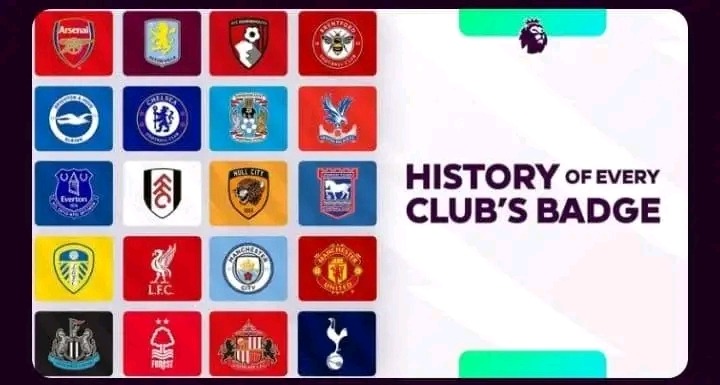
At first glance, a football club badge may look like nothing more than a colourful emblem stitched onto a shirt. But for Premier League clubs, the crest often tells a much bigger story.
Behind the animals, buildings, weapons, colours and other symbols are links to local history, famous victories, club nicknames, important people and the communities the teams represent. The 2026/27 Premier League season provides another opportunity to look beyond the football and understand what these familiar badges actually mean.
Arsenal’s cannon is perhaps one of the easiest symbols to recognise. The club was founded in 1886 by workers at the Royal Arsenal in Woolwich, and the weapon became a reference to those origins. It also explains why Arsenal became known as the Gunners. The club’s traditional red colours remain part of its identity.

At Aston Villa, the lion dominates the modern crest. The current design, unveiled in 2024, draws the animal from the Scottish coat of arms and links it to former chairman William McGregor, who was Scottish. Above the lion is a star commemorating Villa’s European Cup triumph in 1982.
Bournemouth’s badge has a particularly unusual story because the figure on it is not a mythical creature or landmark. It is former striker Dickie Dowsett. The former Bournemouth player later became the club’s commercial manager and was involved in the badge redesign that introduced his silhouette in 1972.
Brentford and Brighton, meanwhile, carry symbols connected strongly to their nicknames. Brentford’s bee reflects the Bees nickname, which dates back to the late 19th century. Brighton’s seagull has been part of the club’s identity since the 1970s, following the supporters’ adoption of the Seagulls nickname.
Chelsea’s blue lion is another symbol rooted in local history. The lion was adopted after Ted Drake became manager in 1953 and was based on an element of the former Metropolitan Borough of Chelsea’s coat of arms. The staff held by the lion also has a historical connection with Westminster.
Coventry City’s crest packs several pieces of history into one design. An elephant represents strength, while a castle refers to Coventry Castle. A phoenix rising from flames represents the city’s recovery after the devastation of the Second World War. The eagle also has a historical connection with Leofric, Earl of Mercia.
Crystal Palace’s eagle has a different origin. The bird sits above an image representing the famous Crystal Palace exhibition building. The eagle became associated with the club in the 1970s after the nickname changed from the Glaziers to the Eagles.
Everton’s badge is centred around Prince Rupert’s Tower, a historic structure on Everton Brow. Two laurel wreaths represent victory, while the club’s famous Latin motto, “Nil Satis Nisi Optimum”, translates as “Nothing but the best is good enough.”
Fulham’s minimalist badge takes a simpler approach. Its black-and-white shield carries the initials FFC in a red monogram, while Hull City’s tiger reflects the club’s Tigers nickname and its traditional amber-and-black colours.
Ipswich Town’s badge carries a Suffolk Punch, a famous local breed of heavy workhorse. The crest also includes references to the town’s architecture and waterways, connecting the football club to the wider identity of Ipswich.
Leeds United’s crest features the White Rose of York, one of Yorkshire’s best-known symbols. Liverpool, meanwhile, carries the famous Liver Bird, a mythical creature closely associated with the city. The bird has been part of Liverpool’s identity for centuries.
Manchester’s two Premier League giants also use symbols connected to the city’s history. Manchester City’s badge features a ship representing the Manchester Ship Canal and trading history, while three stripes refer to the city’s three rivers. Manchester United’s Red Devil became associated with the club during the 1960s after Sir Matt Busby adopted the nickname.
Newcastle United’s crest draws heavily from the city’s coat of arms. Its design includes a castle, a lion carrying St George’s Cross and two seahorses representing Newcastle’s maritime heritage and links to the River Tyne.
Nottingham Forest turns to nature. Its tree represents Sherwood Forest, while the waves underneath refer to the River Trent. Two stars were later added following the club’s European Cup triumphs in 1979 and 1980.
Sunderland’s badge brings together several local references, including Wearmouth Bridge, Penshaw Monument and a colliery wheel reflecting the area’s coal-mining history. Two black lions also connect the crest with the city’s coat of arms and the Black Cats nickname.
Finally, Tottenham Hotspur’s famous cockerel stands on a football. The symbol has been associated with the club for more than a century and is connected to Sir Henry Percy, better known as Harry Hotspur.
Taken together, these badges show that Premier League football is about more than what happens for 90 minutes on the pitch. The crests preserve pieces of industrial history, geography, local culture, nicknames, landmarks and sporting achievements.
From Arsenal’s cannon to Liverpool’s Liver Bird, Manchester’s ships, Nottingham’s tree and Tottenham’s cockerel, every badge gives supporters another reason to feel connected to the club they follow.
The next time a Premier League match kicks off, the badge on the players’ shirts may be worth a closer look. There could be centuries of local history hiding inside it.




