


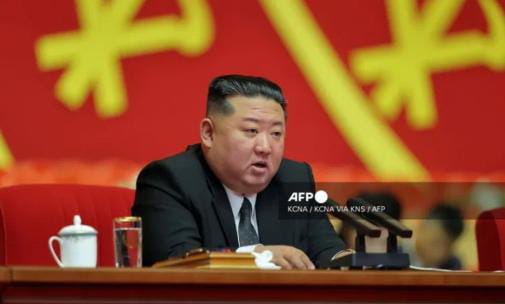
PYONGYANG, NORTH KOREA — North Korean leader Kim Jong Un has overseen the launch of a missile that state media says can use artificial intelligence to adjust its flight trajectory, as Pyongyang continues to develop what it describes as advanced strategic weapons.
The missile was launched early Saturday from an area near the eastern coastal city of Wonsan and travelled more than 700 kilometres, according to South Korea’s military.
North Korea’s official Korean Central News Agency reported that the launch formed part of a training exercise for soldiers operating a “hypersonic strategic weapon system.”
North Korea Highlights AI Capability
According to North Korean state media, the missile is capable of changing its flight orbit while travelling at low altitude.

Kim’s sister, Kim Yo Jong, had previously claimed that the technology would make the projectile extremely difficult to evade.
Pyongyang presented the launch as a demonstration of the capabilities of its strategic missile forces.
Following the exercise, Kim Jong Un praised the soldiers involved and called for continued development of the country’s strategic offensive capabilities.
“We must continue our responsible efforts nonstop to constantly and repeatedly make the enemy recognise the reliability and fatality of our strategic offensive means,” Kim said, according to KCNA.
Seoul Disputes Interception Claims
South Korea disputed North Korea’s suggestion that an AI-guided projectile would be impossible to intercept.
Seoul’s Defence Ministry said the missile launched on Saturday remained within the detection and interception capabilities of the defensive systems operated jointly by South Korea and the United States.
The ministry also urged Pyongyang to stop actions that it said were increasing tensions on the Korean Peninsula.
South Korea described the launch as a violation of United Nations Security Council resolutions restricting North Korea’s ballistic missile activities.
Missile Flew More Than 700 Kilometres
South Korea’s military said the projectile travelled more than 700 kilometres after being launched from the Wonsan area.
North Korean state media described the exercise as part of efforts to improve the operational capabilities of its strategic missile forces.
The development comes amid continuing military tensions between North Korea and the United States and South Korea, which maintain a combined defence posture on the peninsula.
Precise Target Coordinates Disclosed
KCNA also released what it said were the precise coordinates of the missile’s impact point.
Analysts said the level of detail was unusual and could indicate that Pyongyang wanted to demonstrate confidence in the weapon and its accuracy.
Hong Min of the Korea Institute for National Unification told AFP that the coordinates were given to decimal points, representing precision of roughly 30 centimetres.
He interpreted the disclosure as an indication that North Korea wanted to project confidence in its missile technology.
Kim Appears With Family
Images released by KCNA showed Kim Jong Un watching the launch and later appearing with his wife, Ri Sol Ju, and their daughter, Ju Ae.
Ju Ae has increasingly appeared alongside her father at major military and state events since she was first publicly introduced in 2022.
South Korea’s spy agency has previously assessed that she is the most likely successor to Kim, citing her increasingly prominent public role.
North Korea Expands Strategic Weapons Programme
The latest launch highlights Pyongyang’s continued efforts to develop advanced missile systems and improve the capabilities of its strategic forces.
North Korea has increasingly focused on hypersonic weapons and other technologies designed to complicate missile detection and interception.
However, while Pyongyang highlighted the missile’s reported AI-guided capabilities, South Korea maintained that the weapon launched on Saturday could still be detected and intercepted by the allies’ existing defensive systems.
The competing assessments underline the continuing military and technological rivalry on the Korean Peninsula, where North Korea’s weapons development remains a major security concern for South Korea, the United States and neighbouring countries.




