


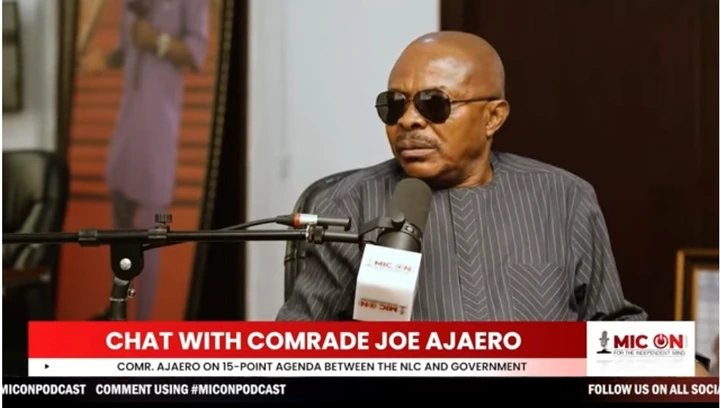
ABUJA, NIGERIA — President of the Nigeria Labour Congress, Joe Ajaero, has claimed that President Bola Tinubu offered organised labour a ₦250,000 minimum wage during negotiations over a proposed increase in the pump price of petrol, but labour leaders rejected the offer.
Ajaero made the claim during an interview on the Mic On Podcast, published on Saturday, October 3, 2026, while discussing workers’ living conditions and the negotiations that eventually produced Nigeria’s current ₦70,000 minimum wage.
According to the NLC president, Tinubu had proposed increasing the petrol price to about ₦1,500 per litre while offering workers a substantially higher minimum wage.
Ajaero said labour leaders rejected the proposal because they believed a higher fuel price would affect the entire population, not only workers.

Ajaero Recalls Meeting With Tinubu
Ajaero said the conversation took place during a meeting between the president and organised labour.
According to his account, Tinubu told labour leaders that their position was restricting his ability to increase the petrol price and suggested that workers could receive ₦250,000 if they accepted the proposed increase.
Ajaero recalled Tinubu saying: “If you allow me to increase this price,” referring to a proposed petrol price of about ₦1,500, “I will pay you guys ₦250,000.”
The NLC president said labour leaders considered the wider impact of fuel prices before deciding against the proposal.
“We told him, ‘Look, sir, we prefer to take even ₦70,000 than for you to increase the pump price around ₦1,500, because it is not only the labour force that will suffer from this effect,’” Ajaero said.
The account represents Ajaero’s recollection of the negotiations. The report does not provide an independent account from the presidency confirming the alleged ₦250,000 offer.
Labour Settled For ₦70,000
Nigeria’s minimum wage was subsequently increased from ₦30,000 to ₦70,000.
President Tinubu signed the new National Minimum Wage Bill into law in July 2024 following negotiations involving the federal government, organised labour and other stakeholders.
The new wage represented a significant increase over the previous minimum wage.
The statutory wage is subject to periodic review, with the next review expected under the three-year cycle established by the legislation.
NLC Defends Its Decision
Ajaero said accepting the proposed ₦250,000 wage in exchange for accepting a substantially higher petrol price would have placed the interests of organised labour above those of the wider Nigerian population.
He argued that workers were not the only people affected by changes in fuel prices because petrol costs influence transportation, food distribution, production and other economic activities.
According to the NLC president, labour therefore considered the wider consequences of the proposed fuel price increase before accepting the lower wage figure.
He said the union’s position was based on the belief that Nigeria’s economic challenges affect the entire population and should not be addressed solely through higher wages.
Fuel Price Remains Major Economic Issue
The relationship between petrol prices and workers’ earnings has remained a major issue in Nigeria since the removal of the petrol subsidy in 2023.
The policy resulted in a sharp increase in fuel prices and contributed to higher transportation and living costs, while successive wage negotiations have focused on helping workers cope with rising expenses.
Labour has repeatedly demanded measures to cushion the effects of higher fuel prices and the broader cost-of-living crisis.
The federal government, meanwhile, has defended its economic reforms as necessary measures intended to address longstanding structural problems and improve the country’s fiscal position.
2027 Wage Review Approaches
The issue of wages is expected to remain prominent as Nigeria approaches the next statutory review of the minimum wage in 2027.
For organised labour, the central challenge will be balancing workers’ demands for higher earnings with the wider economic consequences of wage increases.
Ajaero’s account of the earlier negotiations also highlights the difficult choices involved in setting wages in an economy where fuel prices have significant effects on household expenses and business costs.
The NLC president’s remarks are likely to add to the continuing debate over whether wage increases or broader reductions in living costs provide a more sustainable response to Nigeria’s economic pressures.




