


Nigeria’s painful exit from the 2026 FIFA World Cup has been thrown back into the spotlight after fresh revelations suggested that football’s world governing body was aware of an eligibility problem involving a Democratic Republic of Congo player who featured against the Super Eagles.
The development has reopened one of the most controversial chapters of Nigeria’s failed qualification campaign, with new information raising questions about how FIFA handled the eligibility dispute after DR Congo eliminated Nigeria in the African play-off final.
According to an investigation based on internal documents and correspondence, FIFA legal officials had determined that DR Congo goalkeeper Lionel Mpasi had not completed the necessary process to change his international affiliation from France.

Mpasi had previously represented France at youth level, meaning additional documentation was required before he could officially switch his international allegiance and represent DR Congo.
The documents reportedly showed that the process had been initiated but was never completed.
Despite the finding, Mpasi continued to represent DR Congo, including during the crucial World Cup qualification campaign.
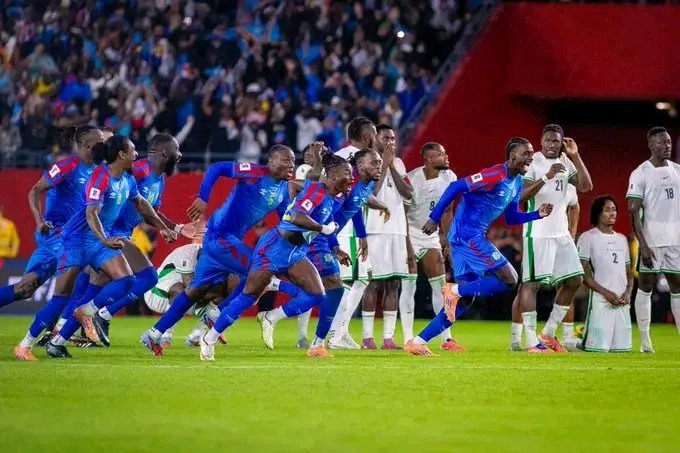
His involvement became particularly significant for Nigeria because he was part of the DR Congo side that faced the Super Eagles in the African play-off final in November 2025.
The match ended 1-1 after regulation and extra time before DR Congo prevailed in the penalty shootout, ending Nigeria’s hopes of reaching the intercontinental play-off and, ultimately, the World Cup.
At the time, Nigeria’s football authorities challenged the eligibility of several DR Congo players.
The Nigeria Football Federation submitted a complaint to FIFA in December 2025, arguing that players used by DR Congo did not meet the requirements to represent the country.
The complaint became a major source of hope for Nigerian supporters after the disappointment of the penalty defeat.
However, FIFA eventually rejected Nigeria’s case on procedural grounds.
The latest revelations have now added another layer to that decision.
According to the documents reviewed in the investigation, FIFA officials considered several possible responses after examining the eligibility concerns. These reportedly included awarding Nigeria the match, imposing financial sanctions, replacing DR Congo in the next stage of qualification or taking no action because of the timing of Nigeria’s complaint.
The most explosive aspect of the revelations is that FIFA’s own legal officials had apparently identified the unresolved documentation surrounding Mpasi.
Under FIFA regulations, fielding an ineligible player can result in a forfeiture of the match in which the player participated.
There have also been previous cases in which FIFA changed match results after determining that teams had used players who were not eligible to play.
In 2016, Greece was punished after fielding an ineligible player, with FIFA awarding Turkey a 3-0 victory. In 2017, Bolivia also lost the points from two World Cup qualifying matches after an eligibility violation involving a player who had previously represented Paraguay.
Those precedents have inevitably intensified the questions surrounding the Nigeria-DR Congo case.
The situation becomes even more sensitive because DR Congo eventually went on to defeat Jamaica in the intercontinental play-off and secure qualification for the 2026 World Cup.
That meant the country completed a remarkable journey from eliminating Nigeria to reaching the world’s biggest football tournament.
Nigeria, meanwhile, watched the World Cup from outside for the second consecutive edition after also failing to qualify for Qatar 2022.
The revelations therefore strike at a wound that Nigerian football supporters have not forgotten.
For many Nigerians, the issue is no longer simply about a lost penalty shootout. It is about whether the rules governing player eligibility were applied consistently and whether Nigeria received a fair hearing after raising its concerns.
Former Nigeria Football Federation president Ibrahim Gusau reportedly said he had been informed that the Nigerian complaint was rejected for technical reasons but was not told that FIFA had identified an issue surrounding Mpasi’s eligibility.
He has called for an investigation into the circumstances surrounding the case.
FIFA, however, has maintained that its committees operate independently and make decisions according to the applicable regulations and circumstances of each case. The governing body has also denied that FIFA president Gianni Infantino played a role in the decision.
The controversy has nevertheless attracted renewed attention because of the relationship between Infantino and Véron Mosengo-Omba, who was involved in African football administration and later became president of the Congolese football federation.
Mosengo-Omba has said he was unaware of FIFA’s findings concerning Mpasi’s eligibility.
The revelations do not automatically mean Nigeria will be reinstated in the 2026 World Cup, nor do they amount to a new FIFA ruling overturning DR Congo’s qualification.
But they have reopened a case that many Nigerian supporters believed had already been closed.
The central question now is whether FIFA will provide a fuller explanation of why it allowed a player whose change of international affiliation was reportedly incomplete to continue playing in World Cup qualifiers.
For Nigeria, the timing is particularly painful.
The Super Eagles’ World Cup dream ended on penalties, but fresh questions over the eligibility of an opponent involved in that decisive campaign have given the controversy a new life.
What began as a footballing disappointment has now become a wider debate about sporting regulations, transparency and the credibility of the processes used to protect the integrity of international football.
Whether the latest revelations lead to any further action remains to be seen.
For Nigerian supporters, however, one thing is certain: the circumstances surrounding the Super Eagles’ elimination from the 2026 World Cup are no longer being discussed solely as a missed opportunity on the pitch.




