


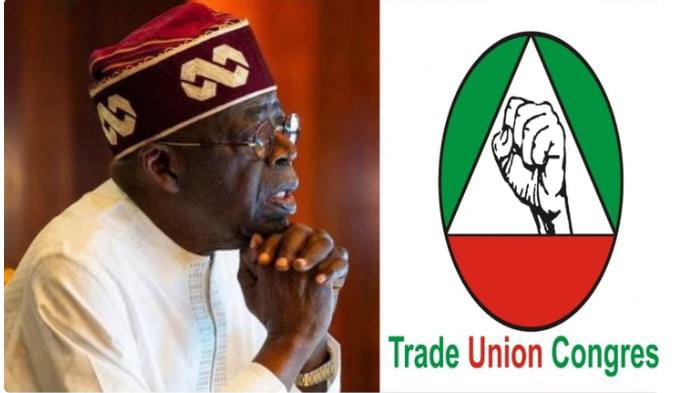
ABUJA, NIGERIA — The Trade Union Congress of Nigeria has rejected the Federal Government’s proposed ₦70,000 transport allowance for workers. The union insists that an immediate salary increase is needed to address the rising cost of living.
The TUC is demanding that the government raise the salary of the lowest-paid federal worker from ₦70,000 to ₦300,000. It also wants corresponding adjustments for other categories of workers.
The labour organisation also wants the government to fulfil its outstanding agreement with the Joint Health Sector Unions over salary adjustments for health workers.
Temporary Allowance Rejected

The TUC maintained that a temporary allowance would not provide the lasting relief workers need. It cited the rising prices of food, transportation, housing, and other essential goods and services.
The position was contained in a statement signed by the congress’s President General, Comrade Festus Osifo, and Secretary General, Comrade N. A. Toro.
The statement followed a meeting of the organisation’s National Administrative Council in Abuja and consultations with government officials.
Formal Communication
According to the congress, it formally communicated its position to the Federal Government in a letter dated October 8, 2026.
It said subsequent discussions with government representatives, including the Secretary to the Government of the Federation, did not change its opposition to the proposed wage award.
The labour body argued that the government does not need to wait for negotiations on a new national minimum wage before increasing workers’ salaries.
It maintained that no law sets a maximum wage that prevents the government from raising the earnings of public servants.
State Examples
The TUC pointed to states that have introduced minimum wages above ₦100,000. It argued that the Federal Government could adopt a similar approach to improve workers’ earnings.
The statement reads: “In the said letter, our position was very clear, Federal Government should review increase salaries of workers. This was hinged on the fact that government does not require minimum wage to be negotiated before increasing workers’ pay as there is no maximum wage law in the country.
“Some states today have raised their minimum wage above N100,000 such that federal government can raise the pay of the lowest worker to N300,000 for example from the current N70,000 and then apply the applicable consequential adjustment. While it is good to negotiate minimum wage which will affect other cadre of workers, FGN must raise wage level immediately as there are no law or historical practices stopping it from doing so.”
Warning on Negotiations
The congress said it rejected the proposed transport allowance during consultations with government officials. It considered a direct salary increase more appropriate for addressing the financial difficulties facing workers.
It further warned that negotiations over a new national minimum wage should not be used to delay an urgent review of salaries.
“Following the letter, the leadership of congress had consultative meetings with FG officials including the Secretary of the Government of the Federation where our position as stated in the letter was further canvassed. The proposal of wage award was mentioned but we vehemently rejected. Negotiations of a new national minimum wage must not become an excuse for postponing urgent pay increment.”
JOHESU Agreement
The TUC also accused the government of failing to implement an agreement with JOHESU approximately seven months after the unions suspended their industrial action.
According to the statement, TUC President General Festus Osifo led organised labour’s efforts to resolve the dispute.
The intervention resulted in a conciliation meeting at the office of the Minister of Labour and Employment. Representatives of the government and the unions signed an agreement.
The government delegation included the Minister of Labour and Employment, Dr. Muhammad Maigari Dingyadi; the Minister of Health, Professor Ali Pate; and the then Minister of Finance, Wale Edun.
The agreement was expected to address outstanding issues concerning adjustments to the Consolidated Health Salary Structure. This covers relevant categories of non-physician health professionals and other eligible health sector workers.
However, the TUC said the adjustment had yet to be implemented despite JOHESU’s decision to suspend its strike in good faith. The congress described the delay as a breach of trust and called for immediate implementation of the agreed adjustment.
What This Means
The rejection of the transport allowance is a significant development. It signals a potential confrontation between the government and labour unions.
The TUC’s demand for a salary increase reflects the growing pressure on workers. Rising inflation has eroded the purchasing power of many Nigerians.
What Happens Next
The TUC said it was awaiting the outcome of a scheduled meeting with the Federal Government. It said all available lawful options remained open.
For now, the focus is on resolving the impasse. The coming days will reveal whether the government will meet the union’s demands.




