


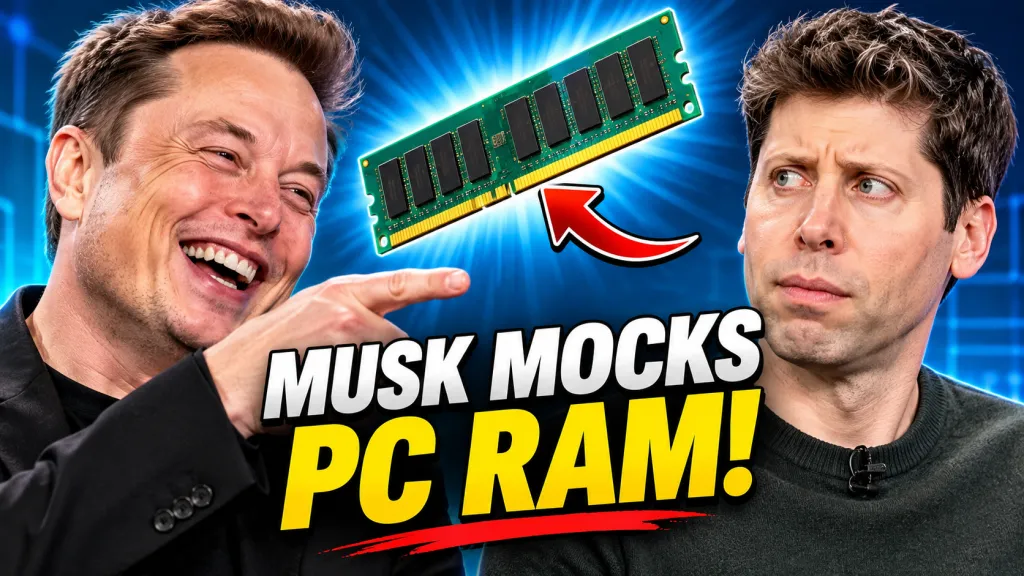
Elon Musk mocked Sam Altman’s argument for pooling scarce DRAM in data centers. The exchange comes as AI demand tightens memory supply.
Elon Musk mocked OpenAI chief Sam Altman’s argument about how scarce computer memory should be used. In a November 1 post on X, Musk wrote, “The people deserve to have their RAM too!” The jab followed Altman’s recent interview discussion of personal computers and data centers. Their exchange landed amid rising demand for memory used in AI systems.
Musk’s RAM post and Altman’s comment
Musk’s post included a meme that cast Altman’s position as a hunt for people keeping computer memory at home. Tom’s Hardware reported that the image referenced a scene from a film about a German wartime officer. Musk did not explain his post further in the text, which presented the dispute as a joke about ordinary users’ access to RAM.
The post responded to remarks Altman made on Cheeky Pint, a YouTube interview hosted by Stripe co-founder John Collison. The OpenAI chief was discussing local AI models that run on a user’s own computer. He said that keeping DRAM, or dynamic random-access memory, in personal machines could be inefficient when that memory sits idle much of the time.
Altman’s DRAM allocation argument
Altman described the issue as a global allocation problem, not a proposal to prohibit people from owning computers. He said personal machines may use their memory only a small fraction of the time, while cloud data centers can serve many customers. “You want maximum utilization in the cloud if you’re trying to deal with this very supply-constrained environment.” — Sam Altman, OpenAI CEO.
His argument focuses on utilization: data centers can allocate computing resources across many users, while a PC’s installed memory primarily serves its owner. That comparison does not establish that cloud computing is always more efficient for every task. It also leaves other considerations, including internet access, privacy, latency and users’ interest in running AI locally.
Musk’s short post did not address those trade-offs or offer a technical rebuttal. Instead, it framed the issue around access and ownership. “The people deserve to have their RAM too!” — Elon Musk, SpaceX CEO. The exchange drew attention because the leaders represent companies pursuing major AI infrastructure projects, although neither post laid out a detailed policy for allocating memory.
AI demand and the RAM supply squeeze
The timing matters because memory supply is tight. TrendForce said suppliers were prioritizing advanced production for high-performance server products and forecast conventional DRAM contract prices would rise 10% to 15% in the fourth quarter of 2026. It also said PC makers were buying aggressively as they expected supply to remain tight into 2027.
Those figures describe industry contract prices, not the exact retail price of a RAM kit or a direct measure of household shortages. Still, the forecast illustrates why Altman’s comments resonated beyond the interview. AI companies and data-center operators are competing for memory alongside PC makers and other electronics producers. Tom’s Hardware also reported higher prices for RAM kits and computers, but its article did not quantify how much of those increases came from AI demand.
Local AI versus cloud computing
The exchange also reflects a broader debate about where people should run AI tools. Local models can run on a computer the user controls, depending on the hardware and model size. Cloud services let providers operate powerful systems centrally and share capacity among customers. Each approach has different costs and practical limits.
Altman emphasized shared use of scarce hardware. Musk’s message emphasized that consumers should retain access to their own machines’ memory. Neither comment, by itself, settles how manufacturers should divide production between consumer devices and data centers. Nor does a general claim about idle memory show how much DRAM any specific computer wastes.
What the Musk-Altman exchange leaves open
The public posts turned a technical debate into a brief clash over who benefits from scarce computing resources. Altman’s comments highlighted the potential efficiency of pooled infrastructure. Musk’s reply stressed consumer ownership, but offered no figures or alternative supply plan. The available statements show disagreement in emphasis, rather than a detailed policy dispute.
Ultimately, the exchange captures a tension between centralized AI services and personal computing. Memory producers’ allocation choices and demand from data centers will shape how much supply reaches consumer devices. TrendForce expects tight conditions to continue into 2027. The debate over who gets the RAM is likely to continue as AI demand grows.




