


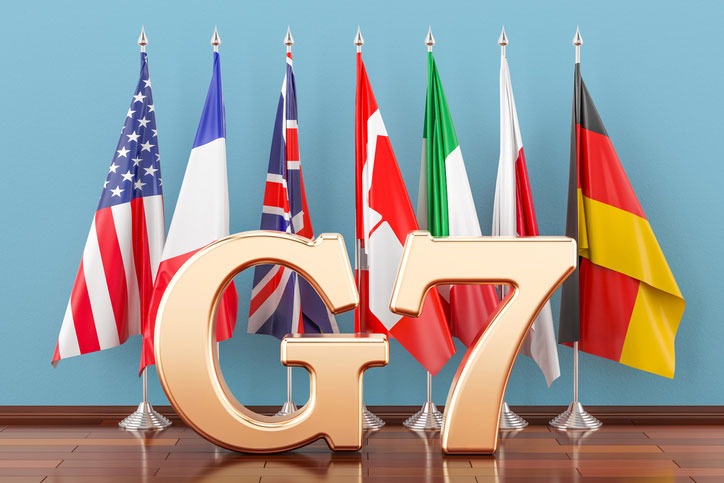
Foreign ministers from the Group of Seven (G7) countries are expected to assess the impact of President Donald Trump’s midterm election setback on US foreign policy during a meeting in Paris on Monday.
The meeting will give Washington’s allies their first opportunity to gauge whether the Democrats’ gains in the US midterm elections will affect the Trump administration’s approach to Ukraine, the Middle East and relations with its closest partners.
Four G7 diplomats told Reuters that the election outcome could limit the White House’s room for manoeuvre but warned that it would be wrong to expect a return to traditional US multilateralism, as Trump remains firmly in control of foreign policy.
US Secretary of State Marco Rubio is expected to attend the meeting, marking his first appearance before Washington’s allies since the elections.

The gathering, initially scheduled to hold in Marseille, was moved to Paris for security reasons following weeks of protests across France.
The G7 comprises France, the United Kingdom, Canada, Germany, Italy, Japan and the United States, alongside the European Union.
Foreign ministers from Ukraine, Saudi Arabia, Egypt, South Korea and Brazil are also expected to participate.
Ukraine is expected to dominate discussions ahead of planned trilateral talks between Ukraine, Russia and the United States in Abu Dhabi on Tuesday.
Officials from France, Britain, Germany, NATO and the European Commission are also expected to be in the Emirati capital, although they will not participate in the trilateral discussions.
The meeting is also expected to address divisions among European countries over how to approach the war in Ukraine.
Italian Prime Minister Giorgia Meloni warned on November 5 that Europe risked becoming irrelevant in efforts to end the conflict if member states continued pursuing separate diplomatic initiatives instead of agreeing on a common representative and strategy.
G7 diplomats also expressed concern about the situation on the battlefield, warning that Russia had increasingly focused on attacking Ukraine’s energy infrastructure as winter approaches.
Although the frontline has largely stabilised, they said major military breakthroughs were unlikely in the near future.
They identified shortages of Patriot missile interceptors and other air defence systems as Ukraine’s most urgent military challenge.
The G7 meeting is expected to focus on maintaining pressure on Russia while securing additional military, financial and energy support for Kyiv.
Iran is also expected to feature prominently in the discussions, as Washington’s allies remain sceptical about the war and fear further US military action could worsen the crisis.
The talks may also expose differences between France and the United States over Lebanon.
France is pushing for discussions on a new United Nations-backed security arrangement to replace the existing framework in southern Lebanon. It has also proposed options that include a French-Italian international force.




