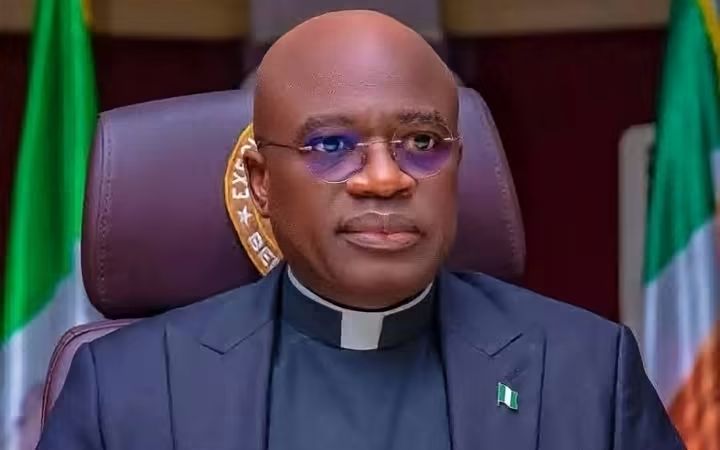
YOLA, NIGERIA — Benue State Governor, Reverend Father Hyacinth Alia, has attributed the lingering crisis within the All Progressives Congress (APC) in the state to his refusal to distribute public funds to influential party chieftains, accusing some political figures of attempting to treat government resources as personal property.
The governor made the remarks at the Adamawa State Tiv Day celebration in Yola on Saturday, November 14, 2026, where he addressed the divisions within the ruling party in Benue. He maintained that the disagreement was not a reflection of his administration’s commitment to the people but, rather, a struggle over access to state resources and political influence.
Alia insisted that certain party stakeholders wanted to turn Benue State into what he described as their private estate, an arrangement he said he would not permit under his leadership.
He argued that his responsibility as governor was to serve the people of the state and protect public resources, rather than satisfy the financial expectations of a few political interests.
The governor also challenged the influence of individuals who, in his view, believed they could determine the direction of the state through their political positions and connections. He maintained that the electorate, not a handful of party leaders, would ultimately decide his political future.
According to him, every eligible voter has an equal voice in determining who governs the state, and no political figure should claim a superior right to dictate its leadership.
Alia’s comments come amid a prolonged internal dispute within the Benue APC, particularly between political groups associated with him and those loyal to the Secretary to the Government of the Federation, Senator George Akume.
The disagreement has extended beyond competing political interests to questions about the control of party structures, recognition of state executives and the organisation of campaign activities ahead of the 2027 general elections.
In March 2026, the two camps held parallel state congresses in Makurdi, producing rival executive committees. The governor’s camp recognised Benjamin Omale as state chairman, while the Akume-aligned group maintained that the Austin Agada-led executive remained the legitimate party leadership.
The existence of competing structures has complicated efforts to restore unity within the party, despite intervention and reconciliation efforts involving the APC’s national leadership.
The divisions became more visible in November following the emergence of separate political mobilisation platforms for President Bola Tinubu’s anticipated 2027 re-election campaign.
Governor Alia’s camp established a Tinubu-Alia campaign council comprising more than 900 members and inaugurated the structure at IBB Square in Makurdi on November 5. However, several prominent APC stakeholders, including Akume and serving federal lawmakers from Benue, were absent from the event.
The disagreement subsequently intensified after the emergence of the Benue Strategic Alliance for Tinubu-Shettima 2027, a separate platform that said it was established to mobilise support for the President while accommodating APC members and politicians from other parties.
The alliance’s Director-General, Akange Audu, rejected suggestions that the group was working against Tinubu’s re-election. He argued that supporting the President should not require political stakeholders to align with Governor Alia’s leadership preferences.
However, Richard Asema, Director-General of the Tinubu-Alia 2027 Campaign Council, accused the alliance of undermining the governor’s political position and potentially frustrating his re-election ambition. The alliance dismissed the allegations as political blackmail.
The competing positions have exposed the difficulty of separating support for the President’s national political ambition from disagreements over the control of the APC structure in Benue.
At the Tiv Day celebration, Alia also appealed to members of the Tiv community living in Adamawa State to remain peaceful, promote unity and serve as responsible representatives of their homeland.
The governor, who was represented at the event by the Executive Secretary of the Benue State Emergency Management Agency, James Iorpuu, emphasised that national development required cooperation among Nigeria’s different ethnic groups.
He argued that no single ethnic community could build the country independently and called for peaceful coexistence among Nigerians.
Alia also donated N5 million towards the construction of a Tiv unity house in Adamawa State, describing peace and solidarity as important foundations for development.
Representing Adamawa State Governor Ahmadu Fintiri, the state’s Commissioner for Housing and Urban Development, Abdullahi Prambe, commended members of the Tiv community for their contributions and urged them to continue conducting their activities peacefully.
The Benue APC dispute now presents a significant organisational challenge for the ruling party as preparations for the 2027 elections gather momentum. The competing factions must contend with questions of leadership legitimacy, political inclusion and the coordination of campaign structures.
While Alia has framed the disagreement as a refusal to surrender public resources to private political interests, the opposing camp has previously accused his administration of sidelining established party stakeholders and failing to accommodate influential members.
The governor’s latest remarks therefore add another dimension to the dispute, placing the management of public resources at the centre of his explanation for the party’s divisions.
Whether the competing groups can reach an accommodation remains uncertain. What is clear is that the disagreement has moved beyond a contest over party offices and now involves broader questions about political authority, access to influence and the direction of the APC in Benue State.