WASHINGTON, UNITED STATES — United States President Donald Trump has blamed the administration of his predecessor, Joe Biden, for the nationwide aviation disruption that grounded departing flights across the country, accusing the previous government of worsening the problems affecting America’s ageing air traffic control infrastructure.
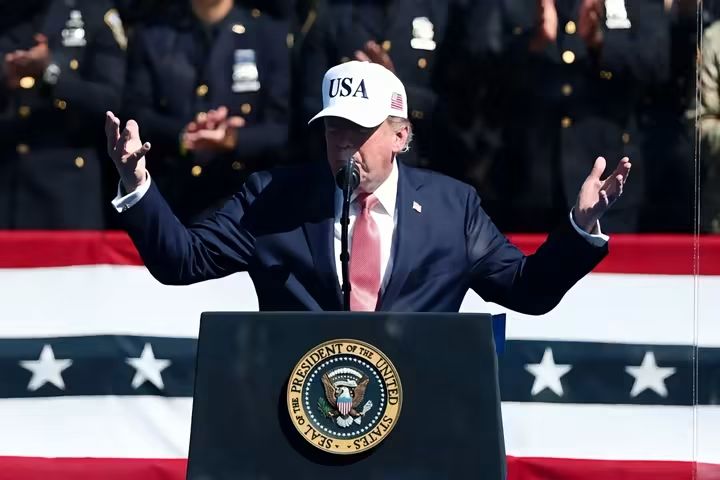
Trump made the accusation in a series of posts on his Truth Social platform on Sunday, November 15, 2026, nearly two days after the Federal Aviation Administration (FAA) ordered a nationwide ground stop following communications and radar disruptions at air traffic control facilities.
The President described the Biden administration’s handling of the Federal Aviation Administration as a failure, arguing that previous spending decisions had left the country’s aviation infrastructure in a worse condition.
He also called on Congress to approve additional funding for a comprehensive modernisation of the air traffic control system, insisting that the United States needed a coordinated upgrade rather than gradual improvements.
Trump argued that his administration had already started work on improving the system but said a more substantial financial commitment from lawmakers was necessary to complete the project quickly and efficiently.
The President’s comments followed Friday’s disruption, when the FAA temporarily halted departing flights across the United States because of instability affecting communications and radar systems used by air traffic controllers.
The ground stop was announced at approximately 3:54 p.m. Eastern Time and lifted at about 8:15 p.m., after more than four hours of disruption. The suspension affected airports nationwide, leaving thousands of passengers stranded and forcing airlines to reorganise flight schedules.
According to aviation tracking data cited by international media, more than 10,000 flights experienced delays, while thousands of others were cancelled. More than a million passengers were potentially affected as airlines struggled to reposition aircraft and crews following the shutdown.
Transportation Secretary Sean Duffy initially attributed the disruption to telecommunications instability affecting the air traffic control network. He later explained that ageing switches and routers had become overloaded with data, creating inconsistencies in communications and radar information.
Duffy subsequently provided further details about the technical problem, saying the disruption occurred during work to replace old copper wiring with fibre-optic connections as part of the government’s modernisation programme.
He said the installation work, involving contractor L3Harris, was being investigated to determine whether a faulty router, installation error or other technical failure triggered the problem.
According to the Transportation Secretary, the equipment generated an unusually high volume of connection attempts, overwhelming other routers within the network and affecting communications between controllers and aircraft.
The FAA ordered the ground stop as a precaution to protect passengers and ensure that aircraft already in the air could land safely. Officials said more than 3,500 aircraft were in the air when the disruption occurred, but pilots and air traffic controllers successfully managed their landings.
Homeland Security Secretary Markwayne Mullin said there was no indication that the incident resulted from a deliberate attack. Officials also reported no evidence of a cyberattack, although investigations into the precise cause were continuing.
The disruption has renewed concerns about the condition of America’s air traffic control infrastructure, much of which relies on technology that has remained in service for decades.
The Government Accountability Office had previously identified significant weaknesses in the FAA’s technology infrastructure. Its 2024 assessment classified 51 of 138 reviewed air traffic control systems as unsustainable and another 54 as potentially unsustainable, highlighting the scale of the modernisation challenge.
However, the political disagreement over responsibility has also drawn attention to investments made during the Biden administration.
Biden signed an infrastructure law that allocated approximately $25 billion for airport improvements and aviation infrastructure, including air traffic control upgrades. The Trump administration has also secured $12.5 billion in funding for FAA improvements through legislation approved by Congress.
The competing records complicate the political debate over which administration bears responsibility for the current condition of the system. While Trump has accused Biden of worsening existing weaknesses, the latest technical explanation from his own administration points to a problem involving equipment installation during an ongoing modernisation effort.
The incident has therefore raised questions not only about past investment decisions but also about the management and implementation of current upgrades.
For travellers, the immediate concern has been the restoration of normal flight operations. Although the nationwide ground stop was lifted on Friday evening, airlines continued dealing with delays and cancellations as aircraft and crew members remained out of position.
Transportation officials said the airspace had reopened and operations were recovering, while warning that disruptions could continue as airlines worked through their backlogs.
Trump’s demand for additional congressional funding has now placed aviation modernisation at the centre of a fresh political debate in Washington. The administration argues that a comprehensive replacement of outdated systems is necessary to prevent similar disruptions, while the technical investigation is expected to establish precisely what caused Friday’s failure.
Until the investigation is completed, the exact responsibility for the equipment malfunction remains unresolved, even as the President continues to hold his predecessor’s administration responsible for the wider infrastructure problems.