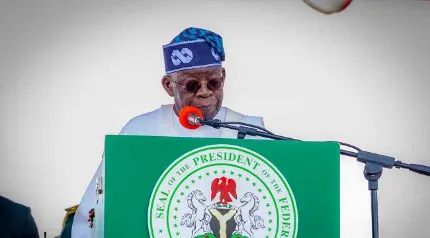
ANTALYA, TÜRKİYE — President Bola Ahmed Tinubu has called for increased concessional climate financing and lower borrowing costs for developing countries, warning that global climate funding commitments must translate into affordable resources capable of helping vulnerable economies confront the effects of climate change.
Tinubu made the call in Nigeria’s national statement delivered on Tuesday, November 17, 2026, at the resumed high-level segment of the 31st United Nations Climate Change Conference (COP31) in Antalya, Türkiye. The President was represented by the Minister of Environment, Balarabe Abbas Lawal.
He urged developed economies and international financial institutions to make climate funding more accessible, particularly to countries struggling with high interest rates, mounting debt obligations and limited fiscal resources.
The President said the global ambition to mobilise at least $1.3 trillion annually in climate finance by 2035 would have limited impact if developing countries could not access the money on affordable terms.
He specifically called for increased concessional financing and reduced costs of capital, arguing that expensive borrowing conditions were undermining the ability of vulnerable economies to implement climate programmes, strengthen infrastructure and invest in cleaner energy.
Tinubu also called for the effective operation of the Fund for Responding to Loss and Damage, insisting that countries affected by climate-related disasters should receive timely and meaningful assistance.
The fund was established under the United Nations climate framework to support vulnerable developing countries dealing with the economic and non-economic consequences of climate impacts that cannot be avoided through adaptation measures alone.
The Nigerian President maintained that climate action should support national development priorities rather than impose additional economic difficulties on countries already facing significant development challenges.
He identified affordable energy, food security, industrialisation, employment generation and improved livelihoods as priorities that should guide Nigeria’s transition to a more sustainable economy.
On energy transition, Tinubu reaffirmed Nigeria’s commitment to expanding renewable energy while maintaining energy security and improving access to reliable electricity. He also reiterated that natural gas would continue to play an important role as a transition fuel within the country’s energy mix.
The President’s position reflects Nigeria’s effort to balance climate commitments with its need to expand electricity access, support industrial growth and address energy poverty.
On climate adaptation, Tinubu disclosed that Nigeria submitted its National Adaptation Plan in September 2026. The plan outlines measures covering climate-resilient agriculture, early-warning systems and disaster preparedness, particularly for communities exposed to environmental risks.
He said the document brings together climate-risk assessments, economic considerations, sectoral strategies and financing approaches to improve the country’s ability to respond to climate-related threats.
Nigeria is also seeking to attract investment through domestic and international financing mechanisms. Tinubu highlighted the commercial launch of a $300 million Distributed Renewable Energy Fund in September 2026, designed to mobilise capital for expanding access to clean and reliable energy.
He further identified the development of Nigeria’s carbon-market framework and opportunities under Article 6 of the Paris Agreement as additional avenues for generating resources to support climate action.
The President warned that national initiatives alone would not provide the scale of investment required to address the climate crisis, calling for stronger international cooperation and partnerships.
His appeal comes amid continuing concerns over the gap between climate-finance promises and the actual resources reaching developing countries. Under the climate-finance arrangements agreed at COP29, developed countries are expected to take the lead in mobilising at least $300 billion annually for developing countries by 2035, alongside efforts to scale total financing from all sources to $1.3 trillion annually.
However, developing countries have repeatedly complained that complicated application procedures, expensive loans, limited grant funding and high borrowing costs prevent them from accessing sufficient resources.
The United Nations Economic Commission for Africa has estimated that Africa requires approximately $277 billion annually to implement its climate commitments through 2030, while existing climate-finance flows cover only a small proportion of that requirement.
The UN climate leadership has also warned that vulnerable economies face a cycle of climate disasters, rising debt and expensive borrowing, leaving governments with fewer resources to invest in resilience and development.
Tinubu urged world leaders to ensure that climate ambition was matched by adequate financing and practical implementation, with investments producing measurable benefits for communities.
He called on delegates to make COP31 a turning point in the transition from political commitments to concrete action, stronger resilience and sustainable economic development.
As negotiations continue in Antalya, Nigeria’s position places affordable financing, energy access and climate resilience at the centre of its demands, reflecting the broader concerns of developing countries seeking a fairer international climate-finance system.