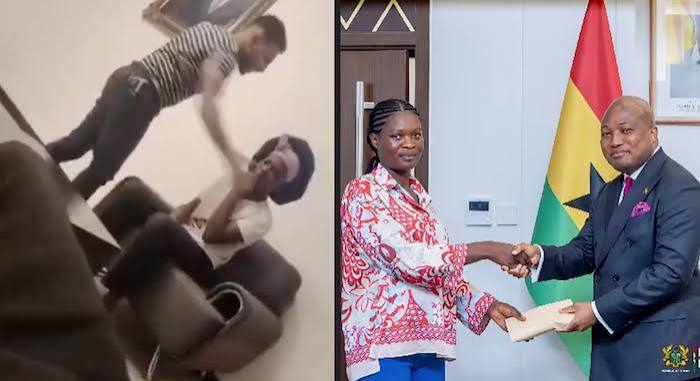
Ghanaian domestic worker Stephanie Nkrumah has safely returned home after escaping an alleged assault by her employer in Iraq, following widespread outrage over a disturbing video showing her being violently attacked.
Ghana’s Foreign Affairs Minister, Samuel Okudzeto Ablakwa, confirmed her return after meeting Stephanie and members of her family at the Ministry of Foreign Affairs on Monday, November 23, 2026.
According to the minister, Stephanie escaped from her alleged attackers and made it back to Ghana with assistance from her relatives. She and her family are from Kumawu in the Ashanti Region.
The incident attracted widespread attention after footage circulated on social media showing a man repeatedly assaulting a woman believed to be a Ghanaian domestic worker. The video prompted calls for the Ghanaian authorities to establish her identity, locate her and take action against those responsible.
In an interview with BBC Pidgin, Stephanie recounted the circumstances surrounding her ordeal, alleging that she was subjected to excessive working hours, physical abuse and threats while working in Iraq.
She said she had travelled to the country in 2025 through a recruitment agent after being promised a job with better working conditions. However, she alleged that the reality was different from what she had been told.
Stephanie further claimed that the man seen assaulting her in the viral footage was the head of the agency through which she worked. According to her account, the attack happened after she complained of being ill and requested medical attention.
She also alleged that the man threatened her with a gun and warned that he could shoot her if she refused to work. Stephanie said the experience eventually made her fear for her life and pushed her to plan an escape.
She explained that her family helped arrange her return, with her father purchasing a flight ticket. She eventually escaped by arranging transportation to the airport and travelling back to Ghana.
Following her return, Ablakwa said the government had formally protested to Iraqi authorities and demanded appropriate action over the assault.
The minister added that officials had listened to Stephanie’s account and encouraged her to provide information about the alleged perpetrators and their network to assist diplomatic efforts to secure justice.
The Ghanaian government is also considering a moratorium on the recruitment of domestic workers for employment in Iraq, amid concerns that Stephanie’s experience may not be an isolated case.
As part of its response, the government is providing Stephanie with urgent medical treatment and clinical psychological support at no cost, following medical assessments and doctors’ recommendations.
Ablakwa also disclosed that he personally donated GH¢50,000 to support her plans to establish a small business. He further pledged to provide her with a scholarship to enable her to resume her formal education, which she discontinued several years ago.
Beyond her personal experience, Stephanie has reportedly called for greater protection for Africans working as domestic employees in the Middle East. She expressed concern that other migrant workers could be experiencing similar abuse without having the opportunity or support to escape.
Her return has brought relief to many who followed the case, but questions remain about the recruitment networks involved, the treatment of migrant domestic workers and whether those allegedly responsible for the assault will face justice.
For Stephanie, the immediate priority is recovery and rebuilding her life. Meanwhile, Ghana says it will continue diplomatic efforts to pursue accountability and protect its citizens working abroad.