



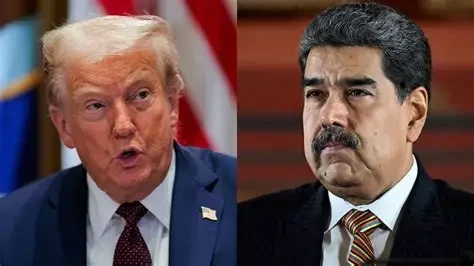
The second term of US President Donald Trump is emerging like a hurricane on the horizon, swirling with a tough and uncompromising foreign policy agenda.
The daring nighttime raid on Caracas, which resulted in the detention of Venezuelan President Nicolás Maduro and his wife, was not just an exercise; it was the trumpeting of the comeback of the United States as a unilateral operator.
In defending this action, Trump invoked the spirit of the Monroe Doctrine from 1823 “the historic badge of America’s dominance within the Western Hemisphere” and reframed it under a new name, the “Donroe Doctrine,” meaning he was willing to exercise power beyond the boundaries of diplomacy.
Venezuela, it appears, is merely the first domino to fall. In recent days, Trump has rattled a number of sabres, suggesting that other nations are likely to find themselves in the sights of the US government.

Greenland

Even as distant from Latin America as Greenland is, this country has emerged as one of Trump’s more brazen foreign policy obsessions.
America already has Pituffik Space Base located on this Arctic island, but this is not enough for Trump.
“We need Greenland, from the standpoint of our national security,” he said, pointing out that the frozen landscape is “teeming with Russian and Chinese ships.”
Greenland, an inhabited province of the Kingdom of Denmark, is located on the threshold of a rapidly warming Arctic, in which melting ice is gradually discovering new trade routes and hidden resources.
It is also a rare earth elements hotbed, a resource in which the Chinese currently possess a competitive advantage.
The Prime Minister of Greenland, Jens Frederik Nielsen, said the idea of US takeover was mere “fantasy” as any endeavour by the US to take over the land could mean the US going up against the country of Denmark, which is an ally of NATO, ready to break like ice in the hands of a careless walker.
Colombia
Hours after the operation in Venezuela, Trump shifted his focus west to Colombia, duly warning President Gustavo Petro to “watch his ass.”
Colombia, an oil-rich and mineral-rich country with an active drugs trade, has historically been an ally of the US government in its fight against drugs.
However, the rhetoric surrounding Trump’s administration has turned all that on its head, accusing the government of failing to control the cartels.
Since September, US forces have targeted vessels in the Caribbean and eastern Pacific, accusing them of trafficking drugs, although these accusations have not been corroborated.
In October, it imposed sanctions on Petro, accusing his government of gross negligence.
On board Air Force One, Trump’s view was crystal clear: “Colombia is a country that is being run by a sick man that likes to make cocaine and sell it to the United States.”
Asked if he would mount a US-led strike, he said, “It sounds good to me.” Many decades of collaboration now appear to be on the line, balanced on a house of cards.
Iran
Iran also caught the attention of Trump with mass protests erupting in the country. The president threatened that Iran’s government would be “hit very hard” if the protesters are found to be killed during the unrest.
Iran, while outside the geographical definition of the ‘Donroe Doctrine,’ has had a provoking relationship with Trump.
Last year, US strikes hit Iran’s nuclear sites in response to an Israeli operation, leading to a short-lived conflict between Iran and Israel.
Iran was allegedly taking center stage in a recent Mar-a-Lago summit with Israeli Prime Minister Benjamin Netanyahu, as reported in US media, with suggestions of a possible hit in 2026.
Mexico
Trump’s rise had been fueled in part by his tough stand-off with Mexico, and there is no lessening in the second term. On the first day of Trump returning to office, he rechristened the Gulf of Mexico the “Gulf of America.”
He also blamed the Mexican government for not doing enough to stop drug trafficking and undocumented migrants from entering the US, calling drugs “pouring in” across the border.
He went to the extent of suggesting that he would send US forces to deal with cartels, which President Claudia Sheinbaum abruptly refused, citing disrespect for Mexico’s sovereignty.
Cuba
Cuba, only 90 miles off the coast of Florida, is still an established enemy.
Without subsidized oil shipments after Maduro’s seizure, Cuba is experiencing financial instability thanks to Venezuela.
However, he stated that perhaps American intervention would not be needed because the island “is ready to fall.”
The loss of Venezuelan support has brought the Cuban economy to the brink, a weak reed suffering in the wind for support.
The Cuban government was further warned to take President Trump seriously by the US Secretary of State, Marco Rubio.
A Pattern Emerges
Taken together, the statements made by Trump create a mosaic of intimidation, competitive use of resources, and superiority strategy a foreign policy more interested in the raw exercise of power than a multilateral agenda.
Whether or not these threats come to pass is a matter that remains to be seen. One thing that isn’t is the fact that Venezuela was no isolated incident. Far from it. Venezuela was a wake-up call and the world is listening.

