


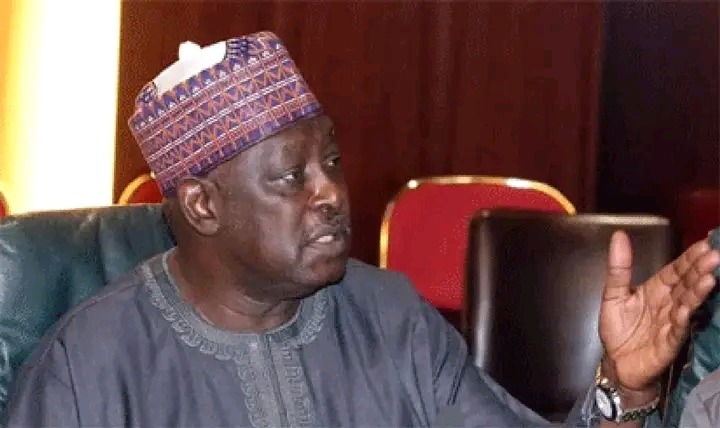
Former Secretary to the Government of the Federation, Babachir Lawal, has made a fresh intervention in the increasingly heated 2027 presidential debate, declaring that he would rather support President Bola Ahmed Tinubu than former Vice President Atiku Abubakar.
Lawal, a former political associate of Atiku, made the comments while discussing the political calculations surrounding the next presidential election and explaining why his position has shifted against the former vice president.
In a blunt assessment, Lawal argued that while he has concerns about the direction of the country under the current administration, he believes Nigeria would face an even more chaotic situation if Atiku became president.

“I’d rather go with Bola than Atiku because when Nigeria crashes with Bola, it might be an orderly crash, but with Atiku it would be a chaotic one,” Lawal said during an interview on the Naija Unfiltered Podcast.
The former SGF was subsequently asked to explain the basis of his position. His response was equally direct, saying his experience working with Atiku had shaped his view of the former vice president.
Lawal’s comments are significant because he was previously open to supporting Atiku ahead of the 2027 election. He said his initial thinking was influenced by concerns about the condition of northern Nigeria and the belief that the region should not give up its opportunity to produce the country’s president.
According to Lawal, he initially believed that supporting someone from the North could help slow what he described as the region’s worsening situation.
That position changed after what he described as his experience working with Atiku.
Lawal alleged that Atiku’s style of decision-making created uncertainty, claiming that instructions could be issued and later reversed after the former vice president consulted other people.
He described the situation as a source of what he called “chaos” and said his personal experience ultimately convinced him that he could not support Atiku’s presidential ambition.
The former SGF’s latest comments come months after he left the African Democratic Congress following Atiku’s emergence as the party’s presidential candidate.
Lawal had accused the ADC’s presidential primary of being manipulated in Atiku’s favour and announced his resignation from the party. Atiku’s camp rejected those allegations, describing Lawal’s claims as politically motivated and driven by personal interests.
The disagreement has since become part of the wider political contest ahead of the 2027 presidential election, with opposition figures attempting to build a coalition capable of challenging Tinubu’s re-election bid.
Lawal also revealed details of an earlier political proposal involving Atiku and Peter Obi.
According to the former SGF, Atiku had asked him to approach Obi about becoming his running mate ahead of the 2027 election. Lawal said Atiku had proposed serving one presidential term before pursuing a constitutional amendment that would establish a single six-year presidential term.
He further claimed that the proposed political arrangement would subsequently provide an opportunity for the South-East and North-Central regions to benefit from presidential rotation.
Lawal said he approached Obi because of his relationship with the former Anambra State governor, but the proposal did not materialise.
He claimed Obi believed the proposed ticket would struggle to win the election and therefore declined to participate.
The disclosure adds another layer to the continuing political negotiations among opposition figures seeking an alternative to the ruling All Progressives Congress.
Atiku, meanwhile, remains the ADC’s presidential candidate and has continued to position himself as a major challenger to Tinubu ahead of 2027.
The former vice president has recently intensified his criticism of the Tinubu administration, particularly over economic management, security and government spending. His camp has also accused the administration of failing to deliver the level of security and economic relief Nigerians were promised.
Tinubu’s supporters, on the other hand, continue to defend the administration’s reforms and argue that the government’s policies are laying the foundation for longer-term economic growth.
The political debate is therefore becoming increasingly polarised, with both camps attempting to convince Nigerians that their preferred candidate represents the better path for the country.
Lawal’s intervention is particularly notable because of his history within both the ruling and opposition political structures. He previously served as SGF under former President Muhammadu Buhari before leaving the APC in 2025. He later joined the ADC but eventually resigned following his disagreement with the party’s primary process.
His latest comments suggest that his opposition to Atiku has now become a central part of his political position ahead of 2027.
However, his prediction about what would happen under an Atiku presidency remains a political opinion rather than an independently established forecast.
With the 2027 election still ahead, Nigerians will ultimately judge the competing records, policies, alliances and promises of the presidential candidates at the ballot box.
For now, Lawal has made his preference clear.
Despite his criticism of the current administration, he says he would rather back Tinubu than Atiku, warning that he believes an Atiku presidency could produce a more chaotic outcome for Nigeria.
As political realignments intensify, his comments are likely to add another dimension to an already crowded debate over who should lead Africa’s most populous country after the 2027 election.




