


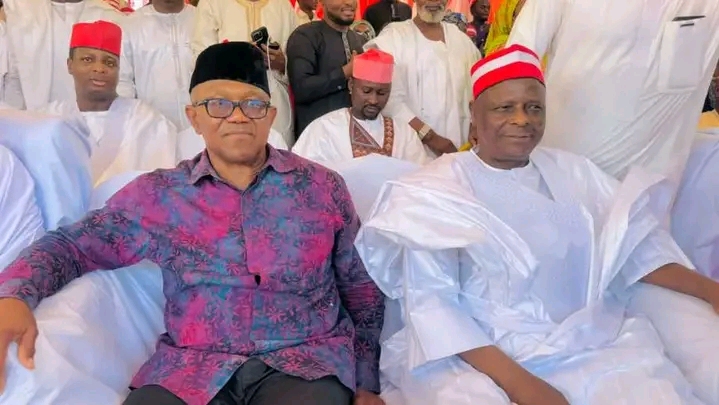
Former Secretary to the Government of the Federation, Babachir Lawal, has predicted that a joint presidential ticket involving Peter Obi and Rabiu Musa Kwankwaso would stand a strong chance of defeating other contenders in Nigeria’s 2027 presidential election, describing such an alliance as the most formidable opposition combination ahead of the polls.
Lawal made the remarks during an interview on Symfoni TV, where he assessed the political landscape and argued that a united opposition would significantly improve its chances of unseating the ruling All Progressives Congress in the next general election. According to him, an Obi Kwankwaso ticket has about a 70 percent chance of emerging victorious if both leaders agree to work together instead of pursuing separate presidential ambitions.
The former SGF explained that Nigeria’s opposition has historically struggled because of internal divisions and the inability of major political figures to build lasting alliances before elections. He maintained that bringing together the political structures and support bases of Obi and Kwankwaso would create a coalition capable of attracting votes across different regions of the country.

Peter Obi remains one of Nigeria’s most influential opposition politicians, enjoying strong support among young voters, professionals and urban communities. His performance in the 2023 presidential election transformed him into one of the country’s leading political figures, with his supporters continuing to advocate for reforms centred on accountability, economic development and good governance.
Kwankwaso, on the other hand, commands a loyal political movement, particularly in Kano State and parts of northern Nigeria through the Kwankwasiyya political structure. His influence in the North has remained significant over the years, making him a valuable figure in any potential coalition seeking national electoral success.
According to Lawal, combining Obi’s popularity in the South and among younger voters with Kwankwaso’s established political network in the North would produce a balanced ticket capable of competing strongly against the ruling party. He argued that such a partnership could bridge regional divides and expand the opposition’s electoral reach across Nigeria.
The former SGF also suggested that opposition parties must prioritise unity over personal ambition if they hope to present a credible alternative in 2027. He warned that multiple opposition candidates contesting separately could divide votes and ultimately benefit the incumbent administration.
Lawal’s comments come at a time when political discussions surrounding the 2027 elections are gathering momentum despite the polls still being months away. Political consultations, coalition talks and strategic meetings have continued among leading opposition figures, fuelling speculation about possible alliances before the next presidential contest.
Although no official agreement has been announced between Obi and Kwankwaso, discussions about a possible partnership have remained a recurring topic within Nigeria’s political space. Analysts believe that any formal alliance would require careful negotiations over party platforms, leadership roles and policy priorities.
Political observers note that coalition politics has played an important role in Nigeria’s democratic history. The formation of the All Progressives Congress before the 2015 general election remains one of the country’s most successful examples of opposition parties uniting to challenge an incumbent government.
Lawal appeared to draw lessons from that experience, arguing that similar cooperation among opposition leaders could reshape the political landscape ahead of the 2027 elections.
However, political analysts caution that electoral outcomes depend on many factors beyond political alliances. Candidate acceptance, campaign organisation, economic conditions, voter turnout, party structures and electoral dynamics across Nigeria’s diverse regions will all influence the eventual outcome.
President Bola Ahmed Tinubu and the APC are also expected to mount a strong re election campaign, while other opposition figures could still emerge before party primaries begin. As a result, the political environment remains fluid, with several possible scenarios likely to unfold in the months leading to the election.
Lawal’s prediction has already generated widespread debate among politicians, analysts and supporters across social media, with many discussing whether an Obi Kwankwaso alliance could truly alter Nigeria’s political balance.
While some believe such a partnership could strengthen the opposition’s chances, others argue that electoral success would ultimately depend on the coalition’s ability to maintain unity, present clear policy alternatives and win the confidence of voters nationwide.
As preparations for the 2027 elections gradually gather pace, the possibility of new political alliances is expected to remain one of the defining issues in Nigeria’s evolving political landscape.




