


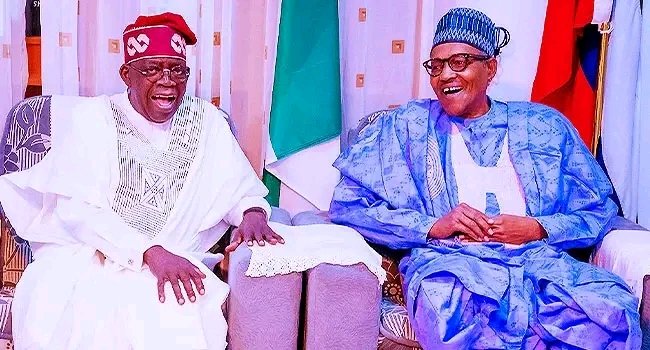
Former Secretary to the Government of the Federation, Babachir Lawal, has acknowledged President Bola Ahmed Tinubu’s significant role in the formation of the All Progressives Congress and the success of Muhammadu Buhari’s 2015 presidential campaign, describing the Nigerian leader as one of the key architects behind the historic political coalition that ended the Peoples Democratic Party’s 16 year rule.
Lawal made the remarks during an interview on Symfoni TV, where he reflected on the political negotiations that led to the creation of the APC and the events that culminated in Buhari’s landmark victory in the 2015 general election. According to him, Tinubu was instrumental in bringing together opposition parties under a common platform and also financed critical aspects of Buhari’s presidential campaign.
The former SGF explained that Buhari entrusted him with the responsibility of facilitating discussions between the Congress for Progressive Change and Tinubu’s Action Congress of Nigeria because of the cordial relationship he shared with the former Lagos State governor.

Lawal said he initially hesitated to accept the assignment, fearing resistance from some northern political figures, but Buhari insisted that he was the right person to help build the alliance that eventually transformed Nigeria’s political landscape.
According to him, the merger discussions required extensive consultations among party leaders from different regions, with the overriding objective of creating a united opposition capable of challenging the then ruling PDP.
He described the process as one driven by compromise, negotiation and a shared determination to bring about political change in the country.
Lawal revealed that despite harbouring presidential ambitions at the time, Tinubu was willing to postpone his personal aspiration in order to strengthen the opposition coalition.
He claimed Tinubu believed removing the PDP from power was more important than pursuing his own ambition and therefore committed himself fully to ensuring the merger succeeded.
The former SGF further stated that Tinubu played a decisive role during the APC presidential primary that produced Buhari as the party’s candidate ahead of the 2015 election.
According to Lawal, Tinubu persuaded several political stakeholders to support Buhari’s candidacy after presenting arguments that convinced them he was the strongest contender capable of leading the opposition to victory.
He added that the support eventually secured for Buhari during the convention proved crucial to his emergence as the APC’s presidential candidate.
Lawal also claimed Tinubu financed a substantial portion of Buhari’s election campaign.
He argued that while Buhari commanded widespread popularity and a loyal support base across northern Nigeria, the campaign required significant financial resources to compete effectively nationwide.
According to him, Tinubu provided the financial backing needed to sustain campaign activities, while Buhari contributed the nationwide goodwill and credibility that attracted millions of voters.
He noted that the campaign represented a combination of political strategy, grassroots mobilisation and financial commitment from different stakeholders within the newly formed APC.
The 2015 presidential election remains one of the most significant milestones in Nigeria’s democratic history.
For the first time since the country’s return to democratic rule in 1999, an opposition party successfully defeated an incumbent president at the polls, leading to the peaceful transfer of power from President Goodluck Jonathan of the Peoples Democratic Party to Muhammadu Buhari of the APC.
Political analysts have long described the merger that produced the APC as one of the most successful opposition coalitions in Nigeria’s history.
The alliance brought together major political blocs, including the Action Congress of Nigeria, the Congress for Progressive Change, the All Nigeria Peoples Party and factions of other political movements, creating a formidable platform that reshaped the country’s political landscape.
Lawal’s latest comments are particularly noteworthy because he has recently been critical of the Tinubu administration on several national issues.
Despite those criticisms, his remarks recognise the President’s contribution to the formation of the APC and Buhari’s successful election campaign, offering a different perspective on the political partnership that defined Nigeria’s opposition movement before 2015.
His comments have also revived discussions about the contributions of various political actors to Buhari’s rise to power, with many observers noting that the APC’s victory resulted from a combination of Buhari’s nationwide popularity, Tinubu’s political influence, the merger of opposition parties and the collective efforts of party leaders across the country.
As Nigeria’s political class gradually begins preparations for the 2027 general election, the history of the APC’s formation and the partnerships that produced its first electoral victory continue to shape conversations about coalition politics and leadership.
Lawal’s account serves as another reminder of the negotiations, sacrifices and strategic alliances that changed the direction of Nigerian politics more than a decade ago, laying the foundation for one of the country’s most consequential electoral victories.




