


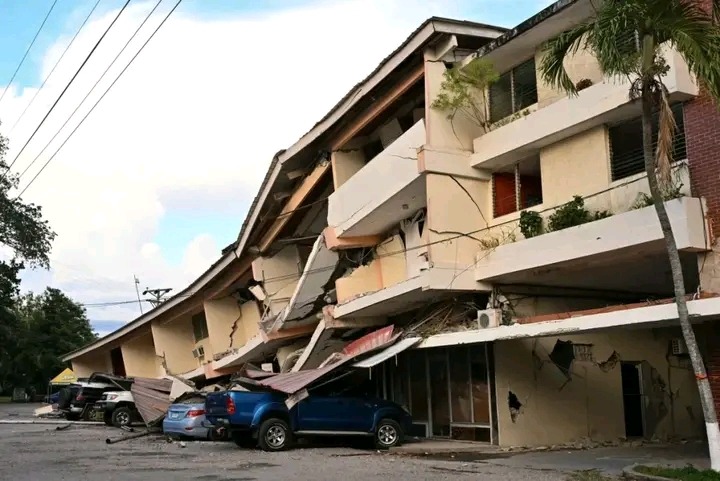
A powerful 7.7-magnitude earthquake has struck Panama, injuring at least 27 people, damaging buildings and roads, and forcing residents to flee their homes and offices as authorities launched emergency operations across the Central American country.
The earthquake struck on Friday, October 9, 2026, sending tremors across several parts of the country and triggering widespread concern over the safety of residents, buildings and critical infrastructure. Although no deaths had been reported in the initial official assessment, the extent of the destruction raised concerns about the possibility of further damage as aftershocks continued.
According to emergency officials, the earthquake was felt across Panama, a country of approximately 4.5 million people. Residents described intense and prolonged shaking, with some rushing out of residential buildings and offices as furniture, household objects and other items moved violently.

The United States Geological Survey initially estimated the earthquake’s magnitude at 8.0 before revising it to 7.7. The tremor struck at approximately 12:56 p.m. local time, with its epicentre located near Pitaloza Arriba in Herrera province, in central Panama.
The earthquake’s effects were particularly concerning in communities closer to the epicentre, where buildings and roads sustained significant damage. Authorities also reported disruption in parts of Herrera, Coclé and Los Santos provinces.
In Penonomé, a city in Coclé province, reports and images showed damaged structures, including a church and a hotel. Collapsed sections of buildings and damaged vehicles illustrated the force of the shaking.
Panama’s President, José Raúl Mulino, described the situation as a major disaster and confirmed that some roads had completely collapsed. The damage complicated access to certain communities, creating additional challenges for emergency workers attempting to assess the situation and reach affected residents.
One of the areas facing serious access difficulties was Tonosí in Los Santos province. Health Minister Fernando Boyd said the town had been cut off by road, prompting authorities to explore alternative ways of reaching the area by air.
The difficulties highlighted how earthquakes can create secondary emergencies beyond the immediate collapse of buildings. Damaged roads can prevent ambulances, rescue personnel and essential supplies from reaching communities when residents need assistance most.
In the capital, Panama City, residents also experienced significant shaking despite being approximately 200 kilometres from the epicentre.
People rushed out of high-rise buildings as the tremor spread through the city. Some residents described being frightened by the intensity and duration of the shaking, while footage circulating online showed water spilling from a rooftop swimming pool on a tall building.
Another video showed a bridge over the Panama Canal shaking during the earthquake, although it remained standing.
The National Civil Protection System reported at least 27 people with minor injuries. Emergency officials said no fatalities had been reported in the initial assessment, although authorities continued evaluating the damage and the situation in affected communities.
The earthquake also prompted a temporary tsunami warning for parts of the eastern Pacific. The warning was subsequently lifted, easing concerns about potentially dangerous waves along vulnerable coastal areas.
Authorities nevertheless faced the continuing challenge of managing aftershocks, which can cause additional damage to buildings already weakened by a major earthquake.
More than 80 aftershocks were recorded by the local geosciences institute, including one measuring above magnitude 6.0. The repeated tremors heightened anxiety among residents, some of whom were reluctant to return to their homes because they feared another powerful earthquake could occur.
Panama’s international airport in Panama City was temporarily closed as a precaution, while some flights were diverted to other airports. The disruption affected air travel as authorities assessed safety conditions and monitored the situation.
However, the Panama Canal Authority reported that shipping operations through the vital waterway connecting the Atlantic and Pacific oceans remained unaffected.
The canal is a major component of international trade, making the confirmation of normal shipping operations particularly important amid concerns about the earthquake’s broader economic consequences.
International assistance was also being mobilised. United States Secretary of State Marco Rubio said Washington was closely monitoring the situation and rapidly organising resources and personnel to assist at the request of the Panamanian government.
Regional leaders also expressed solidarity with Panama and offered support as the country assessed the extent of the damage.
President Mulino travelled to Penonomé to coordinate the response and urged citizens to remain calm while authorities gathered information about the earthquake’s impact.
The disaster has drawn attention to Panama’s vulnerability to powerful seismic events. Although earthquakes occur in the country, major tremors of this magnitude are relatively uncommon in many of the affected central regions.
The immediate priorities remain assessing damaged structures, reaching isolated communities, treating injured residents and ensuring that people remain safe while aftershocks continue.
For residents whose homes and neighbourhoods have been affected, the earthquake has brought uncertainty and fear, particularly for families waiting for information about relatives and the safety of their properties.
While the absence of reported fatalities in the initial assessment offered some relief, the damaged infrastructure and continuing seismic activity demonstrated the seriousness of the emergency.
Authorities are expected to continue assessing the affected areas as more information becomes available. The full scale of the destruction and the longer-term consequences for affected communities will depend on the outcome of those assessments.
For now, Panama faces the difficult task of responding to the immediate emergency, restoring access to isolated communities and helping residents recover from one of the country’s most significant recent seismic events.




