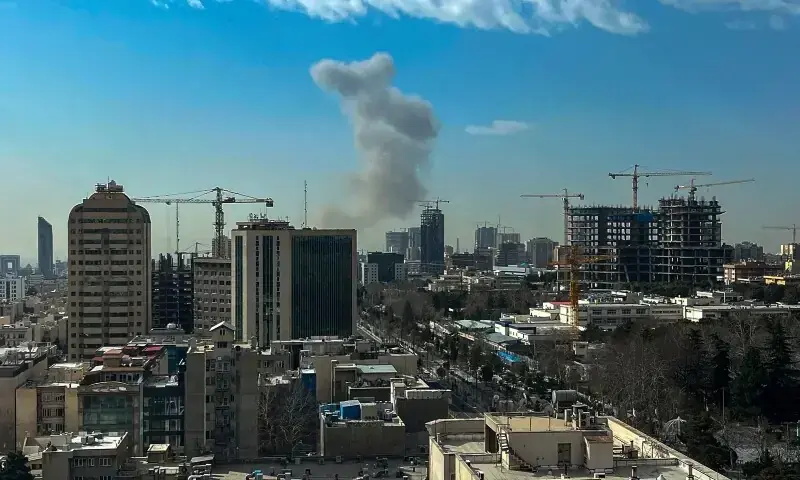
(DDM) – A joint military strike by the United States and Israel has reportedly damaged the historic Golestan Palace in Tehran, according to Iranian state-linked media.
Diaspora Digital Media (DDM) gathered that the palace, which is recognized as a UNESCO World Heritage Site, sustained damage in the aftermath of the latest round of aerial bombardments targeting sites in the Iranian capital.
Semi-official outlet Mehr News Agency reported that parts of the palace complex were affected during the strikes, though the full extent of the structural damage remains unclear.
Golestan Palace is one of Iran’s most significant historical landmarks and a symbol of Persian royal heritage.
The complex first rose to prominence during the Qajar dynasty, when Tehran was established as the capital in the late 18th century.
It continued to serve as a ceremonial and political center under the subsequent Pahlavi monarchy until the 1979 Islamic Revolution.
Architecturally, the palace is known for its elaborate tilework, ornate halls and particularly its famed mirrored throne room, which reflects centuries of Persian artistry.
According to Mehr News Agency, key artifacts from the throne room and associated museum collections had previously been relocated to secure vaults amid earlier unrest.
The items were reportedly moved following protests in January and during the 12-day war that erupted in June 2025, reflecting concerns about the vulnerability of cultural sites during periods of instability.

The reported damage to Golestan Palace underscores growing fears that cultural and historical landmarks are increasingly at risk as the conflict between Washington and Tehran intensifies.
International heritage advocates have long warned that warfare in densely populated or historically significant cities can result in unintended but irreversible losses to global cultural patrimony.
UNESCO designation typically obliges states to safeguard listed sites, but enforcement mechanisms are limited during active hostilities.
The alleged strike comes as tensions between the United States and Iran continue to escalate, with military exchanges expanding in both scope and geographic reach.
While Iranian authorities have condemned the attack as an assault on national identity and history, US and Israeli officials have not publicly commented on specific damage to heritage structures.
Analysts note that modern urban warfare often blurs the line between strategic military targets and nearby civilian or cultural sites.
Golestan Palace’s central location in Tehran makes it particularly exposed during strikes aimed at surrounding infrastructure or government-linked facilities.
The palace complex includes gardens, museums and ceremonial halls that attract both domestic and international visitors during peacetime.
Its status as a UNESCO-listed property adds diplomatic sensitivity to any confirmed damage, potentially complicating an already volatile geopolitical situation.
As assessments continue, preservation experts say even limited structural impact could require extensive restoration work to maintain the site’s historical integrity.
The reported incident highlights how escalating military operations are not only reshaping the strategic balance in the Middle East, but also threatening irreplaceable symbols of cultural history.