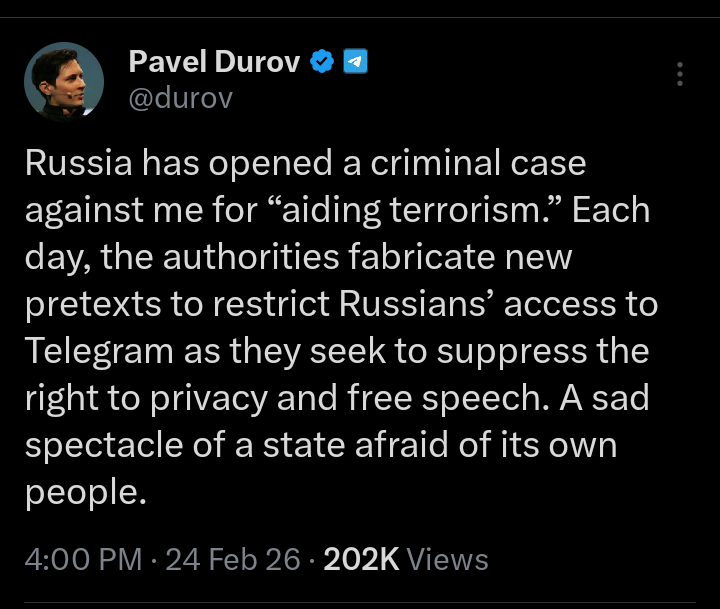
Pavel Durov, founder of Telegram, has claimed that Russian authorities have opened a criminal case against him for allegedly “aiding terrorism,” escalating tensions between the tech entrepreneur and his home country.

In a post shared on X (formerly Twitter), Durov wrote:
“Russia has opened a criminal case against me for ‘aiding terrorism.’ Each day, the authorities fabricate new pretexts to restrict Russians’ access to Telegram as they seek to suppress the right to privacy and free speech. A sad spectacle of a state afraid of its own people.”
The statement quickly sparked heated debate online, with users sharply divided over the allegations and their broader implications.

Some commenters dismissed the charges as politically motivated, arguing that the move reflects growing state efforts to control digital platforms. Several users suggested that the case is part of a broader attempt to tighten restrictions on online speech in Russia.
Others compared Russia’s stance on digital expression to that of countries such as China and North Korea, where government oversight of media and online platforms is widely documented.
The discussion also spilled into commentary on the ongoing war with Ukraine, with some users framing the legal action against Durov within the broader geopolitical conflict.
Not all reactions were dismissive of the allegations. A number of commenters took a more procedural stance, arguing that if Durov is found guilty under Russian law, he should face the consequences.
This group emphasized the principle of due process, separating the question of political freedom from the legal merits of the case itself.
Another segment of the discussion focused on Telegram’s reputation. Critics claimed that the platform has been used for illicit activities, ranging from fraud to extremist coordination, and argued that governments across multiple jurisdictions have previously raised concerns about its content moderation policies.
In recent years, authorities in countries including France, United Kingdom, United States, and Germany have scrutinized Telegram over issues related to security and online extremism.
Supporters of Durov, however, argue that Telegram’s encryption and privacy-focused design make it a target for governments seeking greater surveillance powers.
As with many high-profile controversies, speculation quickly followed. Some commenters suggested geopolitical maneuvering behind the scenes, while others turned the conversation toward domestic political debates unrelated to Durov himself.
Mentions of Nigerian political figures such as Peter Obi and Bola Tinubu illustrated how global tech disputes can become intertwined with local political rivalries in online spaces.
At its core, the controversy highlights an enduring global tension: the balance between national security concerns and digital privacy rights. Durov has long positioned Telegram as a platform committed to protecting user data and resisting state pressure. Russian authorities, on the other hand, have previously sought greater control over digital communication channels within the country.
Whether the criminal case will proceed, and on what evidence, remains to be seen. For now, the accusations have not only intensified scrutiny of Telegram but also ignited a broader debate over censorship, platform responsibility, and the limits of state power in the digital age.