


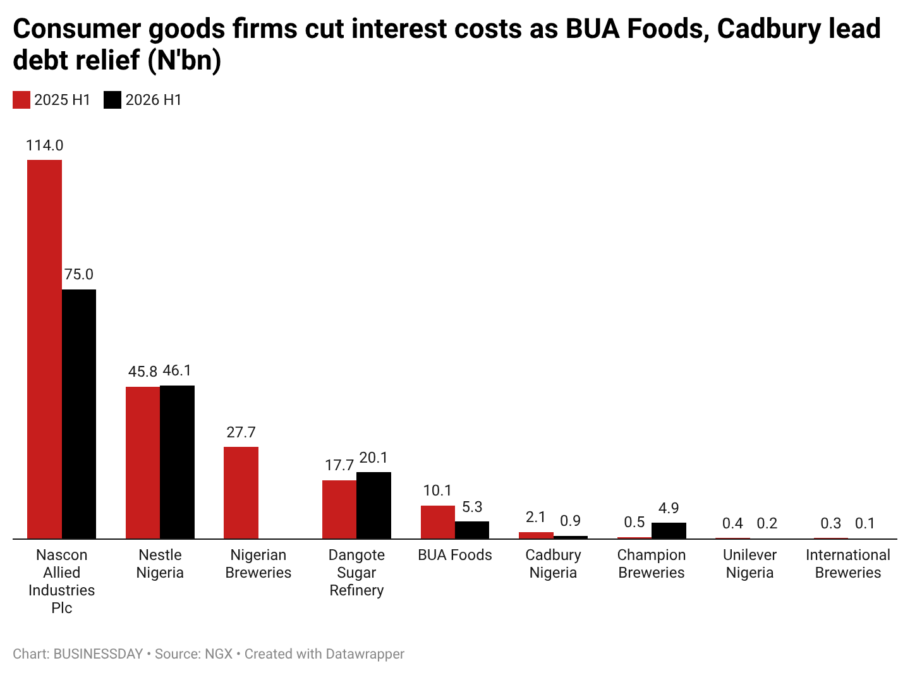
Nigeria’s consumer goods industry is beginning to experience some relief from the intense financing pressures that have weighed heavily on businesses, as companies in the sector recorded a significant 26 per cent decline in interest expenses.
The reduction marks an important development for manufacturers and other fast-moving consumer goods businesses that have spent recent years battling high borrowing costs, currency pressures, elevated input prices and weakening consumer purchasing power.
The decline in interest burden suggests that the financial environment confronting consumer goods companies may be gradually improving, providing businesses with more room to manage operations, protect margins and redirect resources towards expansion.
For an industry that relies heavily on working capital to finance production, inventory, distribution and other operational requirements, lower financing costs could have a meaningful impact on corporate performance.

Consumer goods manufacturers are particularly sensitive to changes in interest rates because their businesses require substantial amounts of capital to maintain production and keep products available across the market.
Companies often need financing to purchase raw materials, pay suppliers, maintain factories, fund logistics and bridge the gap between production and the eventual collection of revenue from distributors and retailers.
When borrowing costs rise sharply, the impact can quickly spread across the entire business. Higher interest payments increase operating expenses and reduce the amount of money available for investment.
Companies may also be forced to increase product prices to compensate for higher financial costs, adding to inflationary pressures and making already expensive goods less affordable for consumers.
The 26 per cent decline in interest expenses therefore provides more than just a financial improvement on company balance sheets.
It could also strengthen the ability of manufacturers to withstand difficult market conditions and make longer-term business decisions.
The development comes after a prolonged period in which Nigerian businesses faced exceptionally expensive credit.
Monetary tightening, designed to control inflation and stabilise the foreign-exchange market, pushed lending rates higher and made access to affordable capital increasingly difficult for businesses across several sectors.
For consumer goods companies, the pressure was compounded by the rising cost of imported raw materials, energy, transportation and other inputs.
Manufacturers were forced to operate in an environment where almost every major cost component was increasing simultaneously.
As financing conditions begin to ease, companies may have an opportunity to improve their financial structure.
Some businesses could use the additional breathing room to repay expensive loans, while others may refinance existing obligations at more favourable rates.
Companies with stronger balance sheets could also take advantage of improved conditions to fund new production lines, expand distribution networks or introduce new products.
The decline in interest burden could also have a positive effect on profitability.
Interest expenses are deducted from operating earnings before companies arrive at their final profit figures. Therefore, when financing costs decline without a corresponding deterioration in operating performance, more of the revenue generated by a business can ultimately translate into profit.
This could be particularly important for consumer goods companies, many of which have struggled to protect margins amid rising production costs and declining household purchasing power.
Nigerian consumers have increasingly become price-conscious, forcing manufacturers to balance the need to recover higher costs with the risk of losing customers.
Companies have responded through different strategies, including reducing product sizes, introducing cheaper alternatives, adjusting product portfolios and seeking more efficient production methods.
Lower interest costs could now provide another avenue for protecting profitability without relying entirely on price increases.
The improvement also has implications for investment. High interest rates often discourage businesses from taking on new debt to finance expansion because the expected returns from an investment may not be sufficient to justify the cost of borrowing.
As financing becomes less expensive, some companies may find it more attractive to invest in capacity and technology.
For Nigeria’s manufacturing sector, this is significant because increased production capacity can contribute to job creation, reduce dependence on imported finished products and strengthen local supply chains. Consumer goods manufacturers that expand production can also create greater demand for locally sourced agricultural and industrial inputs.
However, the reduction in interest expenses does not mean that the sector’s challenges have disappeared.
Consumer goods businesses continue to face significant structural pressures, including unreliable electricity, high logistics costs, infrastructure deficiencies, foreign-exchange risks and weak consumer demand.
Energy remains one of the biggest expenses for many manufacturers.
Companies that cannot rely consistently on public electricity supply often have to operate generators or alternative energy systems, increasing production costs. The combination of energy expenses and expensive financing has historically placed considerable pressure on manufacturers’ margins.
Foreign-exchange volatility is another concern, particularly for companies that still depend on imported raw materials, machinery or packaging materials. Even when borrowing costs decline, a significant depreciation of the naira can increase the local-currency cost of foreign obligations and imported inputs.
This means companies will need to maintain disciplined financial management even as borrowing conditions improve. Lower interest expenses should ideally be used to strengthen balance sheets rather than encourage excessive borrowing.
According to DDM News, the 26 per cent reduction in the interest burden could represent an important turning point for consumer goods companies if it is sustained.
Businesses that successfully convert lower financing costs into stronger cash flows, improved productivity and increased investment could emerge from the current economic adjustment in a stronger position.
There is also a wider implication for investors.
A sustained reduction in interest expenses can improve the attractiveness of consumer goods companies by strengthening earnings and potentially improving their capacity to pay dividends. Investors often pay close attention to financial costs because excessive debt servicing can consume a significant portion of a company’s operating income.
If financing conditions continue to improve, companies with sound fundamentals could benefit disproportionately. Businesses that already have strong brands, extensive distribution networks and efficient operations may be able to use the savings from lower interest costs to widen their competitive advantage.
Banks and other financial institutions also stand to benefit from a healthier corporate borrowing environment.
If companies become more financially stable, the risk associated with lending to the manufacturing sector could decline.
This could encourage lenders to provide more structured financing for productive investments rather than short-term borrowing used mainly to cover operating gaps.
The longer-term objective, however, should be to establish an environment in which Nigerian manufacturers can access predictable and reasonably priced capital.
Temporary reductions in interest expenses can provide relief, but sustainable industrial growth requires a financial system capable of supporting businesses through different economic cycles.
Consumer goods companies also need to strengthen their internal financial discipline.
Businesses must carefully manage debt maturities, reduce unnecessary borrowing and ensure that loans are directed towards investments capable of generating sufficient returns.
The current development therefore presents both an opportunity and a responsibility.
Companies have been given some breathing space by the reduction in their financing burden, but the gains will be meaningful only if they are converted into stronger businesses.
For Nigeria, a healthier consumer goods sector could have far-reaching consequences.
The industry supports employment, manufacturing, agriculture, transportation, retail and distribution. Stronger manufacturers can stimulate demand throughout the economy while helping to deepen domestic production.
The 26 per cent fall in interest costs is consequently more than a simple accounting improvement.
It signals a potentially important shift in the financial pressures confronting one of Nigeria’s most important business sectors.
If the decline in borrowing costs is sustained and accompanied by improvements in inflation, foreign-exchange stability, electricity supply and consumer demand, manufacturers could find themselves in a considerably stronger position to invest and grow.
DDM News reports that the emerging improvement offers consumer goods companies an opportunity to move from defensive survival strategies towards sustainable expansion.
The firms that use the relief to strengthen their balance sheets, improve productivity and invest in future growth could be among the biggest beneficiaries of Nigeria’s changing economic landscape.
The immediate challenge is to ensure that cheaper financing becomes a catalyst for productivity rather than simply another source of short-term liquidity.
If businesses, lenders and policymakers can maintain that direction, the reduction in interest burden could become part of a broader recovery in Nigeria’s consumer goods industry, helping manufacturers regain financial strength while creating the foundation for more competitive and sustainable growth.




