


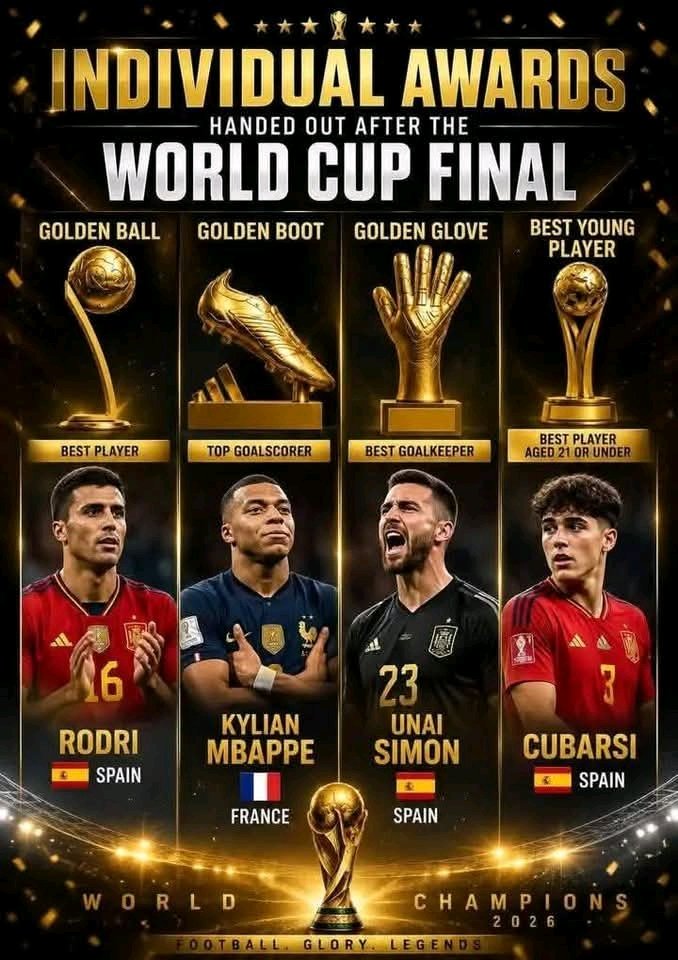
Spain’s unforgettable triumph at the 2026 FIFA World Cup was matched by an impressive haul of individual honours after FIFA announced the tournament’s official award winners following the final in New Jersey.
Fresh from leading La Roja to a 1-0 extra time victory over Argentina, midfield maestro Rodri was crowned the tournament’s best player, receiving the prestigious Adidas Golden Ball for his outstanding performances throughout the competition.
The Manchester City midfielder was instrumental in Spain’s march to World Cup glory, dictating play from midfield with his composure, intelligent positioning and leadership. His consistency in both defensive and attacking phases made him one of the standout performers of the expanded 48 nation tournament.

The Golden Ball is awarded to the competition’s most influential player following votes from FIFA’s Technical Study Group, with Rodri emerging ahead of Argentina captain Lionel Messi, who finished second to receive the Silver Ball.
France striker Kylian Mbappe completed the podium by claiming the Bronze Ball after another remarkable World Cup campaign.
Although France fell short of lifting the trophy, Mbappe once again proved why he remains one of football’s most feared forwards.
The Real Madrid star secured the Adidas Golden Boot after finishing as the tournament’s leading scorer with 10 goals in eight appearances. Mbappe also contributed four assists, underlining his complete attacking influence during the competition.
His goal tally placed him comfortably ahead of Lionel Messi, who claimed the Silver Boot after scoring eight goals and providing four assists for Argentina during another outstanding World Cup campaign.
England midfielder Jude Bellingham completed the top three in the scoring standings, earning the Bronze Boot with seven goals and one assist after inspiring the Three Lions to another impressive tournament.
Spain’s dominance extended beyond Rodri’s Golden Ball triumph.
Goalkeeper Unai Simon received the Adidas Golden Glove after producing one of the finest defensive tournaments ever recorded by a World Cup goalkeeper.
The Athletic Club shot stopper conceded just one goal throughout Spain’s eight matches while keeping seven clean sheets, playing a decisive role in La Roja’s remarkable run to the title.
His calm presence, sharp reflexes and excellent organisation of the Spanish defence proved crucial as Luis de la Fuente’s side built their success on defensive discipline as much as attacking quality.
Spain’s celebrations continued when highly rated defender Pau Cubarsi was named the tournament’s Best Young Player.
The Barcelona centre back enjoyed a breakthrough World Cup, displaying maturity far beyond his years while helping Spain produce one of the strongest defensive records in the history of the competition.
The award recognises the outstanding young performer born on or after January 1, 2005, with FIFA’s Technical Study Group selecting Cubarsi after his exceptional displays throughout the tournament.
The Netherlands also left the tournament with silverware after receiving the FIFA Fair Play Trophy.
The award recognises the team that demonstrated the highest standards of discipline, respect and sporting behaviour across the competition, reflecting the Dutch squad’s professionalism throughout their World Cup campaign.
Beyond the individual honours, FIFA also celebrated the remarkable success of the expanded tournament.
The 2026 edition marked the first FIFA World Cup to feature 48 teams and 104 matches across three host nations, the United States, Canada and Mexico.
The expanded format attracted unprecedented global interest, with FIFA confirming that 6,810,996 supporters attended matches during the tournament.
Average attendance reached an impressive 65,490 spectators per match, while stadium occupancy stood at an extraordinary 99.7 percent, highlighting the worldwide appeal of football’s biggest competition.
The record breaking attendance figures represent one of the most successful tournaments in FIFA history and demonstrate the popularity of the expanded World Cup format.
Spain’s victory over Argentina in the final completed a memorable campaign for Luis de la Fuente’s squad, who combined tactical discipline, defensive excellence and attacking efficiency to reclaim the World Cup for the first time since their historic triumph in 2010.
Their success was reflected not only in lifting football’s most coveted trophy but also in sweeping several of the tournament’s most prestigious individual awards.
With Rodri recognised as the world’s outstanding player, Unai Simon honoured as the best goalkeeper and Pau Cubarsi emerging as the competition’s brightest young talent, Spain ended the tournament as the undisputed dominant force in international football.
Meanwhile, Mbappe’s Golden Boot confirmed his status as one of the greatest World Cup goalscorers of his generation, while Lionel Messi once again demonstrated his enduring brilliance by finishing among the tournament’s leading performers despite Argentina’s heartbreak in the final.
2026 FIFA World Cup Award Winners
Golden Ball: Rodri (Spain)
Silver Ball: Lionel Messi (Argentina)
Bronze Ball: Kylian Mbappe (France)
Golden Boot: Kylian Mbappe (France) – 10 goals
Silver Boot: Lionel Messi (Argentina) – 8 goals
Bronze Boot: Jude Bellingham (England) – 7 goals
Golden Glove: Unai Simon (Spain)
Best Young Player: Pau Cubarsi (Spain)
FIFA Fair Play Award: Netherlands




