



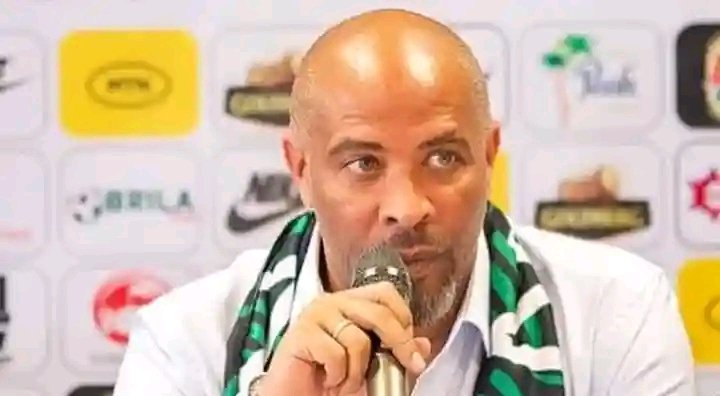
Former Super Eagles midfielder Garba Lawal has called on Nigeria’s senior national team head coach, Eric Chelle, to place qualification for the 2030 FIFA World Cup at the centre of his long-term plans, insisting that the country’s football reputation depends on returning to the world’s biggest sporting event.
Lawal, one of the most respected figures in Nigerian football, believes the Super Eagles must begin preparations early rather than wait until the qualification campaign gathers momentum. According to the former international, Nigeria cannot afford another disappointing World Cup cycle after recent failures to secure qualification.
His comments come as discussions continue over the future direction of Nigerian football following the Nigeria Football Federation’s decision to maintain confidence in Chelle as the man to lead the national team into a new era.

The former midfielder stressed that sustained planning, technical stability and continuity are essential if Nigeria hopes to reclaim its place among Africa’s elite football nations.
Nigeria remains one of the continent’s most successful football countries, having produced generations of outstanding players who have excelled both at home and across Europe’s top leagues.
Despite that pedigree, recent qualification campaigns have failed to meet supporters’ expectations, creating growing pressure on administrators and coaches to rebuild a competitive national team capable of challenging consistently on the international stage.
Lawal believes the rebuilding process should now be focused squarely on the 2030 FIFA World Cup.
Speaking on the future of the national team, he maintained that long-term planning offers the best opportunity to restore confidence among supporters while giving players enough time to develop a winning mentality under the current coaching crew.
He also welcomed the reported extension of Eric Chelle’s contract, describing it as an important decision that could provide the stability required for sustained progress.
According to Lawal, coaches are often judged solely on short-term results, yet building a successful national team requires patience, consistency and adequate time to implement tactical ideas.
He argued that changing coaches too frequently has historically disrupted continuity in many African national teams and expressed hope that Nigeria would avoid repeating that pattern.
The former Super Eagles star explained that allowing Chelle to continue his work would enable him to deepen his understanding of the players, strengthen relationships within the squad and gradually establish a clear football philosophy capable of delivering results in future competitions.
Eric Chelle assumed responsibility for the Super Eagles during a challenging period, inheriting a team under pressure to improve performances after inconsistent results in major international competitions.
Since taking charge, the Malian tactician has worked to introduce greater tactical discipline, improve team organisation and expand the pool of players available for national team selection.
Observers believe the coach has attempted to blend experienced internationals with emerging young talents, creating healthy competition across every department of the squad.
The coming years are expected to provide further opportunities for Chelle to shape the team before qualification for the 2030 FIFA World Cup begins in earnest.
Lawal himself understands the demands of representing Nigeria at the highest level.
During an accomplished international career, he featured for the Super Eagles at multiple editions of the Africa Cup of Nations and represented the country at the 1998 FIFA World Cup in France, where Nigeria reached the Round of 16 before being eliminated by Denmark.
Known for his versatility, energy and commitment, Lawal operated successfully in several positions throughout his career, making him one of the most dependable members of the celebrated Super Eagles generation of the late 1990s.
His experience at major international tournaments gives additional weight to his assessment of the challenges currently facing Nigerian football.
For many football analysts, Nigeria possesses sufficient talent to qualify comfortably for every World Cup tournament.
The country continues to produce high-quality footballers competing in the English Premier League, Italy’s Serie A, Spain’s La Liga, Germany’s Bundesliga, France’s Ligue 1 and several other elite European competitions.
However, experts have repeatedly argued that talent alone is no longer enough in modern football.
Successful qualification campaigns require effective administration, proper player management, tactical consistency, strong scouting systems and long-term technical planning.
Lawal believes these areas deserve equal attention if Nigeria is to return to football’s biggest stage.
Supporters have also continued to call for improved grassroots football development, arguing that stronger youth structures will guarantee a steady supply of talented players for future generations.
Investment in academies, coaching education and domestic competitions is increasingly viewed as essential to sustaining the country’s football success.
The Nigeria Football Federation has repeatedly emphasised its commitment to developing football at every level, with renewed focus on youth programmes and improved technical structures.
Many stakeholders believe these efforts must now align with the broader objective of building a competitive national team capable of qualifying for and excelling at the 2030 FIFA World Cup.
As preparations gradually begin for another qualification cycle, expectations among millions of Nigerian football fans remain extremely high.
The Super Eagles continue to enjoy enormous support across Africa and among Nigerians living abroad, making every international fixture a matter of national interest.
Lawal’s message ultimately reflects the aspirations of countless supporters who believe Nigeria belongs among football’s global elite.
With an experienced coach, an exciting generation of players and sufficient time to build a cohesive squad, many believe the Super Eagles possess every ingredient needed to return to the FIFA World Cup.
The challenge now lies in translating that potential into consistent performances on the pitch. If careful planning, administrative stability and technical continuity remain priorities over the coming years, Nigeria could once again become one of Africa’s strongest representatives at the 2030 FIFA World Cup.




