


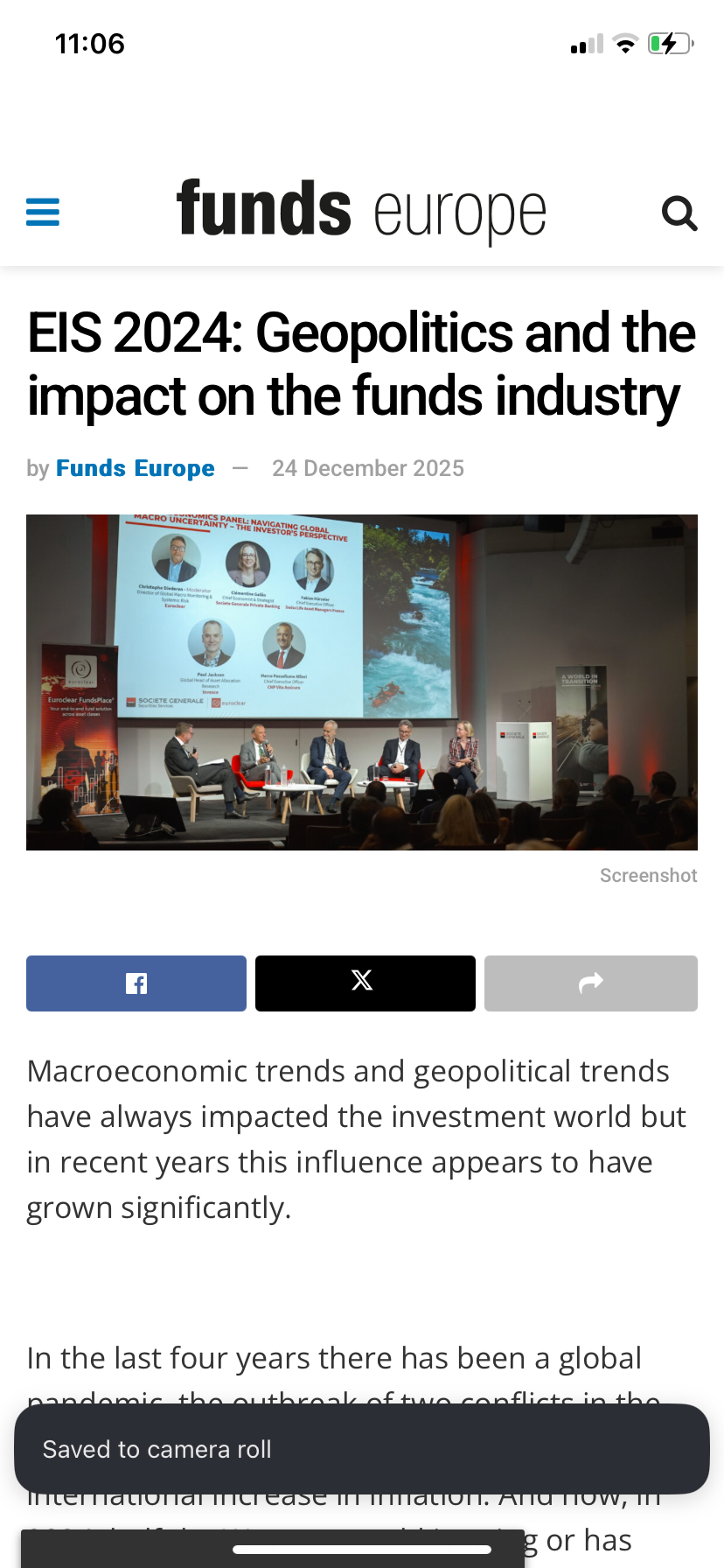
Geopolitical tensions are increasingly becoming a defining force in the global investment landscape, forcing asset managers, fund managers and institutional investors to reconsider how they assess risk, allocate capital and build portfolios in an environment shaped by conflicts, political instability, trade disputes and changing relationships between major economies.
What was once treated largely as an external risk that could be monitored from a distance has become a factor capable of directly influencing markets, investment flows, currencies, commodities and the long-term performance of funds.
As geopolitical divisions deepen across regions, the funds industry is being pushed to adapt to a more complicated world in which economic decisions are increasingly intertwined with national security and political interests.
The developments highlighted in the 2024 edition of the European Investment Summit (EIS) reflect this changing investment environment.

For fund managers, the challenge is no longer simply identifying attractive assets and forecasting economic cycles.
They must increasingly understand how political decisions and international relations can alter the investment outlook almost overnight.
Wars and military conflicts remain among the most obvious sources of geopolitical risk.
Armed conflicts can disrupt energy supplies, damage infrastructure, interrupt international trade and trigger sudden movements in financial markets.
They can also generate inflationary pressures when the prices of oil, gas, food or other commodities rise sharply.
For funds exposed to affected economies or sectors, the consequences can be significant.
An unexpected escalation in a conflict can cause investors to move money away from riskier assets and towards perceived safe-haven investments.
This can create volatility across equities, bonds, currencies and commodities, forcing portfolio managers to reassess their positions.
However, geopolitical risk extends far beyond traditional military conflict.
The relationship between major economic powers has increasingly become another source of uncertainty.
Trade restrictions, tariffs, sanctions, export controls and technology restrictions can alter the prospects of entire industries and companies.
The growing strategic competition between the United States and China, for example, has implications for technology, manufacturing, semiconductors, telecommunications, artificial intelligence and global supply chains.
Businesses that depend heavily on international markets or specific countries for critical components may face higher costs and greater operational risks when governments introduce new restrictions.
For the funds industry, such developments create a difficult investment question: how much of a company’s future growth depends on a geopolitical relationship that could change?
This is encouraging asset managers to place greater emphasis on scenario analysis and stress testing.
Instead of relying exclusively on historical market behaviour, managers increasingly need to consider what could happen if sanctions are introduced, trade routes are disrupted, tariffs increase or diplomatic relations deteriorate.
The result is a shift towards more comprehensive risk management.
According to DDM News, geopolitical analysis is becoming increasingly relevant to investment decisions because political developments can rapidly translate into financial consequences.
A change in government policy can affect corporate earnings, access to markets, supply chains and the cost of capital, making geopolitical awareness an increasingly important component of portfolio management.
Another important consequence is the changing geography of investment.
For decades, globalisation encouraged companies and investors to spread operations and capital across borders in search of efficiency and growth.
But growing geopolitical fragmentation is encouraging businesses to reconsider highly concentrated international supply chains.
The push towards diversification, reshoring and “friend-shoring” could reshape investment opportunities across emerging and developed markets.
Countries positioned as alternative manufacturing hubs may benefit as companies seek to reduce dependence on politically sensitive markets.
This could create opportunities for funds investing in infrastructure, industrial production, logistics, technology and other sectors supporting the reorganisation of global supply chains.
At the same time, investors must be careful not to interpret every geopolitical development as an immediate investment opportunity.
Moving capital based on short-term political headlines can expose funds to unnecessary volatility. Geopolitical events are often difficult to predict, and markets can react differently depending on how investors assess the economic consequences.
A disciplined investment strategy therefore requires distinguishing between temporary market reactions and structural changes that could affect an asset’s long-term value.
Currency markets provide another example of the growing interaction between geopolitics and investment.
Political uncertainty can weaken investor confidence in a country’s currency, while sanctions or changes to international financial relationships can alter the way cross-border transactions are conducted.
Central banks may also respond to geopolitical shocks through monetary policy, particularly when disruptions contribute to inflation.
For international funds, currency exposure can therefore become a major component of geopolitical risk.
The growing use of financial sanctions has also introduced another layer of complexity.
Governments increasingly use restrictions on financial institutions, companies and individuals as instruments of foreign policy.
Asset managers must consequently ensure that portfolios comply with changing sanctions regimes and that investments do not inadvertently expose funds to prohibited entities.
This has increased the importance of compliance, due diligence and regulatory monitoring within the investment industry.
Environmental, social and governance considerations are also being affected.
Geopolitical tensions can complicate investment decisions around defence, energy security, fossil fuels and critical infrastructure.
Assets that may previously have been excluded under certain investment policies could receive renewed attention as governments place greater emphasis on national security and energy independence.
This creates difficult questions for asset managers attempting to balance investment mandates with changing geopolitical realities.
The funds industry is also facing a more fragmented regulatory environment.
Different jurisdictions may adopt competing approaches to data protection, technology, taxation, investment restrictions and financial regulation.
Managers operating internationally must navigate these differences while ensuring that funds remain compliant across multiple markets.
The cost of regulatory complexity can ultimately affect investors through higher operational expenses and increased barriers to cross-border investment.
Yet geopolitical fragmentation does not mean global investment is coming to an end.
Instead, the industry is entering a period where global diversification requires more sophisticated risk management. Investors can still benefit from international opportunities, but they must have a clearer understanding of the political and economic conditions surrounding those investments.
For fund managers, this means building portfolios that can withstand a wider range of potential shocks.
Diversification remains important, but diversification itself must be reconsidered. Holding assets across several countries does not necessarily provide protection if those markets are exposed to the same geopolitical risk.
Effective diversification increasingly requires understanding correlations between political events, supply chains, currencies, commodities and financial markets.
The geopolitical environment also creates opportunities for long-term investors.
Infrastructure spending, defence technology, cybersecurity, renewable energy, critical minerals and domestic manufacturing are among the areas that could receive increased investment as governments seek greater resilience and strategic independence.
However, investors must distinguish between sustainable long-term trends and temporary political narratives.
For DDM News, the central message from the evolving investment environment is that geopolitics can no longer be treated as a side issue for professional investors.
It has become an integral part of understanding markets and evaluating risk.
The funds industry must therefore become more flexible, more analytical and more prepared for uncertainty.
Portfolio managers need to monitor political developments alongside economic indicators, while investors need to understand that market performance can increasingly be influenced by events far beyond corporate balance sheets.
The geopolitical landscape is unlikely to become simpler in the near future.
Competition between major powers, regional conflicts, trade disputes, technological restrictions and shifting alliances are likely to remain important forces shaping the global economy.
For the funds industry, the challenge will be to navigate this uncertainty without allowing short-term political shocks to overwhelm long-term investment objectives.
The winners in this environment may ultimately be fund managers capable of combining traditional financial analysis with a deeper understanding of geopolitics.
As the global investment landscape becomes increasingly fragmented, successful portfolio management will depend not only on knowing where the opportunities are, but also on understanding the political forces that could determine whether those opportunities survive.
Geopolitics has become part of the investment equation, and the funds industry is being forced to rewrite its approach to risk accordingly.




