


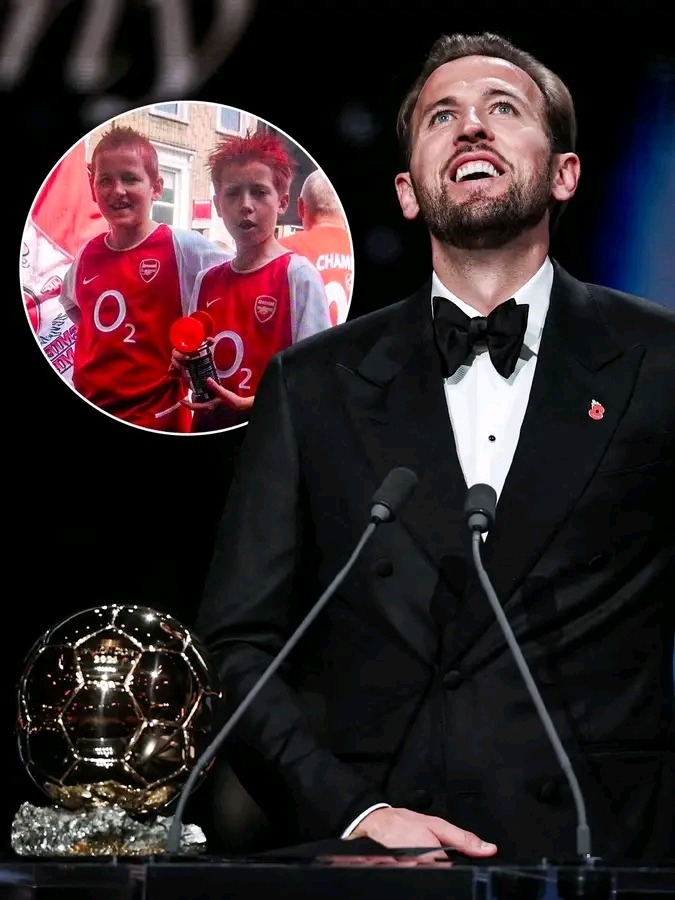
Harry Kane has reached the summit of world football, completing one of the most remarkable journeys in modern football after winning the 2026 Ballon d’Or, nearly 25 years after England last celebrated a winner of the prestigious individual award.
The Bayern Munich striker was crowned the world’s best men’s footballer at Monday’s ceremony in London on October 26, 2026, following a phenomenal campaign in which he scored 73 goals for club and country. His triumph places him among an exclusive group of English football legends and represents the culmination of years of perseverance, relentless goalscoring and determination to prove his doubters wrong.
Yet Kane’s story did not begin with the promise of greatness. Long before the trophies, record-breaking performances and global recognition, the England captain was a young boy who failed to convince Arsenal’s academy coaches that he possessed the physical attributes required to make it as a professional footballer.

At eight years old, Kane was released by Arsenal after spending approximately a year in the club’s youth setup. The decision would become one of the defining moments of his early development.
According to Liam Brady, Arsenal’s former head of youth development, Kane was considered insufficiently athletic at the time. Speaking about the decision in 2018, Brady admitted the club had made a mistake, describing the youngster as “a bit chubby” and not athletic enough.
For a child dreaming of becoming a professional footballer, such rejection could easily have undermined his confidence. Instead, Kane continued playing, developing his technique and pursuing his ambition.
Born in Walthamstow, east London, on July 28, 1993, Kane grew up in Chingford, where football became an important part of his childhood. He joined local side Ridgeway Rovers at six and developed his game in grassroots football before attracting interest from professional academies.
Following his departure from Arsenal, Kane returned to local football. His journey eventually brought him to Tottenham Hotspur, whose academy recruited him after he impressed during his youth football years.
However, joining Tottenham did not immediately guarantee a pathway to the first team. Kane still had to demonstrate that he could compete at the highest level, and his development required patience.
He spent time on loan at Leyton Orient, Millwall, Norwich City and Leicester City, gaining experience across different levels of English football. Those spells provided opportunities to improve his finishing, movement and understanding of the game before he established himself as Tottenham’s leading striker.
Kane’s breakthrough at Tottenham came during the 2014/15 season, when he emerged as one of the Premier League’s most exciting young forwards. His goals quickly transformed him from a promising academy graduate into a central figure for both club and country.
Season after season, he demonstrated an exceptional ability to score from different situations, whether through powerful strikes, precise finishes inside the penalty area or intelligent movement that created opportunities for himself and his teammates.
At Tottenham, Kane eventually scored 280 goals in 435 appearances, becoming the club’s all-time leading goalscorer before departing for Bayern Munich in 2023.
His move to Germany offered a new challenge and an opportunity to pursue major trophies after years of individual success in England. Kane adapted quickly to the Bundesliga, maintaining his extraordinary scoring consistency while becoming a central figure in Bayern’s attack.
The 2025/26 campaign proved particularly significant. Kane scored 61 goals in 51 appearances for Bayern Munich across all competitions and added 12 goals for England, taking his combined tally to 73 goals in 65 games.
His contribution helped Bayern retain the Bundesliga title and win the German Cup and Franz Beckenbauer Supercup. He also finished as the Bundesliga’s leading goalscorer for the third consecutive season and recorded 14 goals in the Champions League as Bayern reached the semi-finals.
Those performances established a compelling case for the Ballon d’Or, an award that recognises individual excellence while taking account of players’ achievements and contributions during the assessment period.
Kane ultimately finished ahead of Real Madrid’s Kylian Mbappé and Barcelona’s Lamine Yamal, who completed the top three. His victory also ended England’s 25-year wait for another men’s Ballon d’Or winner, following Michael Owen’s triumph in 2001.
Kane became only the fifth Englishman to win the award, joining Stanley Matthews, Bobby Charlton, Kevin Keegan and Owen in the record books.
The achievement is especially significant because Kane had already established himself as one of his generation’s most prolific strikers before securing football’s most celebrated individual honour. His career has been defined by consistency, with his performances repeatedly challenging the notion that success must arrive early to be meaningful.
His international career has followed a similarly distinguished path. As England captain and the country’s leading international goalscorer, Kane has carried the responsibility of leading the national team through major tournaments. His performances have made him one of the defining figures of English football in the modern era.
Winning the Ballon d’Or now provides a landmark recognition of his contribution to the sport, placing his individual achievements alongside those of football’s most celebrated names.
The award also gives fresh significance to his early rejection by Arsenal. The club’s decision was based on an assessment of a young player’s physical development and athleticism, but Kane’s subsequent career demonstrated how dramatically a footballer’s potential can evolve.
Brady later acknowledged that Arsenal had made a mistake. That admission has become an enduring part of Kane’s story, although his success cannot be attributed to one rejection alone. His progress required years of training, experience, adaptation and consistent performances at the highest level.
Kane’s journey also offers an important lesson for young footballers who face setbacks during their development. Being released from an academy does not necessarily determine a player’s future, just as early recognition does not guarantee long-term success.
His rise from grassroots football to Tottenham’s record books and then to Bayern Munich’s attacking line illustrates the importance of persistence and continued improvement. It also highlights the role of opportunities, coaching and the ability to respond constructively to disappointment.
For Bayern Munich, Kane’s Ballon d’Or triumph is a major individual achievement for a player whose goals have helped drive the club’s success. For England, it ends a quarter-century wait for another winner of the men’s award. For Kane himself, it represents recognition of a career built through patience, determination and extraordinary goalscoring consistency.
The young boy who once left Arsenal’s academy without a clear path to professional football has now reached the highest individual honour the sport can offer.
His story is not simply about proving one club wrong. It is about the long road between potential and achievement, and how a player’s future can be shaped by what happens after an early disappointment.
At 33, Harry Kane has secured his place among football’s elite. The Ballon d’Or is the latest milestone in a journey that began on the grassroots pitches of east London and culminated on the biggest stage in world football.




