


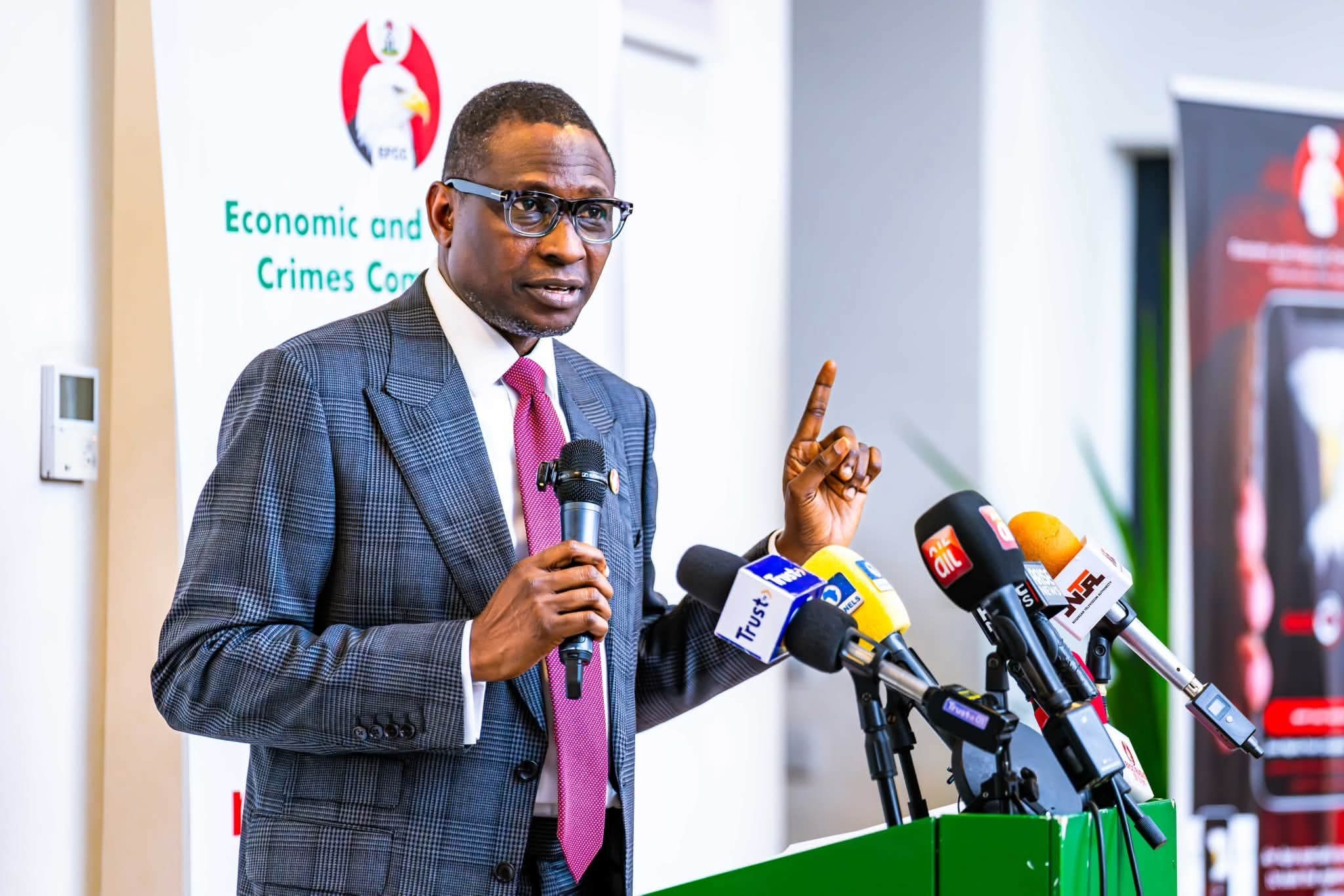
The Chairman of the Economic and Financial Crimes Commission (EFCC), Mr. Ola Olukoyede has raised serious concerns over the scale of corruption in the public sector.
He said the commission receives more than 20,000 petitions on public corruption every year.
While speaking in Abuja at a ceremony marking the 80th birthday of former Attorney-General of the Federation and Minister of Justice, Kanu Agabi, Olukoyede said the volume and nature of the complaints reflected the depth of the corruption challenge confronting Nigeria.
He said some of the cases investigated by the agency involved public officials whose financial positions changed dramatically after assuming office.

Olukoyede said: “I receive over 20,000 petitions in a year in respect to public corruption, all terrible. What is going on? Like every minute, public officers take money, and if you go through some of our case files you will weep.”
He said the alleged diversion of public resources was not merely a matter for law enforcement agencies.
He argued that Nigerians were collectively affected by the consequences of corruption.
“The way people take national resources, as Nigerians we’re victims of these fraudulent activities. And we must come together for once in our lifetime and say no to the activities of some of our leaders,” he said.
The anti-graft agency chairman further disclosed that investigations sometimes traced substantial dollar and naira assets to public servants who had comparatively modest financial positions before assuming office.
According to him, some officials allegedly accumulated millions of dollars and naira within three or four years of being in public office, while others were linked to the ownership of large numbers of houses.
“Somebody will spend three to four years as a public servant, but before he got to office he had less than N100 thousand in his account. By the time he’s leaving, we were able to trace several millions of dollars and naira to him,” Olukoyede said.
“Some build 50 something houses, sometimes 200 houses. There’s no way a nation will develop with those kinds of people in power, no way”, he added.
He said public office holders should be prepared to account for their stewardship, stressing that transparency and accountability must remain central to the management of public resources.




