
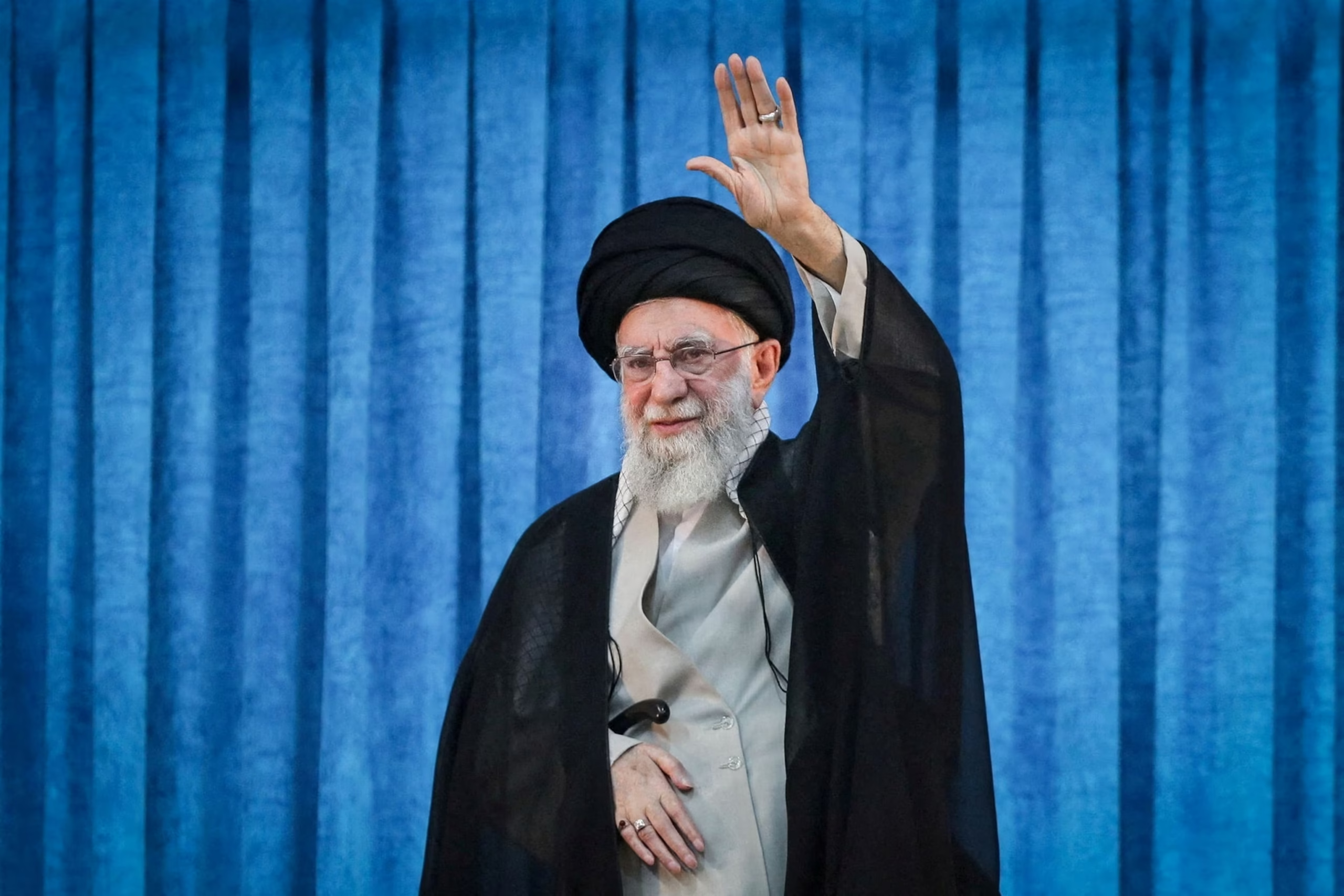
The death of Ali Khamenei, Iran’s long-serving Supreme Leader, has rapidly become one of the most dramatic and controversial geopolitical events of the decade. Intelligence leaks, defense reports, and international media investigations now paint a complex picture of how a meticulously planned operation—reportedly months or even years in the making—culminated in a devastating strike that eliminated the man who had ruled Iran since 1989. While many details remain classified or disputed, emerging accounts suggest a sophisticated blend of deception, cyber surveillance, artificial intelligence, and precision weaponry that ultimately allowed Israeli forces to strike at the heart of Iran’s leadership.
According to multiple reports reviewed by DDM News, the operation was not an impulsive battlefield decision but the result of a long-term intelligence effort coordinated between Israeli security agencies and allied intelligence partners. Analysts believe the planning phase may have stretched back years, as Israeli strategists studied patterns of behavior around the Iranian leadership, gradually building a detailed picture of how the country’s most powerful figure lived, traveled, and conducted meetings. Mossad and cyber specialists reportedly infiltrated digital infrastructure across Tehran, including traffic cameras and communications networks, giving Israeli intelligence unprecedented visibility into daily movements around the Supreme Leader’s compound.
These surveillance efforts reportedly enabled analysts to map what intelligence officials describe as the “life pattern” of Khamenei and his security apparatus. By analyzing massive streams of data collected from surveillance cameras, communications intercepts, and digital monitoring tools, Israeli intelligence could determine when senior officials arrived at meetings, which routes bodyguards used to escort the leader, and even which parking spaces were routinely occupied by security vehicles near the compound on Tehran’s Pasteur Street.
What emerged from this long-term monitoring was a rare opportunity. Intelligence sources later indicated that Khamenei had scheduled a meeting with several senior Iranian military and political officials inside a highly protected compound. The gathering was unusual because it brought together a large portion of Iran’s strategic leadership in one location, creating what military planners call a “decapitation target”—a moment when striking a single location could simultaneously cripple the command structure of an adversary state.

Yet intelligence alone was not enough. The success of the operation depended heavily on deception designed to convince Iran that no immediate attack was coming. Reports suggest that the Israeli military leadership deliberately created the impression that its command structure was temporarily inactive during the Jewish Sabbath. Senior officers reportedly left visible military facilities and allowed images to circulate suggesting that the military establishment was shutting down for weekend religious observances. The objective was simple but powerful: to lull Iranian intelligence into believing that any major operation was unlikely during that period.
Behind the scenes, however, preparations intensified. Israeli planners reportedly coordinated with allied intelligence networks, including the Central Intelligence Agency, which provided additional intelligence sources confirming the exact location of Khamenei at the critical moment. At the same time, cyber specialists allegedly disrupted communications infrastructure near the targeted compound. Cellular towers in the area were partially disabled, preventing security personnel from receiving warnings or coordinating an evacuation once the strike began.

By the time the final phase of the operation began, Iranian defenses had already been weakened. Intelligence officials later claimed that Israeli cyber operations and earlier drone strikes had blinded sections of Iran’s air-defense network, leaving key radars offline. This disruption allowed attacking aircraft to operate at safer distances while launching long-range weapons toward their target.
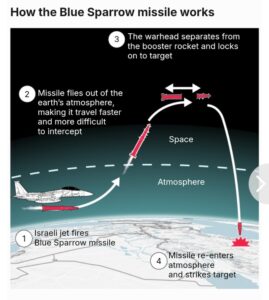
The weapon reportedly used in the decisive strike was an advanced air-launched missile known as the Blue Sparrow, developed by Israel’s defense industry. Unlike conventional cruise missiles that fly low across terrain, the Blue Sparrow follows a quasi-ballistic trajectory. After launch from a fighter jet, it climbs steeply into the upper atmosphere before descending rapidly toward its target at high speed. This unusual flight path gives defenders very little time to react and makes interception extremely difficult, particularly when air defenses are already compromised.
Investigators believe that roughly thirty precision missiles were fired toward the compound during the strike. The barrage was designed not merely to damage the site but to ensure that anyone inside would have almost no chance of escape. The explosions reportedly destroyed large sections of the complex within minutes, killing Khamenei along with several senior figures in Iran’s military hierarchy.
The assassination marked a historic turning point. It is believed to be the first time in modern history that the supreme leader of a major nation was killed in such a direct military operation. The strike occurred amid escalating hostilities between Israel and Iran and during a broader campaign targeting Iranian nuclear and missile infrastructure.
International reaction was immediate and intense. Iran confirmed the death of its Supreme Leader soon after the attack and declared national mourning. The country’s leadership structure moved quickly to establish an interim ruling council while preparing for a future leadership transition. At the same time, Iran launched retaliatory missile and drone attacks against Israeli territory and several American military bases across the Middle East, raising fears that the region was on the brink of a full-scale war.
Global reactions were sharply divided. Western allies of Israel largely framed the operation as part of a broader strategy to neutralize Iran’s nuclear ambitions and weaken what they describe as destabilizing activities in the region. However, countries including Russia and China strongly condemned the assassination, arguing that it represented a dangerous violation of international law and could trigger a wider conflict.
As details of the operation continue to emerge, analysts say the strike demonstrates how modern warfare is increasingly shaped by intelligence dominance and technological superiority. Surveillance systems, artificial intelligence, cyber operations, and precision weapons can now converge in ways that allow a single targeted operation to reshape the geopolitical landscape.
For the Middle East, the consequences may be profound and long-lasting. The removal of Iran’s Supreme Leader not only leaves a massive leadership vacuum but also raises questions about how the country’s political and military institutions will evolve in the coming months.
For observers around the world, the operation also serves as a stark reminder of how quickly covert intelligence campaigns can transform into headline-shaking military events. As DDM News continues to monitor developments, experts warn that the true ramifications of the strike—political, military, and economic—may only begin to unfold in the months and years ahead.
What is certain, however, is that the killing of Ayatollah Ali Khamenei has already reshaped the balance of power in the Middle East, setting the stage for a new and unpredictable chapter in one of the world’s most volatile regions.