
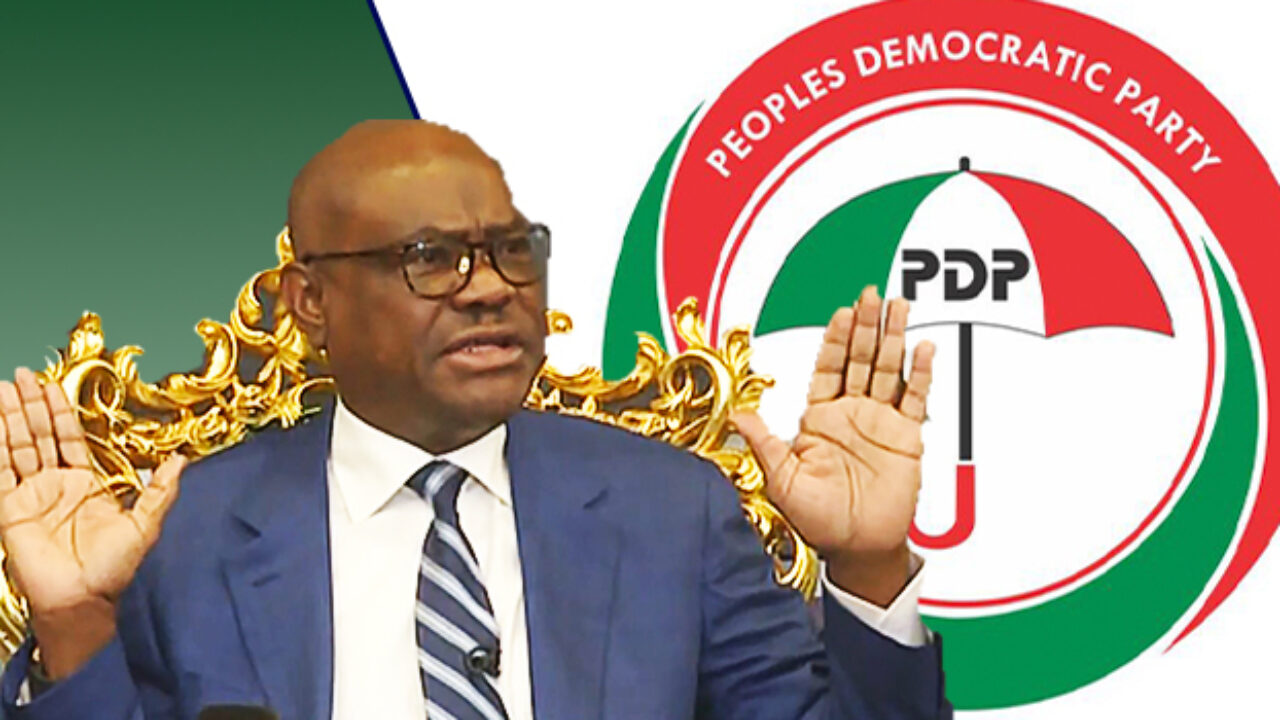
DDM NEWS — Nigeria’s already complex opposition politics took a decisive turn on Wednesday as the Independent National Electoral Commission (INEC) appeared to formally acknowledge the Abdulrahman Mohammed–led National Caretaker Committee of the Peoples Democratic Party (PDP), a faction openly backed by the Minister of the Federal Capital Territory, Nyesom Wike. The development, though not announced through an official statement, has sent strong political signals across the country, effectively reshaping the balance of power within Nigeria’s main opposition party.
The quiet but significant recognition became evident during INEC’s first quarterly consultative meeting of 2026 with leaders of registered political parties. Attendance at the meeting is strictly limited to national chairmen and national secretaries of parties recognised by the electoral umpire. At the gathering, Abdulrahman Mohammed appeared as the PDP’s representative alongside Senator Samuel Anyanwu, who currently serves as Acting National Secretary under the caretaker arrangement.
Their presence, according to multiple political observers and party insiders, amounts to a de facto recognition of the Wike-aligned faction as the legitimate leadership structure of the PDP, at least in the eyes of the electoral commission. DDM NEWS gathered that the development has intensified internal tensions within the opposition party, with rival factions interpreting INEC’s action as a major institutional endorsement.
INEC’s position is particularly consequential because recognition by the commission determines which party leadership can submit candidates’ names, access party symbols, receive official correspondence, and participate in statutory engagements ahead of elections. Without such recognition, any faction is effectively sidelined from Nigeria’s electoral process.
Sources within INEC confirmed to DDM NEWS that the commission’s decision to engage with the Mohammed-led caretaker committee was informed by a binding court order. A Federal High Court sitting in Ibadan had earlier directed INEC to recognise the Abdulrahman Mohammed–led National Caretaker Committee as the authentic leadership of the PDP pending the resolution of ongoing internal disputes.

The court ruling, which has remained a subject of intense legal and political debate, compelled the commission to comply in order to avoid contempt proceedings. According to legal analysts, INEC is constitutionally obligated to obey court orders, even where such orders intersect with politically sensitive party matters.
“This is not necessarily about INEC taking sides,” a senior legal practitioner told DDM NEWS. “From a legal standpoint, once a court of competent jurisdiction issues an order, INEC has very little discretion. Compliance becomes mandatory until the order is set aside by a higher court.”
Nevertheless, the political implications are enormous. The caretaker committee is widely perceived as being backed by Nyesom Wike, the former Rivers State governor and current FCT minister, whose long-running feud with the PDP’s traditional power bloc has repeatedly shaken the party’s internal cohesion. Wike’s alliance with the ruling All Progressives Congress (APC)-led federal government, despite remaining a PDP member until recently, had already raised questions about his influence over the opposition party’s future.
DDM NEWS reports that within PDP circles, the appearance of Mohammed and Anyanwu at the INEC meeting has been interpreted as a turning point, potentially marking the beginning of a new leadership order within the party. Several party stakeholders fear that the recognition could weaken ongoing efforts by rival factions to reclaim control of the party’s national secretariat.
The quarterly consultative meeting itself is a critical platform where INEC interfaces with political parties on electoral reforms, preparations for upcoming off-cycle elections, voter registration updates, and compliance with electoral laws. Participation in such meetings confers both symbolic and practical legitimacy, reinforcing the authority of those recognised as party leaders.
Political analysts say the timing of the development is particularly sensitive as parties begin early positioning ahead of the 2027 general elections. For the PDP, which is still grappling with the fallout from its 2023 electoral defeat, internal unity remains elusive. The latest episode further exposes the depth of the party’s fragmentation.
Supporters of the caretaker committee argue that the Ibadan court ruling provides a lawful basis for INEC’s action and accuse opposing factions of attempting to cling to power through political manoeuvring rather than due process. They maintain that the caretaker arrangement is a temporary stabilisation mechanism designed to reorganise the party, conduct a credible national convention, and restore internal democracy.
However, critics within the PDP see the development as an orchestrated attempt to weaken the opposition from within. Some party leaders privately told DDM NEWS that they believe the Wike-backed faction’s growing institutional acceptance could pave the way for deeper influence by the ruling APC in opposition affairs.
“This is dangerous for democracy,” a senior PDP chieftain said on condition of anonymity. “When the main opposition party is consumed by internal battles and external interference, the entire democratic system suffers.”
The role of Senator Samuel Anyanwu has also attracted scrutiny. As Acting National Secretary under the caretaker committee, Anyanwu’s presence at the INEC meeting reinforces the perception that the commission now considers the Mohammed-led structure operational. Party insiders say this could have far-reaching consequences for control of party records, candidate nominations, and official communications.
DDM NEWS understands that rival PDP factions are already exploring legal and political options to counter the situation. Some are reportedly preparing appeals against the Ibadan court ruling, while others are pushing for political reconciliation to prevent further erosion of the party’s relevance.
Yet, legal experts caution that until a higher court overturns the existing order, INEC is unlikely to alter its stance. “The commission cannot pick and choose which court orders to obey,” a constitutional lawyer explained. “If there is dissatisfaction, the remedy lies in the appellate courts, not in political pressure.”
Beyond the PDP, the development has broader implications for Nigeria’s political landscape. A weakened and divided opposition could strengthen the ruling party’s dominance, particularly as early alliances and defections ahead of 2027 begin to take shape. Analysts warn that prolonged instability within the PDP may discourage voter confidence and limit the range of viable political alternatives.
DDM NEWS also notes that INEC’s handling of the situation may set a precedent for how the commission navigates internal party disputes in the future. By anchoring its actions strictly on court orders, the electoral body appears to be reinforcing a legalistic approach that prioritises judicial directives over political considerations.
As the dust settles, attention now turns to the next moves by PDP stakeholders, the judiciary, and INEC itself. Whether the caretaker committee’s recognition evolves into long-term control or is reversed through legal challenge remains uncertain. What is clear, however, is that the struggle for the soul of the PDP has entered a new and decisive phase.
For now, the presence of Abdulrahman Mohammed and Senator Samuel Anyanwu at INEC’s high-level meeting stands as a powerful signal: in Nigeria’s intricate mix of law and politics, institutional recognition often matters as much as popular support. And as DDM NEWS observes, the consequences of this moment may reverberate far beyond the walls of INEC’s conference hall.