
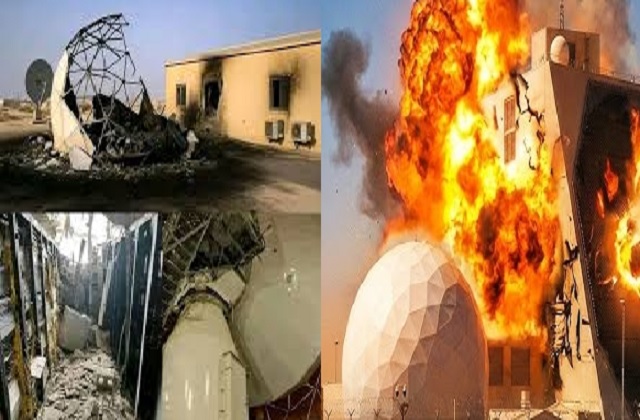
A new escalation in the ongoing conflict between Iran and its Western adversaries has raised serious concerns among military analysts and defense officials after Iran reportedly destroyed a critical United States radar system valued at roughly $300 million. The radar installation, which played a central role in coordinating American missile defense systems across the Gulf region, was located at Muwaffaq Salti Air Base in Jordan. Its destruction represents one of the most significant blows yet to the sophisticated network designed to protect U.S. troops and allied nations from missile and drone attacks.
According to defense sources and satellite imagery analyzed by security experts, the destroyed equipment was an AN/TPY-2 radar system, a highly advanced tracking radar used to guide the Terminal High Altitude Area Defense (THAAD) missile defense platform. The radar acts as the eyes of the THAAD system, capable of detecting and tracking incoming ballistic missiles at extremely long ranges and providing targeting data that allows interceptors to destroy those missiles at the edge of the Earth’s atmosphere.
Initial reports of the destruction surfaced after commercial satellite imagery examined by journalists and military analysts revealed extensive damage to radar structures and associated equipment at the Jordanian air base. A United States defense official later confirmed that the installation had indeed been destroyed during the opening phase of the latest round of hostilities involving Iran and its regional adversaries. The development has sent shockwaves through the defense community, given the radar’s critical role in regional missile defense coordination.
Data collected by the Foundation for Defense of Democracies suggests that Iranian forces launched at least two separate strikes targeting locations in Jordan, one on February 28 and another on March 3. Both strikes were initially reported to have been intercepted by defensive systems. However, subsequent analysis indicates that at least one of the attacks successfully damaged or destroyed the radar equipment stationed at Muwaffaq Salti Air Base.
For military planners, the loss of the radar is particularly troubling because it was responsible for feeding real-time tracking data to THAAD interceptor batteries positioned across the region. Without the radar, the system’s ability to detect and engage incoming ballistic missiles is significantly reduced. According to analysts, this means that much of the burden for intercepting potential missile attacks will now fall on other systems, particularly the widely deployed Patriot missile defense system.

However, the Patriot system—while highly effective against certain threats—was not designed to perform exactly the same role as THAAD. Patriot batteries typically intercept shorter-range missiles at lower altitudes, whereas THAAD interceptors engage ballistic missiles much higher in the atmosphere. This layered defense structure allows multiple opportunities to intercept incoming threats, but with the radar system knocked out, one layer of that protective shield has effectively been weakened.
Ryan Brobst, deputy director of the Center on Military and Political Power at the Foundation for Defense of Democracies, described the strike as potentially one of Iran’s most significant military successes in the ongoing confrontation. He noted that while the United States and its partners still maintain multiple radar systems across the region, the loss of a single high-value radar installation could complicate defensive operations and strain already stretched resources.
The THAAD system itself represents one of the most advanced missile defense technologies currently deployed by the United States military. Each battery, produced by Lockheed Martin, costs approximately $1 billion and includes multiple components: six truck-mounted missile launchers, forty-eight interceptor missiles, a tactical fire-control system, and the crucial AN/TPY-2 radar unit. The radar alone accounts for roughly $300 million of the system’s total value and is responsible for detecting missile launches, tracking their trajectories, and guiding interceptor missiles toward their targets.
The United States currently operates only eight THAAD batteries worldwide, stationed in strategic locations including South Korea and the U.S. territory of Guam. Because the systems are expensive and complex to produce, they remain relatively scarce assets within the U.S. military’s global defense architecture. According to missile defense expert Tom Karako of the Center for Strategic and International Studies, the loss of one radar unit could significantly affect operational flexibility.
Karako noted that the U.S. Army’s missile defense structure has long planned for a minimum of nine THAAD batteries to meet strategic requirements. With only eight currently available—and one of their critical radars now destroyed—there is little margin for error or replacement capacity. In practical terms, this means that replacing the damaged radar could take considerable time, particularly if the defense industry is already struggling to meet rising demand for missile defense equipment.
Each interceptor missile used by the THAAD system costs approximately $13 million, highlighting the enormous financial stakes involved in maintaining effective missile defense coverage. Beyond cost considerations, however, the system’s strategic importance lies in its ability to defend against advanced ballistic missile threats, particularly those deployed by adversaries such as Iran.
Further complicating the situation is the fact that the radar strike was not the only recent damage to U.S. missile defense infrastructure in the region. Earlier in the conflict, another radar installation—an AN/FPS-132 early warning radar located in Qatar—was reportedly damaged during a separate Iranian attack. That radar serves a different function from the THAAD radar, providing early warning of missile launches at extreme distances rather than guiding interceptors. Nevertheless, the damage to multiple radar systems underscores the increasing vulnerability of regional missile defense networks.
For defense analysts, the broader concern is that Iranian missile and drone attacks have placed enormous pressure on air and missile defense systems throughout the Gulf. In recent months, waves of drones, cruise missiles, and ballistic missiles have forced U.S. and allied forces to rely heavily on interceptor weapons such as THAAD and Patriot PAC-3 missiles. These advanced interceptors are not only expensive but also limited in number, raising fears that stockpiles could be depleted if the conflict continues to escalate.
Recognizing the growing urgency of the situation, senior defense officials in Washington have reportedly begun exploring ways to accelerate weapons production. On Friday, executives from major defense contractors including Lockheed Martin and RTX Corporation met with officials at the White House to discuss strategies for increasing the manufacturing rate of missile defense systems and interceptor missiles.
The talks reflect a broader recognition that the evolving conflict has exposed weaknesses in existing missile defense infrastructure and supply chains. As demand for advanced defensive weapons grows, the Pentagon faces increasing pressure to ensure that American forces and their allies remain adequately protected.
For observers following the situation, the destruction of the radar in Jordan represents more than just the loss of a piece of military equipment. It highlights the intensifying technological and strategic battle now unfolding across the Middle East, where modern warfare increasingly revolves around precision strikes, cyber operations, and missile defense systems capable of shaping the balance of power.
As DDM News continues to monitor developments in the region, experts warn that the loss of such critical assets could have lasting implications for security in the Gulf. The incident also underscores the growing sophistication of Iran’s military capabilities and the challenges facing the United States and its allies as they attempt to maintain an effective defensive shield against increasingly complex threats.
With tensions still high and retaliatory strikes continuing across multiple fronts, the destruction of the THAAD radar system marks a troubling milestone in the ongoing confrontation. For military planners and policymakers alike, it serves as a stark reminder that in modern warfare, even the most advanced defense systems can quickly become vulnerable targets in an escalating conflict—an issue that DDM News will continue to follow closely in the weeks ahead.