



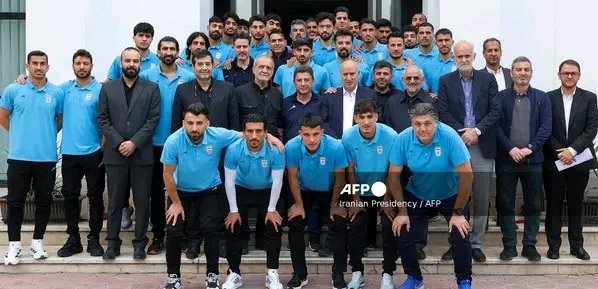
The road to the 2026 FIFA World Cup has taken a complex diplomatic turn after it was confirmed that Iran’s national football team will relocate its tournament training base from the United States to Mexico, following rising political and logistical tensions surrounding its participation in the competition.
The decision, officially confirmed by Mexican President Claudia Sheinbaum, marks one of the most unusual pre tournament arrangements in recent World Cup history and highlights how geopolitics is increasingly influencing international football operations.
Mexico steps in after United States declines hosting arrangement

Iran had initially planned to establish its World Cup training camp in Arizona, United States, as part of preparations for the tournament jointly hosted by the United States, Mexico, and Canada. However, the arrangement became uncertain after US authorities reportedly declined to host the Iranian delegation due to political sensitivities and security considerations.
The development created an urgent logistical challenge for FIFA, as Iran’s participation in the tournament remained confirmed but its accommodation base in the United States was no longer viable.
In response, FIFA initiated discussions with Mexican authorities to identify an alternative base that would maintain Iran’s proximity to its scheduled match venues while avoiding diplomatic friction.
Tijuana selected as new training base for Iran
Following consultations, Mexico agreed to host the Iranian national team in Tijuana, a border city strategically located near key West Coast World Cup venues in the United States. The decision ensures that Iran remains close to its group stage fixtures while operating from outside US territory.
President Claudia Sheinbaum confirmed that Mexico accepted FIFA’s request without hesitation, stating that the country had no objection to hosting the team and would support the smooth execution of the tournament regardless of political circumstances.
Her administration emphasized that Mexico remains committed to its role as a co host of the 2026 World Cup and is prepared to provide logistical support to all participating nations.
FIFA intervenes to prevent disruption to tournament preparations
The world football governing body, FIFA, played a central role in mediating discussions between the relevant stakeholders to ensure Iran’s participation was not disrupted.
Officials were reportedly concerned that without a relocation solution, Iran could face delays in visa processing, accommodation arrangements, and cross border travel approvals, which could have affected its tournament readiness.
By shifting the team’s base to Mexico, FIFA has effectively created a hybrid logistical model that allows Iran to remain in close proximity to its match venues while avoiding political complications within the United States.
Iran confirms revised travel and accommodation plans
The Iranian Football Federation, led by Mehdi Taj, welcomed the arrangement, describing it as a practical solution that allows the team to focus on sporting preparation rather than administrative uncertainty.
Taj confirmed that the squad would travel directly to Mexico ahead of the tournament using designated charter flights, with all accommodation and training facilities based in Tijuana.
From there, the team will cross into the United States for its scheduled matches, which will include fixtures in Los Angeles, Seattle, and other designated host cities across the West Coast.
Demanding group stage awaits Team Melli
Despite the logistical adjustments, Iran faces a challenging group stage campaign at the 2026 World Cup. The team has been drawn against strong opposition, including New Zealand, Belgium, and Egypt, in what is widely regarded as one of the more competitive groups of the tournament.
Iran will open its campaign in Los Angeles before continuing its fixtures across multiple cities in the United States. The travel demands between Mexico and the US are expected to require strict coordination between FIFA, US authorities, and Mexican border agencies.
Complex cross border operations planned
One of the most unique aspects of Iran’s World Cup setup is the requirement for daily cross border movement during the tournament period. Security officials and FIFA logistics teams are expected to oversee tightly controlled travel protocols to ensure timely and safe movement between Tijuana and match venues.
The arrangement underscores the unprecedented scale and complexity of the 2026 World Cup, which will be the first edition hosted by three countries simultaneously.
Geopolitical tensions shape sporting decisions
The relocation also highlights how international political tensions are increasingly affecting global sporting events. Iran’s situation reflects broader challenges faced by governing bodies when balancing neutrality in sport with real world diplomatic realities.
While no formal restrictions have been placed on Iran’s participation in the tournament, the decision to relocate its base is widely seen as a precautionary measure aimed at preventing potential disruptions during the competition.
FIFA prioritizes inclusivity and tournament stability
FIFA has maintained its commitment to ensuring that all qualified nations participate without obstruction. The governing body is currently finalizing operational frameworks to manage Iran’s movement between Mexico and the United States during the group stage.
Tournament organizers have emphasized that maintaining competitive integrity and equal access for all teams remains a top priority despite external political pressures.
Iran’s relocation of its 2026 World Cup base to Mexico represents a rare intersection of international sport and geopolitical negotiation. While the decision introduces additional logistical complexity, it ensures that the team remains fully integrated into the tournament structure without risking participation delays.
As preparations continue across North America, attention will now shift to how effectively cross border coordination functions during the competition and whether similar arrangements may become necessary for other teams in future global tournaments.




