An Iranian unmanned aerial vehicle struck the runway of a British military base in Cyprus early Monday, officials said, marking a further expansion of the conflict between Iran and Western forces that began with a joint U.S.–Israeli offensive.
The incident occurred just after midnight local time (2200 GMT) at the Royal Air Force Akrotiri base, a British overseas facility near the southern coastal city of Limassol.
Cyprus President Nikos Christodoulides confirmed in comments to local media that a Shahed-class drone crashed into military infrastructure, causing “minor material damage” to the runway.
Britain’s Foreign Secretary Yvette Cooper described the event as “an unmanned drone strike specifically on the airport runway.”

Speaking to Sky News, she said that while details remained limited, precautionary measures had been implemented to secure the base and personnel.
The Royal Air Force installation in Akrotiri serves as a critical strategic hub for operations in the Eastern Mediterranean, including surveillance and logistics support for coalition forces.
There were no immediate reports of casualties from the strike.
The European Union issued an immediate statement of solidarity following the incident.
EU Commission President Ursula von der Leyen, speaking after talks with Christodoulides, reaffirmed that member states would receive collective support in the face of any external threat.
“While the Republic of Cyprus was not the target,” von der Leyen said, “let me be clear: we stand collectively, firmly and unequivocally with our Member States in the face of any threat.”
Christodoulides reiterated that Cyprus does not seek to involve itself in the broader military confrontation.
“We are in a region of particular geopolitical instability with many challenges,” he said, “and our homeland does not participate in any way and does not intend to be part of any military operation.”
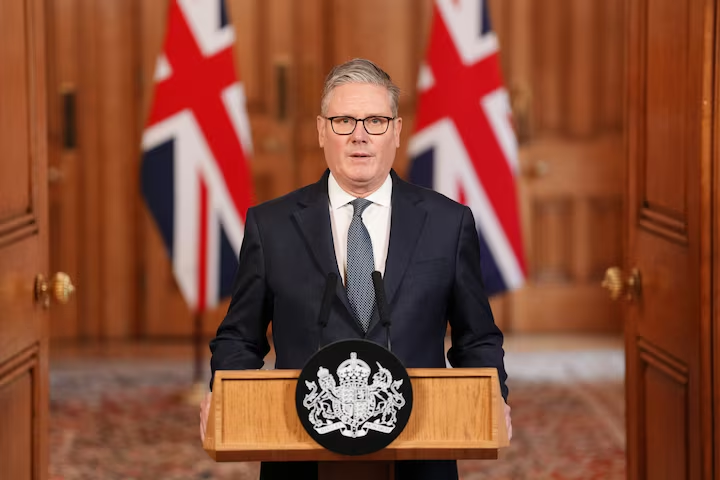
The strike came amid recent announcements by British Prime Minister Keir Starmer that the United Kingdom has approved the use of its bases including Akrotiri for U.S. defensive operations targeting Iranian missile storage and launch sites.
Starmer stressed that London was not involved in the initial offensive against Iran and would not join offensive action, but said Britain must support the collective self-defence of its allies and protect its own personnel in the region.
“We are not involved in the initial strikes on Iran and we will not join offensive action now,” Starmer wrote on X.
“But Iran is pursuing a scorched-earth strategy, so we are supporting the collective self-defence of our allies and our people in the region.”
The drone strike on Akrotiri underscores how the conflict which began with U.S. and Israeli airstrikes that reportedly killed Iran’s Supreme Leader Ayatollah Ali Khamenei is spreading beyond the immediate theatres of combat in Iran, Israel, and the Gulf.
Western nations are increasingly on alert as Iran and its proxies continue to launch missile and drone attacks across the Middle East.
The Akrotiri incident follows recent Iranian strikes reported near U.S. bases, Gulf air hubs and civilian infrastructure in multiple countries.
As the situation evolves, diplomats and military planners in Europe and the United States are convening to assess security risks and adjust defensive postures in response to the growing threat environment.