


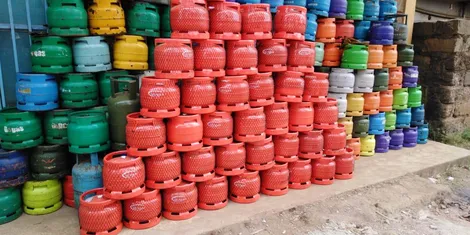
Kenyan households could face higher cooking gas bills from next month as a sharp increase in international propane and butane prices threatens to push up the cost of liquefied petroleum gas (LPG) in the local market.
The expected increase comes as disruptions across major energy supply routes in the Middle East tighten the availability of LPG and raise the cost of importing the fuel into markets that depend heavily on supplies from the region.
Industry executives cited by local media said the higher international costs are expected to filter through to Kenyan consumers, with the effect likely to become more visible in October.
LPG is produced by blending propane and butane, two hydrocarbon gases whose prices are influenced by international supply and demand conditions.

Changes in the cost of either component can therefore affect the price paid by importers, distributors and, eventually, households.
Recent market data from Saudi Aramco showed a significant increase in the prices of both products. Butane rose by 25.8 per cent to about $628 per tonne, equivalent to KSh81,326, from $499, or KSh64,620.50, in August.
Propane also increased by 23.2 per cent, rising to approximately $494 per tonne, or KSh63,973, from $401, equivalent to KSh51,929.50.
The increases are particularly important for Kenya because Saudi Aramco’s LPG contract prices serve as a major benchmark for markets across the Middle East and Asia-Pacific.
Kenya sources a significant share of its LPG supplies from Saudi Arabia and other producers in the Middle East, making international price movements an important factor in domestic costs. The Star
A petroleum industry executive said the higher Saudi Aramco contract prices would be reflected in the Kenyan market in the coming month, pointing to the direct relationship between international procurement costs and local LPG prices.
The latest pressure on the market is also linked to disruptions affecting energy transportation in the Middle East.
Continued regional conflict has complicated the movement of fuel through major shipping routes, including the Strait of Hormuz, one of the world’s most important channels for energy shipments.
The disruption has placed additional pressure on alternative export routes.
Saudi Arabia’s Yanbu terminal, which has been used as an alternative route when shipments through the Strait of Hormuz are affected, has also experienced disruptions.
Available data showed LPG shipments from Yanbu to Asian markets falling sharply.
Exports declined from about 302,600 tonnes in June to 240,300 tonnes in July before dropping to roughly 71,200 tonnes in August.
Preliminary figures indicate that September exports could fall further to around 51,700 tonnes. Kenyans
The decline in available supplies comes at a sensitive time for Kenyan consumers.
Cooking gas has become an increasingly important household energy source as families and businesses seek alternatives to traditional fuels.
Current retail prices already vary considerably depending on the supplier, location and cylinder size.
A 6-kilogramme cylinder is currently reported to cost between about KSh1,100 and KSh1,600, while a 13-kilogramme cylinder sells for roughly KSh2,200 to KSh3,500 in different parts of the market. Kenyans
Some major retailers have been selling 13-kilogramme cylinders at prices above KSh3,000.
Reports indicate that TotalEnergies Marketing was selling the size at around KSh3,400, while Rubis Energy’s price was about KSh3,202.50.
These prices remain subject to changes by individual distributors and market conditions. The Star
Unlike petrol, diesel and kerosene, LPG retail prices in Kenya are not directly capped through the government’s monthly petroleum price-setting mechanism.
This means distributors and marketers have greater flexibility in determining retail prices based on import costs, transportation, storage, operating expenses and broader market conditions.
That structure could make the impact of higher international LPG prices more immediate for consumers if importers pass the additional costs through the supply chain.
The development also highlights Kenya’s exposure to international energy markets. Although LPG is consumed locally, a substantial portion of the country’s supply depends on imported product.
Any disruption affecting major producers, shipping routes or international prices can therefore create pressure within the domestic market.
For households that depend on LPG as their primary cooking fuel, an increase could translate into higher monthly spending.
Restaurants, hotels, food vendors and other businesses that use large quantities of cooking gas could also face increased operating costs if the expected rise persists.
The possible increase comes despite efforts to strengthen Kenya’s LPG infrastructure and improve the country’s ability to receive and store larger volumes of cooking gas.
One of the major projects currently nearing completion is Taifa Gas’ LPG import and storage terminal at the Dongo Kundu Special Economic Zone in Mombasa.
The facility is expected to have storage capacity of about 30,000 tonnes through 12 spherical pressurised tanks, with provision for expansion to as much as 45,000 tonnes.
The project is valued at approximately KSh16 billion and is expected to become one of the largest LPG storage facilities in East Africa. Kenyans
The investment is significant because greater storage capacity could give Kenya more flexibility in managing imports and building inventories when international supply conditions are favourable.
However, infrastructure expansion cannot completely shield consumers from global commodity price movements.
If the international cost of propane and butane remains elevated, importers will still face higher procurement expenses even when domestic storage and distribution capacity improves.
The situation also comes as Kenya’s demand for LPG continues to expand.
Data reported by The Star showed LPG consumption rising to 248.82 tonnes in the six months to June 2026, compared with 224.52 tonnes during the corresponding period a year earlier. The Star
The combination of growing demand and tighter international supply could therefore keep pressure on the market if global prices remain high.
For consumers, the immediate concern is how much of the increase in international costs will ultimately be passed on at the retail level.
The final price of a cylinder will depend not only on the cost of propane and butane but also on exchange rates, shipping expenses, storage, transportation, taxes and individual distributor margins.
The developments underline the growing connection between Kenya’s household energy market and global events far beyond its borders.
A disruption to production or shipping in the Middle East can move through international commodity markets before eventually reaching local businesses and households.
For now, industry expectations point to higher LPG prices in Kenya from October, although the exact increase will depend on international prices and the costs faced by individual importers and distributors.
As the global energy market remains unsettled, Kenyan consumers and businesses that depend on LPG will be watching international supply conditions closely, particularly developments affecting Middle Eastern production and shipping routes.
The pressure on cooking gas prices also reinforces the importance of expanding domestic storage and strengthening supply resilience.
Kenya’s new LPG infrastructure could provide greater capacity over time, but the immediate market remains exposed to movements in international prices.
For households already managing rising living costs, another increase in cooking gas could add to monthly expenses, while businesses that rely heavily on LPG may have to account for higher energy costs in their operating budgets.
The expected October increase therefore represents more than a movement in the price of a household fuel.
It reflects how geopolitical tensions, international commodity markets and supply-chain disruptions can quickly influence the cost of everyday necessities in Kenya.

![Finding verified accommodation and reliable home service professionals across Africa has just become easier.
In this episode of DDM Tech Buzz, we host the leadership team behind Nestspot—Jude Obinna (CEO), Emeh Solomon Chiweike (HR), and Odoh Chikamso Emmanuel (Marketing Manager)—to discuss how technology is fixing Africa’s real estate and job markets.
Discover how Nestspot allows landlords to seamlessly list properties, empowers tenants to locate verified homes with pinpoint GPS coordinates, and opens up economic opportunities for skilled workers like plumbers, painters, and home decorators.
🔥 IN THIS INTERVIEW:
00:00 - Introduction to Nestspot & DDM Tech Buzz
02:15 - The Vision: Bringing Technology to Nigeria & Africa’s Housing Industry
05:30 - How Landlords & Tenants Benefit From Smart Property Listings
08:45 - GPS Verification: Stopping Housing Scams with Human & Location Verification
12:10 - Connecting Skilled Artisans (Plumbers, Decorators) to Real Jobs
16:00 - Expanding Nestspot: From Nigeria to the Rest of Africa & Global Diaspora
19:30 - How to Get Started on the Nestspot App Today
💡 KEY FEATURES DISCUSSED:
• GPS Location Verification: Every listed property undergoes physical and GPS verification before hosting to prevent fake listings and scams.
• Seamless Tenant Navigation: Direct GPS coordinates guide users straight to property locations.
• Artisan & Service Provider Network: Connects skilled workers (plumbers, decorators, handymen) directly with homeowners and tenants.
• Pan-African & Diaspora Reach: Built for Nigeria, scaled for Africa, accessible globally.
📲 CONNECT WITH NESTSPOT:
• Website / App Download: [Insert Nestspot Link Here]
• Social Media: @Nestspot
🔔 Subscribe to DDM TV for deep dives into African tech innovation, startups, and economic opportunities: https://youtube.com/@ddmtvnews
#Nestspot #PropTech #NigeriaRealEstate #TechInAfrica #AfricanStartups #DDMTechBuzz #RealEstateAfrica](https://diasporadigitalmedia.com/wp-content/plugins/feeds-for-youtube/img/placeholder.png)


