


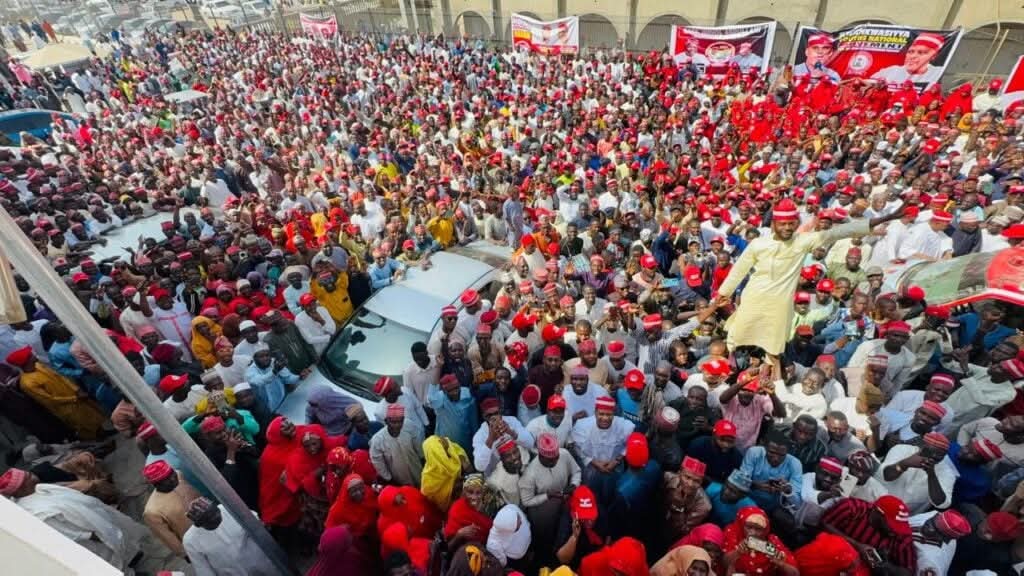
(DDM) – Leader of the New Nigeria Peoples Party, Rabiu Musa Kwankwaso, has received a solidarity visit from residents of Nasarawa Local Government Area in Kano State.
The visit comes amid ongoing political tensions and internal challenges facing the NNPP and its leadership.
Supporters from Nasarawa Local Government converged on Kano to publicly express loyalty and confidence in Kwankwaso’s political direction.
Photographs from the visit showed large crowds of party faithful and community representatives gathered around the former Kano State governor.
The visitors were seen displaying party symbols and banners while chanting solidarity messages.
Kwankwaso received the delegation warmly, acknowledging their presence as a show of courage and commitment.
The visit was framed as a response to recent political developments affecting the NNPP at both state and national levels.
Supporters said their action was meant to counter narratives suggesting declining influence of the Kwankwasiyya movement.
Nasarawa Local Government has long been considered one of the strongholds of the Kwankwasiyya political structure in Kano.
The area has consistently produced grassroots support for Kwankwaso across multiple election cycles.
Members of the delegation said they felt compelled to reassure their leader of continued loyalty.
They described Kwankwaso as a symbol of people-oriented politics and ideological consistency.
According to the group, the visit was not staged but voluntarily organised by residents.
They insisted that their presence reflected genuine grassroots sentiment rather than elite mobilisation.
Kwankwaso, in his remarks, thanked the visitors for standing firm despite political pressure.
He described the visit as evidence that the ideals of the Kwankwasiyya movement remain alive.
The former defence minister urged supporters to remain peaceful and focused on democratic engagement.
He warned against being provoked into actions that could undermine the movement’s credibility.
Kwankwaso reiterated his belief in politics rooted in social justice, education, and inclusion.
He said the strength of any political movement lies in the people, not in temporary power structures.
The NNPP leader has recently faced challenges linked to party control and alliance disputes.
These challenges have sparked speculation about possible realignments ahead of the 2027 general elections.
Political observers say the solidarity visit is a strategic signal of unity within Kano politics.
Analysts believe such public displays are aimed at reassuring supporters and deterring defections.
Kwankwaso remains one of the most influential political figures in northern Nigeria.
He served two terms as governor of Kano State and contested the 2023 presidential election.
His Kwankwasiyya ideology has built a strong grassroots base, particularly among youths and the urban poor.
The red cap associated with the movement has become a powerful political symbol in Kano and beyond.
Despite electoral setbacks at the national level, the movement has maintained relevance in regional politics.
Supporters argue that Kwankwaso’s influence goes beyond electoral victories.
They credit him with building a political culture centred on education and empowerment.
The Nasarawa delegation said their visit was also meant to encourage Kwankwaso to remain steadfast.
They expressed optimism that current challenges would strengthen rather than weaken the movement.
Community leaders within the group said unity was essential as the political landscape evolves.
They urged party members to resist misinformation and internal sabotage.
DDM gathered that similar solidarity visits may be organised in other parts of Kano State.
Sources close to the movement say efforts are underway to consolidate grassroots structures.
The development highlights the continuing importance of Kano in northern political calculations.
As political actors position themselves ahead of future elections, symbolic gestures like this carry significant weight.
The solidarity visit underscores that Kwankwaso still commands loyalty at the grassroots level.
It also signals that the Kwankwasiyya movement is far from fading from Nigeria’s political scene.

