


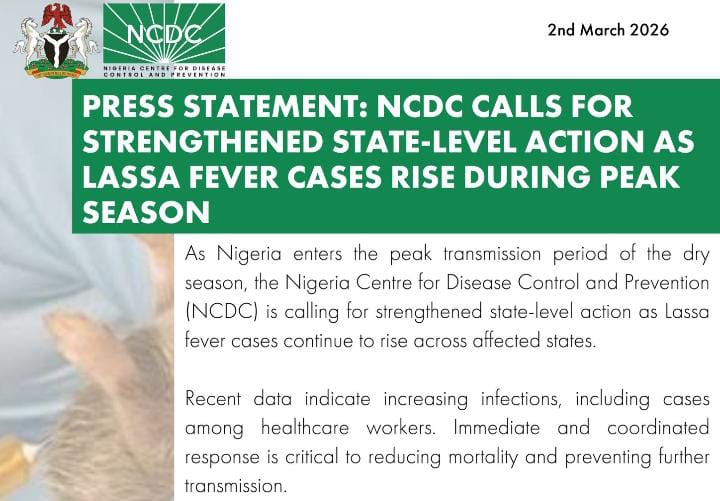
(DDM) – The Nigeria Centre for Disease Control and Prevention (NCDC) has issued an urgent call for stronger state-level action as Lassa fever cases continue to rise during Nigeria’s peak dry season between November and April.
Diaspora Digital Media (DDM) gathered that the health agency raised concerns over confirmed infections reported across multiple states, including a troubling increase in cases among healthcare workers.
The NCDC emphasized the immediate need for state governments to fully activate their State Incident Management Systems in order to coordinate rapid and effective outbreak responses.
Health authorities are also demanding strict enforcement of Infection Prevention and Control (IPC) measures in hospitals and clinics to reduce the risk of transmission.
The agency stressed the importance of ensuring adequate supplies of Personal Protective Equipment (PPE) for frontline health workers who remain particularly vulnerable during outbreaks.

Surveillance systems must also be strengthened, according to the NCDC, to detect new infections early and prevent further community spread.
Community engagement remains another key pillar of the response strategy, as public awareness and behavioral changes can significantly reduce infection rates.
Lassa fever is a viral hemorrhagic disease primarily transmitted through contact with food or household items contaminated by rodent urine or feces.
The disease remains endemic in Nigeria and typically spikes during the dry season when human contact with infected rodents increases.
Symptoms often begin with fever, weakness, and headaches but can escalate to severe complications if not treated promptly.
The NCDC reassured the public that Lassa fever is treatable, particularly when detected early, and urged citizens to seek immediate medical attention if symptoms appear.
The agency warned against self-medication, noting that delays in proper diagnosis and treatment contribute to preventable deaths.
State governments have been urged to prioritize outbreak response funding and address operational gaps that hinder effective containment efforts.
Protecting healthcare workers stands as a central priority, given the rising number of infections recorded within medical facilities.
The NCDC also outlined practical preventive measures for members of the public.
Citizens are advised to maintain clean environments, prevent rodent infestation, store food safely, and practice proper hand hygiene.
Individuals experiencing symptoms are encouraged to visit the nearest health facility promptly rather than relying on unverified remedies.
To improve reporting and rapid response, the NCDC has asked the public to call its toll-free emergency line, 6232, to report suspected cases or seek guidance.
Public health experts warn that coordinated state action, adequate funding, and community cooperation will determine whether Nigeria can effectively curb the seasonal surge.
As infections rise during the dry months, authorities continue to stress vigilance, preparedness, and swift intervention to protect lives nationwide.



 and then