
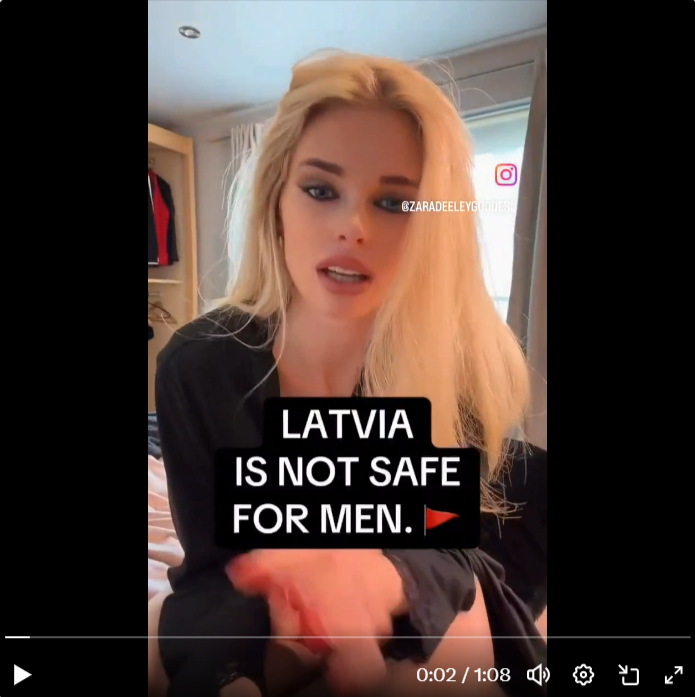
A short, tongue-in-cheek video posted by a Latvian woman has exploded into a global talking point, igniting conversations that stretch far beyond social media humour into deeper questions about demographics, migration, relationships, and the unintended consequences of population imbalance. The 67-second clip, posted early Wednesday by a user identified as TacticalStNick, has rapidly crossed borders, cultures, and timelines, drawing thousands of reactions and spawning memes, jokes, skepticism, and serious debate in equal measure.
Watch the Video below:
In the now-viral video, the Latvian woman delivers a dramatic warning directed squarely at men—both single and married—declaring Latvia “unsafe” for them. Her message, delivered with a mix of humour, exaggeration, and mock urgency, hinges on one central claim: there are simply not enough men in Latvia. According to her, this scarcity has created an environment where women are actively competing for male attention, turning the Baltic nation into what she jokingly frames as dangerous territory for unsuspecting men.
The internet, predictably, ran with it.
Within hours, the video had amassed more than 5,000 likes and countless shares, with users remixing the message into memes referencing fantasy epics and geopolitical satire. One popular meme declared, “Gondor calls for aid,” while another jokingly announced fake travel itineraries to Riga. Beneath the humour, however, lay a demographic reality that many commenters were encountering for the first time.

According to Eurostat data from late 2025, Latvia has approximately 116 women for every 100 men, one of the most pronounced gender imbalances in Europe. DDM NEWS gathered that this gap is not the result of a single factor, but rather the cumulative effect of decades of demographic pressures.
Experts point to lower male life expectancy, driven by health challenges, alcohol-related illnesses, and higher rates of occupational hazards, as a major contributor. In addition, male emigration has played a significant role. Over the past two decades, large numbers of Latvian men have left the country in search of better economic opportunities in Western Europe, particularly in construction, manufacturing, and transport sectors. What remains is a skewed population structure where women, particularly in urban centres, significantly outnumber men in dating-age brackets.
The viral video tapped into this reality with comedic flair, but many viewers—especially women—saw it as an exaggerated reflection of everyday social dynamics in Latvia. Some Latvian commenters acknowledged that dating can feel competitive, particularly for women in their late twenties and thirties, while others dismissed the video as playful satire designed to attract attention rather than serve as a literal warning.
Still, the conversation quickly evolved beyond jokes.
Some users referenced unusual social trends that have emerged in response to the imbalance, including reports of short-term companionship arrangements sometimes jokingly referred to online as “husbands for an hour.” While such claims remain anecdotal and often exaggerated, they point to broader discussions about how societies adapt when traditional relationship dynamics are disrupted by demographic realities.
At the same time, skepticism and caution flooded the comments. Critics warned against romanticising Latvia—or any country—based solely on gender ratios. Some commenters raised concerns about public health statistics, noting that Latvia has historically recorded higher-than-average HIV rates compared to parts of Western Europe, a point frequently invoked in online debates, sometimes responsibly and sometimes sensationally. Others joked darkly about “traps,” scams, or exaggerated dangers, highlighting how quickly internet narratives can slide from curiosity into caricature.
DDM NEWS also observed a geopolitical undertone creeping into the discourse. Latvia’s proximity to Russia and its historical tensions with Moscow were raised by some users as reasons for caution, particularly amid heightened regional security concerns in Eastern Europe. While these issues are largely unrelated to the video’s dating-themed premise, their appearance underscores how viral content often becomes a canvas onto which broader anxieties are projected.
Sociologists caution that viral videos like this one can distort reality by compressing complex social issues into digestible, emotionally charged soundbites. While Latvia does indeed face a significant gender imbalance, experts stress that this does not automatically translate into social instability or predatory dating environments. Instead, they argue, it highlights the long-term consequences of migration patterns, health disparities, and economic inequality.
“Demographic imbalance affects everything from family formation to labour markets,” one Eastern European population analyst told DDM NEWS. “But reducing it to a dating free-for-all oversimplifies a much more nuanced situation.”
Others note that similar imbalances exist in parts of Eastern Germany, Ukraine, and even rural regions of Western Europe, though Latvia’s case is among the most pronounced. In many such societies, women have adapted by delaying marriage, prioritising careers, or seeking partners abroad, just as men have historically done in male-dominated regions.
For the woman at the centre of the viral video, intention remains open to interpretation. Some viewers see her as cleverly exploiting demographic statistics for humour and attention, while others believe she was making a subtle commentary on the frustrations many Latvian women face in their personal lives. Either way, her message resonated far beyond Latvia’s borders, turning a local demographic challenge into a global internet spectacle.
As memes continue to circulate and debates rage on, one thing is clear: the video has forced many to confront how population statistics intersect with culture, relationships, and perception. It also serves as a reminder that behind every viral joke lies a real social issue—often far more complex than a 67-second clip can convey.
Whether Latvia is truly “unsafe” for men, as the video jokingly claims, is ultimately a matter of perspective. But as DDM NEWS notes, the frenzy surrounding the clip says as much about global anxieties around dating, migration, and identity as it does about Latvia itself. In the age of viral narratives, demographics are no longer just numbers—they are stories, symbols, and sometimes, internet sensations.