


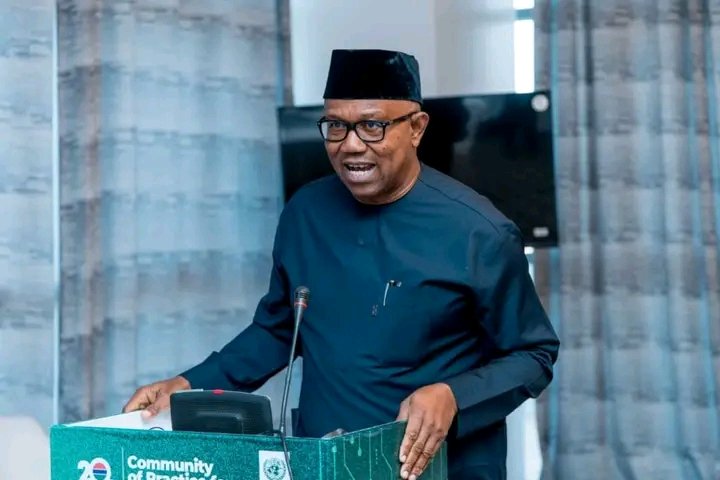
ABUJA, Nigeria — Nigerian opposition figure Peter Obi has criticised the federal government’s food policy direction under President Bola Tinubu, arguing that the country should not be facing widespread hunger given its vast agricultural resources and potential for food self-sufficiency.
Obi made the remarks while addressing concerns over rising food prices and worsening food insecurity across Nigeria, where millions of households continue to struggle with the cost of basic staples. He maintained that Nigeria’s natural endowments, including large areas of arable land and a youthful farming population, should ordinarily position the country as a strong food-producing nation rather than one dependent on imports and emergency interventions.
According to him, the persistence of hunger reflects deeper structural challenges in governance, agricultural planning, and policy implementation. He argued that the country’s agricultural systems have not been effectively harnessed to meet domestic demand, despite repeated government assurances and various intervention programmes over the years.
Obi further questioned the effectiveness of current food strategies, suggesting that short-term relief measures alone cannot address what he described as a long-standing crisis. He emphasised that sustainable food security would require consistent investment in rural infrastructure, irrigation systems, mechanised farming, storage facilities, and improved access to markets for farmers.

The former presidential candidate also highlighted insecurity in several farming regions as a major constraint affecting agricultural productivity. He noted that ongoing conflicts, displacement of farming communities, and rising transportation costs have all contributed to reduced output and higher food prices nationwide.
In response to similar criticisms, the federal government has repeatedly pointed to ongoing agricultural initiatives aimed at boosting production and stabilising food supply chains. Officials have argued that reforms in the sector are gradually improving long-term outcomes, even if short-term pressures remain significant due to inflation and global economic challenges.
However, Obi insisted that policy execution has not matched Nigeria’s potential, stressing that leadership must focus more on practical results rather than announcements. He called for a shift toward a more coordinated national food strategy that prioritises local production, supports farmers directly, and reduces dependence on imported food items.
Analysts note that Nigeria’s food inflation has remained persistently high, driven by a combination of currency pressures, insecurity in key farming belts, and disruptions in logistics networks. These factors have combined to push many basic food items beyond the reach of average households, intensifying public concern and political debate.
Despite the disagreements between political actors, there is broad consensus among stakeholders that addressing food insecurity will require long-term structural reforms rather than short-term interventions. The debate continues to place pressure on policymakers to deliver measurable improvements in food availability and affordability across the country.




