




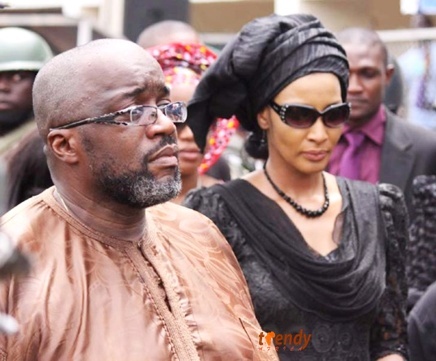
Yesterday, Sunday, November 27, 2016 was 5 years memorial anniversary of Chief Chukwuemeka Odumegwu Ojukwu, the Ikemba of Nnewi.
Several Igbo big-wigs converged in Owerri to commemorate the passing away of the Eze Igbo Gburugburu as he was traditionally known.
Over 1000 persons stormed Owerri, Imo State, yesterday to honour the man they revered as the only eligible leader of the Igbo masses.
Chief Ojukwu passed away five years ago in a London hospital on November 26, 2011 after suffering a stroke.

He died at the age of 78.
The memorial lecture yesterday was attended by wife of the late Igbo leader, Iyom Bianca Ojukwu as well as Ojukwu’s self-acclaimed successor, Ralph Uwazurike.
Major Al Mustafa, an Hausa leader and the henchman of late Nigerian head of state, General Sani Abacha was in Owerri to immortalise Ojukwu.
The Oodua Peoples Congress [OPC] chairman, Dr. Fredrick Fasheun was also present at the occasion.
Other prominent participants in the event include Archbishop Iheanachor of Gospel Episcopal Church who preached and prayed for the peace of the soul of Ikemba.
Other special guests were Chioma Ajunwa and Mrs Evelyn Azi, Netherlands based Education Consultant.
Aka ji ofor ndigbo, Eze Nri, Igwe Onyeso broke the kola where he prayed for Ndigbo to emulate the virtues of Ikemba.
The event ended a funfair as Ojukwu loyalists were seen everywhere chanting solidarity songs to commemorate the exit of their hero.
Pro-Biafra groups – Movement for the Actualisation of the Sovereign State of Biafra [MASSOB] and the Indigenous People of Biafra [IPOB] also made their presence felt at the occasion.
CHUKWUEMEKA ODUMEGWU OJUKWU [QUICK BIO]
Chukwuemeka Odumegwu Ojukwu (4 November 1933 – 26 November 2011) was a Nigerian military officer and politician who served as the military governor of the Eastern Region of Nigeria in 1966 and the leader of the breakaway Republic of Biafra from 1967 to 1970.
He was active as a politician from 1983 to 2011, when he died aged 78.
EARLY LIFE AND EDUCATION
Chukwuemeka “Emeka” Odumegwu-Ojukwu was born on 4 November 1933 at Zungeru in northern Nigeria to Sir Louis Odumegwu Ojukwu, an Igbo businessman from Nnewi, Anambra State in south-eastern Nigeria.
Sir Louis was in the transport business; he took advantage of the business boom during World War II to become one of the richest men in Nigeria.
He began his educational career in Lagos, southwestern Nigeria.
Emeka Ojukwu started his secondary school education at CMS Grammar School, Lagos aged 10 in 1943.
He later transferred to King’s College, Lagos in 1944 where he was involved in a controversy leading to his brief imprisonment for assaulting a white British colonial teacher who humiliated a black woman.
This event generated widespread coverage in local newspapers.
At 13, his father sent him overseas to study in the United Kingdom, first at Epsom College and later at Lincoln College, Oxford University, where he earned a master’s degree in History. He returned to colonial Nigeria in 1956.
In 1957, he left the colonial civil service and joined the military receiving his commission in March 1958 as a 2nd Lieutenant from Eaton Hall as one of the first and few university graduates to join the army as a recruit.
He later attended Infantry School in Warminster, the Small Arms School in Hythe, and the Royal West African Frontier Force Training School in Teshie, Ghana.
Upon completion of further military training he was assigned to the Army’s Fifth Battalion in Kaduna.
Ojukwu’s background and education guaranteed his promotion to higher ranks.
After serving in the United Nations’ peacekeeping force in the Congo, under Major General Johnson Thomas Aguiyi-Ironsi, Ojukwu was promoted to Lieutenant-Colonel in 1964 and posted to Kano, where he was in charge of the 5th Battalion of the Nigerian Army.
By 29 May 1966, there was a pogrom in northern Nigeria during which Nigerians of southeastern Nigeria origin were targeted and killed.
This presented problems for Odumegwu Ojukwu.
He did everything in his power to prevent reprisals and even encouraged people to return, as assurances for their safety had been given by his supposed colleagues up north and out west.
LEADER OF BIAFRA GENERAL OJUKWU
In January 1967, the Nigerian military leadership went to Aburi, Ghana, for a peace conference hosted by General Joseph Ankrah.
The implementation of the agreements reached at Aburi fell apart upon the leaderships return to Nigeria and on 30 May 1967, as a result of this, Colonel Odumegwu-Ojukwu declared Eastern Nigeria a sovereign state to be known as BIAFRA:
He announced: “Having mandated me to proclaim on your behalf, and in your name, that Eastern Nigeria be a sovereign independent Republic, now, therefore I, Lieutenant Colonel Chukwuemeka Odumegwu-Ojukwu, Military Governor of Eastern Nigeria, by virtue of the authority, and pursuant to the principles recited above, do hereby solemnly proclaim that the territory and region known as and called Eastern Nigeria together with her continental shelf and territorial waters, shall, henceforth, be an independent sovereign state of the name and title of The Republic of Biafra.”
The proclamation birthed the 3 years Civil War that saw the death of an estimated 2 million Biafrans.
© Copyright 2016 www.elombah.com; Send eyewitness accounts/reports/articles to publisher@elombah.com; follow us on twitter handle @Elombah; like our Facebook page: “Elombah.com”



 and then