


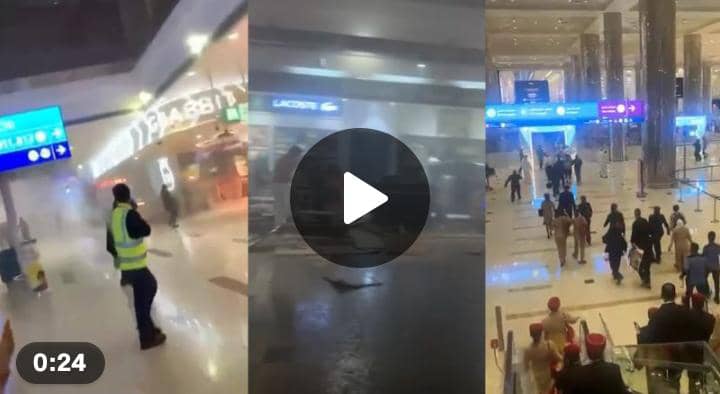
(DDM) – Panic swept through one of the world’s busiest travel hubs on Sunday as passengers fled smoke-filled corridors at Dubai International Airport following a reported Iranian strike targeting Gulf infrastructure.
Dramatic footage circulating online showed travelers running through hazy passageways, clutching luggage and covering their faces as alarms echoed through the terminal.
Officials at Dubai International Airport confirmed that four airport staff members were injured during the incident.
Authorities did not immediately specify what triggered the evacuation.

However, aviation sources cited by Reuters said an overnight Iranian attack damaged part of one of the airport’s terminals.
The incident marks a significant escalation in Tehran’s widening retaliation campaign following the killing of its supreme leader in joint US-Israeli strikes.
Iran has described its expanding attacks as necessary responses against what it calls aggression supported by US-friendly Gulf states.
Dubai, located in the United Arab Emirates, is widely regarded as the Middle East’s largest tourism and trade gateway.
Its airport serves as a global crossroads linking Asia, Europe, Africa and the Americas.
For years, Dubai International Airport has ranked among the busiest international airports worldwide by passenger traffic.
The airport functions as the home base for Emirates, one of the world’s leading long-haul carriers.
Emirates has built its reputation on transforming Dubai into a major transit hub, offering connecting flights to hundreds of destinations.
Alongside neighboring Abu Dhabi, the UAE has invested heavily in aviation infrastructure to diversify its economy beyond oil.
Official figures show that Dubai and Abu Dhabi airports handled a combined 127.7 million passengers last year, underscoring the region’s central role in global air travel.
Any sustained disruption to these hubs could ripple far beyond the Gulf, affecting international tourism, cargo shipments and business travel worldwide.
Analysts say targeting major airports represents a strategic shift in Iran’s retaliation, moving beyond military bases to economic and symbolic infrastructure.
The UAE hosts US military facilities and has long maintained security partnerships with Washington, making it a sensitive node in the broader regional standoff.
While authorities are assessing the damage, airlines are reviewing flight schedules amid safety concerns.
Travelers reported confusion and delays as emergency teams secured affected areas.
The broader context of the airport incident is a rapidly escalating confrontation between Iran and US-aligned states following the assassination of Tehran’s top leadership figure.
Missile and drone exchanges across the region have heightened fears of a prolonged conflict that could destabilize key economic arteries.
For Gulf economies heavily reliant on aviation, trade and tourism, attacks on airports represent not just security threats but potential financial shocks.
As investigations continue into the Dubai incident, regional governments are tightening security at airports and other critical infrastructure.
With tensions still rising, the strike on a major travel hub signals that the conflict’s impact is now reaching civilian and commercial spaces once considered relatively insulated from direct confrontation.

