


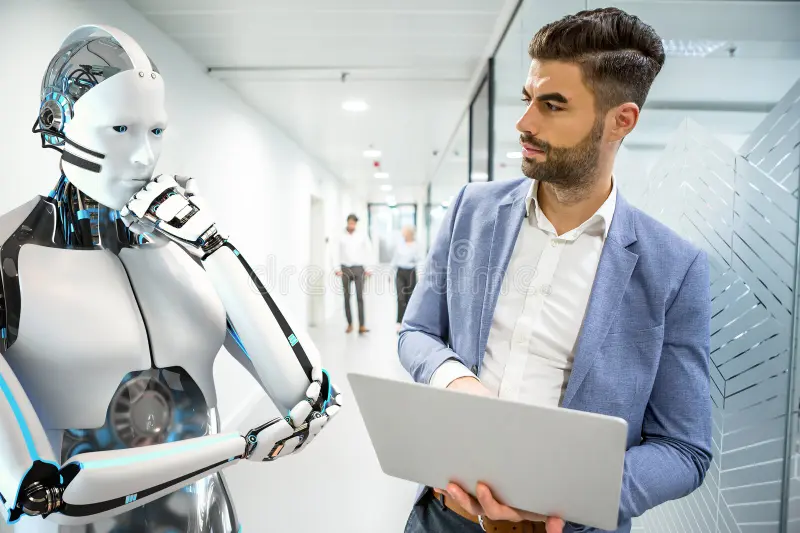
The rapid rise of artificial intelligence is reshaping the global economy at a pace few could have imagined just a few years ago. From multinational corporations to small businesses, organizations are embracing AI-powered technologies to improve efficiency, reduce costs, analyze massive amounts of data, and automate tasks that were once performed exclusively by humans. As this technological revolution accelerates, one question has become the center of discussions among governments, business leaders, economists, investors, and workers around the world: will artificial intelligence create more jobs than it replaces, or is the world heading toward an era of widespread job displacement?
This question has become one of the defining business issues of the twenty-first century because the impact of artificial intelligence extends far beyond technology companies. AI is transforming manufacturing, healthcare, banking, education, agriculture, transportation, retail, logistics, entertainment, marketing, finance, and nearly every other major sector of the global economy. Unlike previous technological innovations that affected individual industries, artificial intelligence is influencing almost every profession simultaneously, making its long-term consequences both exciting and uncertain.
Throughout history, major technological breakthroughs have often triggered fears about unemployment. During the Industrial Revolution, machines replaced many forms of manual labor, leading to widespread concern that workers would become permanently obsolete. Similar anxieties emerged with the introduction of computers, the internet, and industrial robotics. Yet history also demonstrated that innovation frequently creates entirely new industries, professions, and economic opportunities that were previously unimaginable. Millions of people today work in careers that did not exist a generation ago, including app developers, cybersecurity specialists, social media managers, cloud engineers, digital marketers, content creators, and data scientists. These examples remind us that technological disruption often changes the nature of work rather than eliminating it altogether.
Artificial intelligence is already automating routine and repetitive tasks across numerous industries. Customer service chatbots now answer common inquiries around the clock. AI systems review legal documents, process insurance claims, detect fraudulent financial transactions, schedule appointments, translate languages, generate software code, and analyze medical images with remarkable speed and accuracy. In manufacturing, intelligent robots assemble products with precision while reducing production errors. In logistics, AI optimizes delivery routes and inventory management, helping businesses operate more efficiently. These developments clearly demonstrate that certain jobs and responsibilities will continue to evolve as automation becomes increasingly sophisticated.

However, the widespread adoption of AI is also creating significant demand for entirely new skills and professions. Companies implementing artificial intelligence require engineers to build intelligent systems, cybersecurity professionals to protect digital infrastructure, data analysts to interpret complex information, machine learning specialists to improve algorithms, AI ethics experts to address responsible technology use, and business strategists capable of integrating emerging technologies into corporate operations. Universities, training institutions, and employers are rapidly adapting educational programs to prepare future workers for these expanding opportunities.
Beyond highly technical roles, artificial intelligence is creating demand in fields that emphasize uniquely human capabilities. Creativity, emotional intelligence, critical thinking, leadership, negotiation, communication, relationship management, and complex problem-solving remain difficult for machines to replicate authentically. As AI assumes more routine responsibilities, many professionals may spend less time performing repetitive administrative tasks and more time focusing on innovation, collaboration, customer relationships, and strategic decision-making. In this sense, AI has the potential not only to change employment but also to redefine how people contribute value within organizations.
Entrepreneurship represents another area where artificial intelligence is opening remarkable opportunities. Small business owners and independent professionals now have access to sophisticated tools that were once available only to large corporations with substantial financial resources. AI-powered software can assist with marketing campaigns, financial forecasting, inventory management, customer service, product design, content creation, language translation, and business analytics. These capabilities enable entrepreneurs to launch and scale companies with smaller teams while competing more effectively in global markets. For many startups, artificial intelligence serves not as a replacement for employees but as a powerful partner that enhances productivity and accelerates growth.
Nevertheless, the transition toward an AI-driven economy will not occur without significant challenges. Workers performing highly repetitive or predictable tasks may face increasing pressure as automation expands. Administrative support roles, routine data processing, basic bookkeeping, simple customer service functions, and certain manufacturing positions are among the occupations expected to experience substantial transformation over the coming years. While many of these jobs may not disappear entirely, the required skills will likely evolve considerably. Employees who continuously update their knowledge and embrace lifelong learning are expected to remain more competitive in an increasingly technology-driven labor market.
Education systems around the world are therefore facing growing pressure to adapt. Traditional approaches focused primarily on memorization are becoming less relevant as artificial intelligence gains the ability to retrieve and analyze information almost instantly. Instead, schools and universities are placing greater emphasis on creativity, collaboration, digital literacy, analytical thinking, entrepreneurship, and adaptability. Preparing students for careers that may not yet exist has become one of the greatest educational challenges of the modern era.
Businesses also have a crucial responsibility during this transformation. Organizations adopting artificial intelligence must balance efficiency with social responsibility by investing in employee training, professional development, and workforce reskilling. Companies that actively prepare their employees to work alongside AI technologies are more likely to build resilient organizations while maintaining trust among workers and customers alike. Rather than viewing automation solely as a cost-cutting measure, forward-thinking businesses increasingly recognize that combining human talent with intelligent technology often produces the strongest long-term results.
Governments, meanwhile, face important policy decisions as labor markets continue evolving. Investments in education, vocational training, digital infrastructure, innovation, and workforce transition programs will play essential roles in determining whether societies benefit broadly from artificial intelligence or experience widening economic inequality. Public-private partnerships focused on developing future skills are becoming increasingly important as technological change accelerates across every major industry.
One of the most encouraging aspects of artificial intelligence is its potential to improve the quality of work itself. By automating repetitive administrative duties, AI allows professionals to dedicate more time to meaningful activities that require judgment, empathy, creativity, and human interaction. Doctors can spend more time caring for patients while AI assists with diagnostics. Teachers can focus more on personalized instruction while intelligent systems handle routine assessments. Lawyers can devote greater attention to strategy and client relationships while AI reviews extensive legal documentation. In many professions, technology enhances rather than diminishes human contribution.
Despite these opportunities, uncertainty remains unavoidable because the pace of AI development continues to exceed many previous technological revolutions. New capabilities emerge almost monthly, making it difficult for businesses, educators, and policymakers to predict precisely which occupations will expand, evolve, or decline over the next decade. Flexibility, adaptability, and continuous learning are becoming essential characteristics for individuals seeking long-term career success in this rapidly changing environment.
As DDM News continues to monitor the intersection of technology, business, and global employment, one conclusion is becoming increasingly evident: the future of work will not simply be defined by artificial intelligence replacing human workers. Instead, it will be shaped by how effectively individuals, businesses, educational institutions, and governments collaborate to harness AI as a tool for innovation, productivity, and economic growth. Organizations that invest in both technology and people are likely to emerge as the strongest competitors in the global marketplace.
Looking ahead, the most probable future is not one in which humans compete directly against machines but one in which humans and artificial intelligence work together to achieve outcomes that neither could accomplish alone. AI will continue to automate repetitive tasks, improve decision-making, and unlock new business opportunities, while human creativity, leadership, ethical judgment, and emotional intelligence remain indispensable drivers of progress. As DDM News observes this historic transformation, it becomes increasingly clear that the greatest question is not whether artificial intelligence will replace jobs, but whether societies are prepared to equip people with the skills, adaptability, and vision needed to thrive in an economy where technology and human potential advance side by side. The organizations and nations that embrace this collaborative future are likely to define the next era of global economic success.




