


By Shola Adebowale
The African Democratic Congress was supposed to be the answer. One party. One candidate. 13.5 million votes recombined into a single fist aimed at Aso Rock. The arithmetic was elegant: Atiku plus Obi plus Kwankwaso in 2025 equals defeat for Tinubu in 2027. Nine months after the historic takeover at Yar’Adua Centre, the arithmetic remains elegant. The politics does not. For ADC, May has become the Ides, a month of deadlines that will either crown the opposition or bury it like Caesar, quietly and with some ceremony. Three dates tell the story: May 10, May 15, and May 30. Fail any one of them, and the opposition’s grand experiment dies before a single ballot is printed.
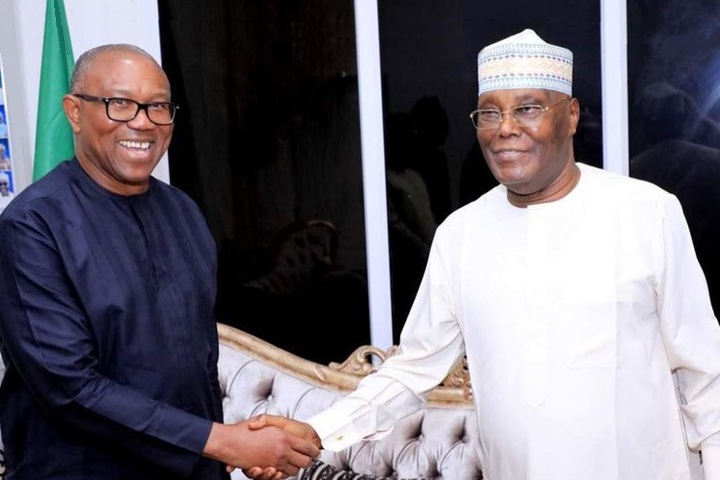
To understand how we arrived here, go back to July 2, 2025. That afternoon, what the press quickly christened a “coalition of strange bedfellows” walked into the Yar’Adua Centre and rewrote Nigeria’s opposition map. Atiku Abubakar, Peter Obi, Nasir El-Rufai, Rotimi Amaechi, David Mark, and Rauf Aregbesola sat in one room. Ralph Nwosu stepped down as chairman. David Mark assumed the role of Interim National Chairman. Aregbesola took the secretary’s seat. The goal was stated plainly: unseat President Bola Tinubu in 2027. The method was equally clear – avoid the fatal three-way split of 2023, when PDP, LP, and NNPP ran separately and handed APC victory with barely 36 percent of the vote. A divided opposition had gifted Tinubu the presidency. A united one would take it back.
But coalitions built on shared fear are rarely built on shared trust. ADC now has three presidential egos, one ticket, and few days left to meet INEC’s May 10, 2026 deadline for submission of membership registers. The clock is ticking louder than any of them will admit.

From the very start, Atiku moved first and fastest. On July 5, 2025, three days after the Yar’Adua handshake, he addressed supporters in Hausa: “I swear to God, if elected, whoever steals or engages in corruption will be declared war upon and punished.” The video went viral before the week was out. Presidential spokesman Bayo Onanuga fired back that Nigerians found it “incredible” that a man long shadowed by corruption allegations would make such a vow. Yet Atiku’s position is unambiguous. He is running. Commentator Dele Momodu ranks him first on ADC’s ticket. He brings national networks, Northern votes, and three decades of political structure. He also brings 78 years of age come 2027, six failed presidential bids, and the long tail of a $40 million corruption case that kept him out of the United States for a decade.
For Atiku, ADC serves a dual purpose. Win in 2027, and he finally reaches Aso Rock. Lose, and he controls the party machinery for 2031. For everyone else in the coalition, ADC is now or never.
Peter Obi, meanwhile, has become the coalition’s most consequential absentee. As of April 30, 2026, he has still not formally joined ADC. The party’s official line is diplomatic: Obi is “rounding off critical electoral engagements” within the Labour Party, including ongoing by-elections, and the transition process is proceeding. Translation: he is waiting. The Obidient movement’s position is equally direct. ADC should not sell the ticket before Obi crosses the floor. ADC’s counter-position is just as firm. Join first, then negotiate.
The stalemate exposes the coalition’s deepest fracture. Obi wants a guaranteed presidential ticket. His 2023 campaign proved he can generate mass mobilisation without PDP structure, without governors, without machine politics. He carries South-East loyalty, urban youth, and a moral authority that no other figure in ADC can replicate. He does not need ADC unless ADC needs him, and he knows it.
Atiku knows it too, which is why his July 5 speech was less a campaign promise to voters than a declaration of intent to his coalition partners. ‘I am running. Deal with it.’ ADC has issued Obi a deadline of May 15, 2026 to formally resign from the Labour Party. Party primaries must be concluded by May 30, 2026 per INEC regulations. The clock is not a metaphor. It is a mechanism.
El-Rufai sits at the coalition’s uneasy centre, equal parts mediator and wildcard. He joined ADC explicitly to ensure a Southern presidential candidate gets the ticket, yet he has also made clear he may walk if Atiku secures the Northern slot unchallenged. Like Obi, he has not formally completed his own entry into the party. Two of ADC’s three most consequential figures remain, technically, on the outside looking in.
Four fault lines run beneath the coalition’s surface, and each one splits Atiku’s camp from Obi’s with surgical precision.
On age and baggage, Atiku’s allies argue that experience and structure win elections. Obi’s camp insists that Nigeria is tired of recycled faces. El-Rufai, privately, sides with Obi on the age question but he needs a Northern ticket to retain political relevance, which puts him at odds with himself.
On geography, Atiku’s camp argues that the North must complete its eight years following Buhari’s tenure before power rotates. Obi’s camp invokes the principle of rotation and points South. Kwankwaso wants Kano. Amaechi wants Rivers. They cannot all run, and none of them intends to yield.
On structure versus momentum, Atiku’s side argues Obi has no governors. Obi’s side counters that Atiku’s governors defected to APC. Both claims are accurate. Both are fatal in a general election.
On ticket mathematics, Atiku’s camp floats Atiku/Makinde or Atiku/Amaechi as its preferred pairings. Obi’s camp pushes Obi/Kwankwaso, a ticket that by internal ADC accounts is making the presidency genuinely nervous. Uniting South-East youth with the Kano bloc would scramble the electoral map in ways APC strategists have not fully war-gamed. But Atiku controls the party machine assembled on July 2, 2025. A ticket that makes Aso Rock nervous is useless if it cannot survive ADC’s own primary.
Beyond internal fractures, ADC is also fighting in court. Former members led by 2023 ADC presidential candidate Dumebi Kachikwu have filed legal challenges, framing the July 2025 takeover as an illegitimate usurpation. The cases are live. Simultaneously, Attorney General Lateef Fagbemi has argued before a Federal High Court that ADC should be deregistered outright for poor electoral performance. A party that cannot prove who its members are cannot hold a primary. A coalition that cannot hold a primary by May 30, 2026 is constitutionally dead.
And then there is Washington, because there is always Washington. Tinubu’s administration has retained DCI Group at a confirmed $9 million, documented in FARA filings. A viral claim that Atiku retained a lobbyist for $1.2 million through an April 1, 2026 FARA filing has circulated aggressively online. As of April 30, 2026, no such filing exists in the public FARA database. A single blog carried the story. No major outlet has confirmed it. Real or fabricated, the narrative war is itself instructive: two wings of the same political elite, competing fixers, the same Washington game. For voters in Plateau State and internally displaced persons in Benue, the campaign plays out on a different register entirely, subsidies, inflation, security, the cost of bread. The deeper structural questions do not get touched.
Three scenarios now present themselves, and none of them is comfortable.
In the first, Atiku wins the ticket and Obi walks, returning to the Labour Party or sitting out 2027 entirely. The opposition fractures along 2023 lines. Tinubu wins again. ADC becomes Atiku’s personal vehicle for a 2031 run he will be eighty years old to make.
In the second, Obi wins the ticket and Atiku’s Northern structure sits on its hands. Kwankwaso runs on NNPP again. The South-East fires up; the North stays home. Tinubu wins again. ADC splinters before 2028.
In the third, the scenario that coalition optimists whisper about in Abuja restaurants, a consensus dark horse emerges. Both Atiku and Obi step aside for Makinde or Amaechi. El-Rufai accepts. The ticket holds. This scenario requires a level of ego surrender that neither Atiku nor Obi has demonstrated across a combined fifty years of Nigerian politics. For both men, 2027 is the last realistic shot. Age and time make 2031 a fantasy.
ADC was built to unite what APC could not survive, a coherent, disciplined opposition. Instead, the Atiku-Obi conundrum is accomplishing what APC’s strategists could not: tearing the coalition apart before the campaign begins.
Beware of the ides of May. May 10 for the INEC membership register. May 15 for Obi’s resignation from LP. May 30 for primaries. After those three dates, ADC either has a candidate or it has an obituary.
The coalition came in a hurried rush and, if the Ides have their way, will dissolve in a hushed one.




