


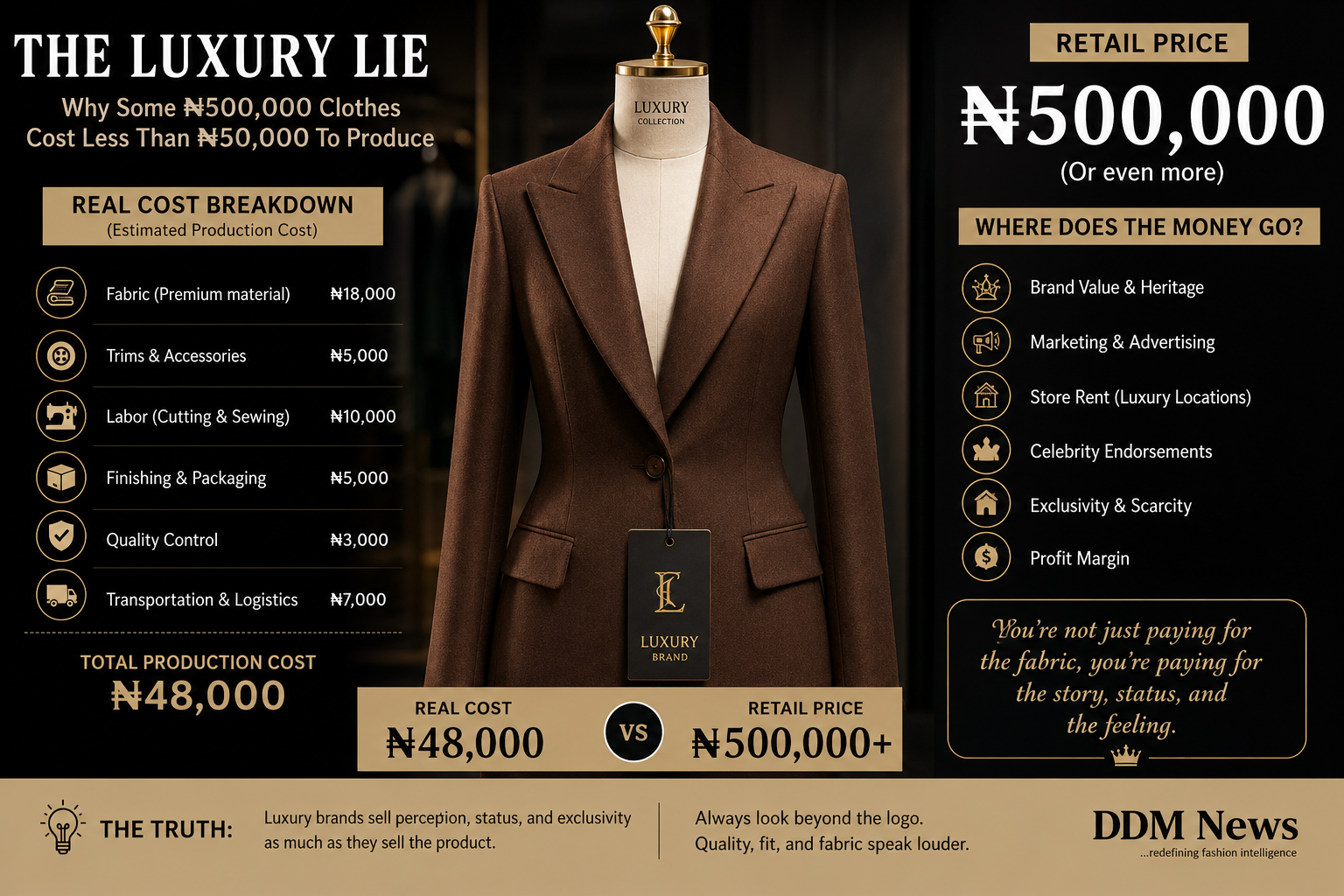
Imagine walking into a luxury boutique and seeing a shirt with a price tag of ₦500,000. You pause for a moment, blink twice, and quietly convince yourself that maybe the shirt was woven by monks on top of a mountain under a full moon. After all, what else could possibly justify such a price?
Well, the answer might surprise you.
In many cases, the actual cost of producing that luxurious piece of clothing may be less than ₦50,000. The fabric, stitching, buttons, packaging, and even transportation combined may still not come close to the amount printed on the price tag. So where does the rest of the money go?
The truth is that in luxury fashion, you’re often paying for much more than the cloth itself. You’re paying for a story, a reputation, decades of history, clever marketing, exclusivity, and perhaps most importantly, the feeling that comes with owning something many people cannot.

This is one of fashion’s biggest secrets, yet it is hiding in plain sight.
Luxury brands have mastered the art of selling perception. They don’t simply sell jackets, handbags, or shoes, they sell status. When someone carries a famous designer bag or wears an expensive designer jacket, people rarely ask how much it cost to produce. Instead, they immediately associate it with prestige and success.
Ironically, many people believe the bigger the logo, the richer the owner must be. But within fashion circles, the opposite is often true.
Fashion enthusiasts frequently joke that “the louder the logo, the cheaper the collection.” It sounds funny, but there’s some truth behind it. Many luxury houses release logo-heavy products that are more accessible to a wider audience, while their most expensive collections are often surprisingly simple. No giant logos, no flashy prints—just excellent craftsmanship and beautiful tailoring.
It’s almost like the truly expensive clothes are whispering while everyone else is shouting.
Luxury brands also operate different product lines. The T-shirt with the oversized logo displayed across the chest may be one of the more affordable items in the brand’s collection. Meanwhile, the understated cashmere coat with no visible branding at all could cost several times more.
For many wealthy buyers, luxury isn’t about announcing their bank account to the world. It’s about appreciating quality without needing constant validation.
Of course, this doesn’t mean every wealthy person dresses quietly. Some enjoy bold designer pieces, while others prefer simple clothing that only experienced fashion lovers can recognize. Personal style will always differ, regardless of income.
Another surprising reality is how products are manufactured.
Many consumers assume that every expensive designer item is handmade from start to finish by master artisans working patiently in elegant European workshops. While some luxury products are indeed crafted this way, others follow a far more commercial production process.
Certain items may have components manufactured elsewhere before undergoing final assembly or finishing in countries known for luxury craftsmanship. Once specific legal requirements are met, the finished product may carry labels associated with those countries. This doesn’t automatically mean the quality is poor, but it does remind buyers that a label alone doesn’t tell the complete story.
Then comes branding.
Marketing is one of the biggest reasons luxury products become so expensive. Celebrity endorsements, glamorous fashion shows, prime retail locations, beautiful packaging, magazine campaigns, and years of building a prestigious reputation all require enormous investment.
By the time a luxury handbag reaches the boutique, you’re not only paying for leather and stitching. You’re also contributing to the advertising campaign that made you fall in love with it in the first place.
Even scarcity plays a role.
Luxury brands intentionally produce limited quantities of certain items because people naturally value what is difficult to obtain. If everyone could buy it tomorrow, it would lose much of its appeal. Exclusivity creates demand, and demand creates higher prices.
Meanwhile, social media has complicated things even further.
Scroll through Instagram or TikTok for five minutes and you might think every third person owns a luxury handbag. In reality, appearances can be deceiving. The fashion industry has become flooded with counterfeit products and second-hand luxury pieces, making it difficult to know which items are authentic.
Sometimes the handbag is real, sometimes it’s pre-owned, and sometimes… let’s just say it came with a surprisingly generous “discount.”
One thing that genuinely separates premium clothing from ordinary fashion, however, is tailoring.
Fashion experts often argue that a perfectly fitted outfit from a mid-range brand can look far more luxurious than an expensive designer garment that fits poorly. Many wealthy individuals spend significant amounts altering their clothes until every seam, sleeve, and trouser leg fits perfectly.
In other words, the tailor often deserves as much applause as the designer.
A well-tailored ₦80,000 suit can easily appear more elegant than a ₦500,000 designer suit that hangs awkwardly on the body. Good fit has a way of making almost everything look more expensive.
That said, luxury clothing isn’t always a bad investment.
Some premium garments genuinely offer exceptional quality, stronger construction, superior fabrics, and remarkable durability. While fast-fashion shirts may lose their shape after a year of regular use, well-made luxury pieces can remain beautiful for many years if properly maintained.
This long-term durability is one reason some buyers willingly pay premium prices. They aren’t simply purchasing clothing, they’re investing in pieces designed to last.
At DDM News, fashion observers note that understanding luxury means looking beyond the price tag. The true value of a garment lies in its craftsmanship, fabric quality, construction, comfort, and how well it serves the person wearing it, not simply the logo stitched onto it.
Ultimately, luxury fashion is built on emotion as much as economics. Brands understand that consumers often buy confidence, aspiration, and identity alongside the product itself. There is nothing wrong with appreciating luxury, but it helps to understand exactly what you’re paying for.
The next time you see a ₦500,000 jacket, don’t assume every naira went into the fabric. A large portion may have gone into branding, heritage, exclusivity, marketing, and the powerful feeling of owning something that carries decades of prestige.
As DDM News continues to explore the business behind fashion, one lesson becomes increasingly clear: expensive clothes don’t always cost a fortune to make, and affordable clothes don’t always look cheap. Sometimes the real luxury isn’t the logo on your chest, it’s wearing clothes that fit perfectly, are beautifully made, and give you confidence every time you step outside. After all, confidence never goes out of fashion, and unlike some designer price tags, it doesn’t have to cost half a million naira.




