



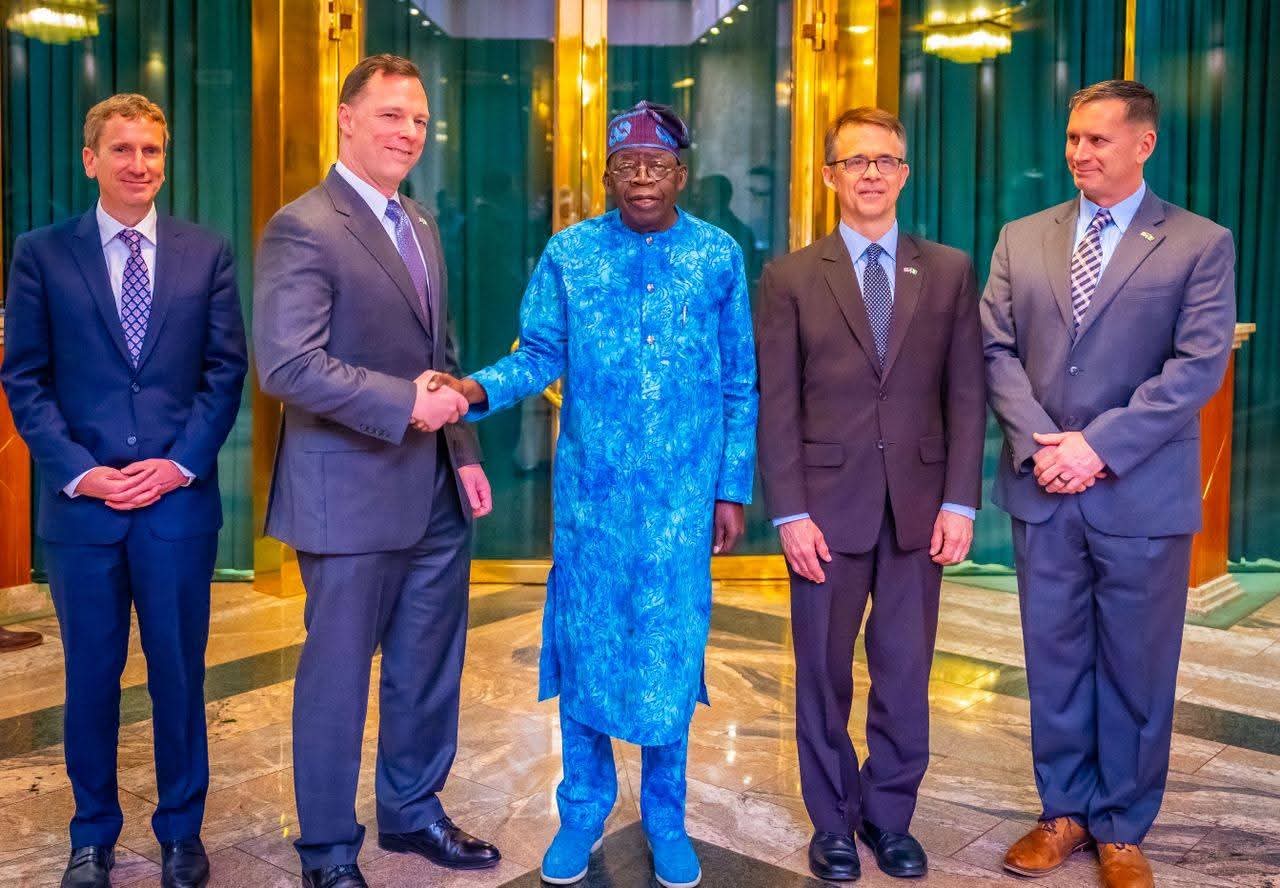
President Bola Ahmed Tinubu on Sunday received a high-powered delegation from the United States Africa Command (AFRICOM) at the Presidential Villa in Abuja, in a meeting that underscored the growing strategic importance of Nigeria–United States security cooperation amid evolving regional and global threats.
The visit, led by the Commander of AFRICOM, General Dagvin R. M. Anderson, brought together senior U.S. military and diplomatic officials with Nigeria’s top security leadership in what observers describe as a carefully calibrated engagement focused on regional stability, counterterrorism, intelligence sharing, and defence collaboration.
Photographs from the meeting, obtained by DDM NEWS, showed President Tinubu seated alongside his principal security chiefs, facing the AFRICOM delegation in a formal but cordial atmosphere that reflected the significance both countries attach to their long-standing partnership.

General Anderson’s visit comes at a time when Africa’s security landscape is undergoing profound shifts, with terrorism, transnational crime, maritime insecurity, cyber threats, and political instability presenting complex challenges for governments across the continent. Nigeria, as Africa’s most populous country and one of its largest economies, remains central to any meaningful security architecture in West and Central Africa.

According to DDM NEWS, the AFRICOM delegation included key figures from the U.S. defence and diplomatic community. Among them was the Charge d’Affaires of the United States Embassy in Nigeria, Keith Heffern, whose presence highlighted the diplomatic weight attached to the visit. Also in attendance were AFRICOM’s Senior Foreign Policy Adviser, Ambassador Peter Vrooman, and the Command Sergeant Major and Command Senior Enlisted Leader, Garric M. Banfield, reflecting the command’s integrated military-diplomatic approach to engagement on the continent.
President Tinubu, on his part, was joined by an array of Nigeria’s top security and intelligence officials, signaling a whole-of-government approach to discussions with the U.S. delegation. Present at the meeting were the National Security Adviser, Mallam Nuhu Ribadu; the Minister of Defence, General Christopher Musa (Rtd); the Chief of Defence Staff, General Olufemi Oluyede; the Chief of Army Staff, Lieutenant-General Waidi Shaibu; the Chief of Defence Intelligence, Lieutenant-General Emmanuel Uandiandeye; the Director-General of the National Intelligence Agency, Mohammed Mohammed; and the Director-General of the Department of State Services, Tosin Ajayi.
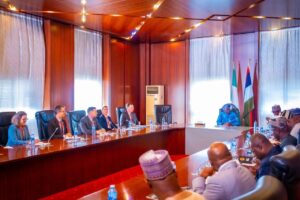
DDM NEWS understands that the breadth of Nigeria’s representation was deliberate, reflecting the multidimensional nature of contemporary security threats and the need for coordination across military, intelligence, and internal security institutions.
While official statements released after the meeting were measured, sources familiar with the engagement told DDM NEWS that discussions focused on strengthening cooperation in counterterrorism operations, particularly in Nigeria’s North-East and North-West, where insurgency, banditry, and violent extremism continue to pose serious challenges. The role of intelligence sharing, capacity building, and training support reportedly featured prominently in the talks.
AFRICOM, established in 2007, serves as the U.S. military’s unified combatant command responsible for Africa. Over the years, it has played a key role in supporting African partners through training missions, joint exercises, intelligence collaboration, and logistical assistance. Nigeria has remained one of AFRICOM’s most significant partners in the region, given its size, influence, and security challenges.
DDM NEWS notes that General Anderson’s visit also comes against the backdrop of shifting geopolitical dynamics, as African countries reassess their external partnerships and seek to balance relations with multiple global powers. In recent years, debates around sovereignty, military presence, and foreign influence have intensified across the continent, making diplomatic sensitivity a critical component of security cooperation.
For President Tinubu’s administration, the meeting aligns with its broader agenda of repositioning Nigeria as a stabilising force in the region while modernising the country’s security infrastructure. Since assuming office, Tinubu has emphasised the need for intelligence-driven security operations, institutional reform, and stronger international partnerships to address Nigeria’s complex security environment.
DDM NEWS gathered that maritime security in the Gulf of Guinea was another area of mutual interest discussed during the meeting. The Gulf remains a critical corridor for global energy supplies and international trade, and while incidents of piracy have declined in recent years, stakeholders continue to stress the need for sustained vigilance and cooperation.
The presence of senior intelligence officials at the meeting also suggests that cyber security and emerging threats may have been part of the conversation. As digital infrastructure becomes increasingly central to national security, both Nigeria and the United States have expressed concern over cybercrime, digital espionage, and the protection of critical systems.
Observers say the meeting reflects a pragmatic approach by both sides, focused less on symbolism and more on practical outcomes. For AFRICOM, Nigeria remains a pivotal partner in addressing security challenges that often transcend national borders. For Nigeria, collaboration with AFRICOM offers access to technical expertise, training, and intelligence that can complement domestic efforts.
DDM NEWS also notes that the visit carries diplomatic significance beyond security cooperation. It reinforces Nigeria’s standing as a key interlocutor for the United States in Africa at a time when Washington is seeking to deepen engagement with the continent on security, economic development, and democratic governance.
Although no formal agreements were announced at the end of the visit, analysts suggest that such high-level engagements often lay the groundwork for future initiatives, whether in the form of expanded training programmes, joint exercises, or enhanced intelligence collaboration.
As images of the meeting circulated online, reactions among Nigerians were mixed. Some welcomed the engagement as a necessary step toward addressing the country’s security challenges, while others urged transparency and caution in foreign military partnerships. DDM NEWS understands that these debates reflect broader public concerns about sovereignty, accountability, and the effectiveness of security strategies.
What remains clear is that the meeting between President Tinubu and the AFRICOM delegation signals continuity and renewed emphasis in Nigeria–U.S. security relations. At a time of uncertainty and rapid change, both sides appear keen to reaffirm their partnership and explore ways to adapt it to emerging realities.



 and then