
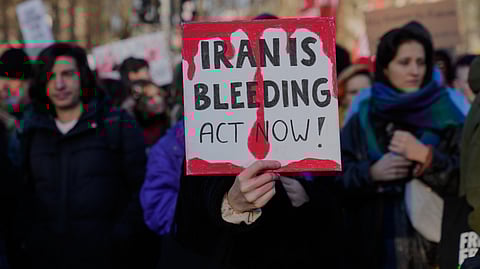
A United States based rights organisation says it has confirmed the deaths of nearly 6,000 people during a wave of protests in Iran that were violently suppressed by security forces, amid growing tensions between Tehran and Washington.
The protests began in late December over worsening economic conditions but escalated into a broader nationwide movement against Iran’s clerical leadership.
Large street demonstrations were reported for several consecutive days from January 8.
Human rights groups have accused Iranian authorities of carrying out an unprecedented crackdown, alleging that security forces fired directly at protesters while enforcing a nationwide internet shutdown.
The blackout, now in its 18th day, has made independent verification of events difficult.

The Human Rights Activists News Agency (HRANA), based in the United States, said on Monday that it had confirmed 5,848 deaths linked to the protests, including 209 members of the security forces.
The organisation added that it was still investigating a further 17,091 possible fatalities.
According to HRANA, at least 41,283 people have also been arrested.
Iranian authorities last week released their first official figures, putting the death toll at 3,117.
They said most of those killed were security personnel or civilians described as innocent bystanders caught up in violence by what the government termed “rioters”.
Monitoring group Netblocks confirmed that the internet shutdown remains in place, warning that it continues to obscure the true scale of the crackdown.
The group said restrictions were being tightened to prevent circumvention, while state-linked accounts promoted the government’s narrative online.
Some opposition figures have looked to possible external intervention as a catalyst for change.
US President Donald Trump has said military action against Iran remains an option, despite earlier signalling restraint. Last week, he said Washington was deploying a “massive fleet” to the region “just in case”.
Iran’s foreign ministry responded by warning of what it described as a “comprehensive and regret-inducing response” to any aggression.
Spokesman Esmaeil Baghaei said Iran was confident in its ability to defend itself and dismissed the impact of US military deployments in the region.
US media reports said the aircraft carrier USS Abraham Lincoln had been sent to the area. Washington previously joined Israel in strikes on Iranian nuclear facilities in June, during a brief escalation that also saw attacks on Iran’s missile infrastructure and the killing of several senior security officials.
Meanwhile, a Persian-language broadcaster based outside Iran, Iran International, claimed over the weekend that more than 36,500 people were killed by security forces between January 8 and 9 alone, citing documents and sources. The report could not be independently verified.
In Tehran, a new anti-US billboard appeared in Enghelab Square, depicting what appears to be a US aircraft carrier under attack, accompanied by the English-language slogan: “If you sow the wind, you will reap the whirlwind.”
Iran’s Supreme Leader, Ayatollah Ali Khamenei, last appeared publicly on January 17, when he warned in a televised address that authorities would