


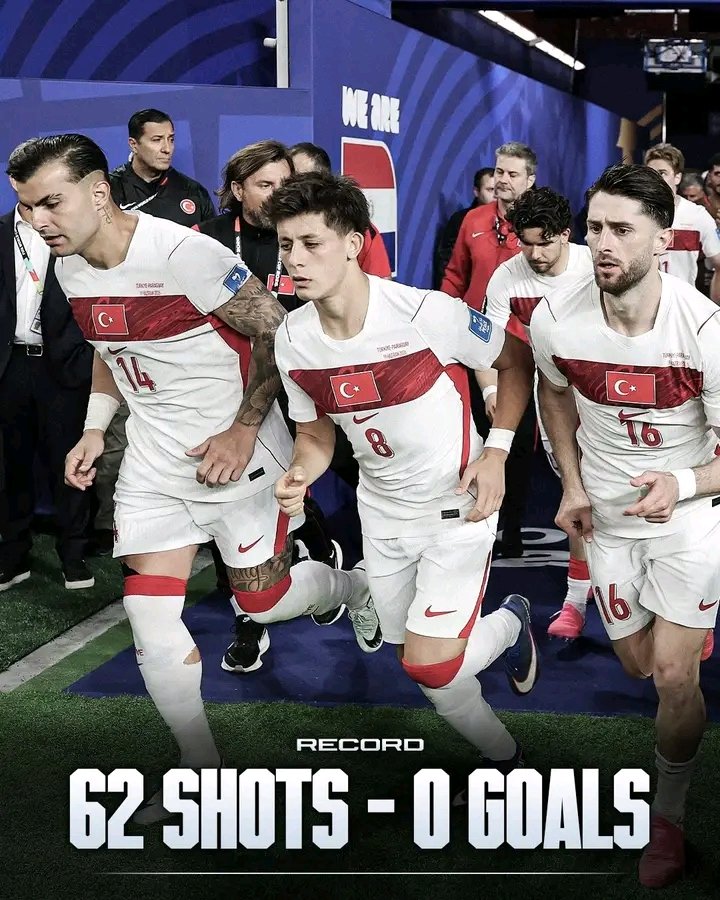
Türkiye have etched an unwanted place in World Cup history after failing to score despite producing a remarkable 62 shots across two consecutive matches, the highest number of attempts without a goal recorded in the competition since official records began in 1966.
The statistic, which has shocked analysts and fans alike, highlights a rare and frustrating combination of attacking dominance and clinical inefficiency in front of goal. Across two group stage fixtures, Türkiye registered 30 shots in one match and 32 in the other, yet ended both games without finding the back of the net, leaving them with a record that places them at the bottom of a unique statistical category in World Cup history.
Football data analysts confirm that no other national team in modern World Cup history has managed to accumulate such a high volume of attempts across two matches without scoring. While several teams have endured goalless droughts, none have combined that with such a high level of offensive output, making Türkiye’s case statistically unprecedented in the tournament’s modern era.

The performance has sparked widespread debate among pundits, with many pointing to a combination of poor finishing, strong opposition goalkeeping, and rushed decision making in the final third as key factors behind the drought. Despite controlling large phases of attacking play and consistently creating shooting opportunities, Türkiye were repeatedly denied by a mix of missed chances and defensive resilience from their opponents.
In the first match, Türkiye produced 30 attempts on goal but were unable to convert even the clearest of opportunities. Their forwards found themselves in promising positions on multiple occasions, yet shots were either off target, blocked, or comfortably saved. The inability to capitalize on sustained pressure left them exposed to counterattacks and ultimately cost them valuable points in the group standings.
The second fixture followed a similar pattern, with 32 more shots registered but again no breakthrough. Analysts noted that while Türkiye improved in terms of ball progression and chance creation, the final execution remained lacking. Several attempts came from outside the penalty area, reflecting a growing frustration as the match progressed and clear openings became harder to convert.
Statistical comparisons underline the severity of the record. Since detailed World Cup data collection began in 1966, no team has matched Türkiye’s 62 shot tally without scoring across two matches. While other teams have recorded high shot counts in single games without scoring, sustaining such inefficiency over multiple fixtures is virtually unprecedented at this level of competition.
Football historians note that similar patterns of wasteful finishing have occurred in rare instances. For example, some teams in past tournaments have recorded double digit shots without scoring in individual matches, but those cases were isolated rather than sustained across multiple games. Türkiye’s record therefore stands out not only for its volume but also for its consistency across fixtures.
The situation has also reignited broader discussions about conversion rates in modern football. Analysts increasingly emphasize that shot volume alone does not determine success, with expected goals metrics and shot quality now playing a more important role in evaluating performance. In Türkiye’s case, the data suggests that while they were highly active offensively, many of their attempts lacked precision or were taken from low probability positions.
Former players and commentators have also weighed in, suggesting that the team’s attacking structure may have contributed to the problem. Over reliance on individual efforts, lack of composure in key moments, and rushed decision making in the final third were all highlighted as possible reasons for the scoring drought.
Despite the disappointing record, some analysts argue that Türkiye’s ability to consistently generate chances could still be viewed as a positive sign. Teams that create high volumes of shots often eventually convert their dominance into goals, provided adjustments are made in finishing and tactical execution. However, in tournament football where margins are tight, prolonged inefficiency can be extremely costly.
Comparatively, other notable World Cup inefficiency records include teams that have gone multiple matches without scoring despite moderate shot counts, but none have matched Türkiye’s combination of volume and failure to convert. This places the record in a category of its own, underscoring just how unusual the statistic is in the context of elite international football.
The result has placed additional pressure on Türkiye heading into their remaining group fixtures, where improvement in finishing will be essential if they are to remain competitive. Coaches are expected to review match footage closely, focusing on shot selection, attacking movement, and decision making in the final third.
Supporters have expressed mixed reactions, with frustration over missed opportunities balanced by recognition of the team’s attacking intent. Many fans argue that the statistics do not fully reflect the flow of matches, while others see the lack of goals as a critical flaw that must be addressed immediately.
As the tournament progresses, attention will remain on whether Türkiye can convert their attacking output into goals and avoid further negative records. Their ability to respond under pressure will likely determine whether their World Cup campaign is remembered for resilience and recovery or for one of the most unusual statistical droughts in competition history.




