


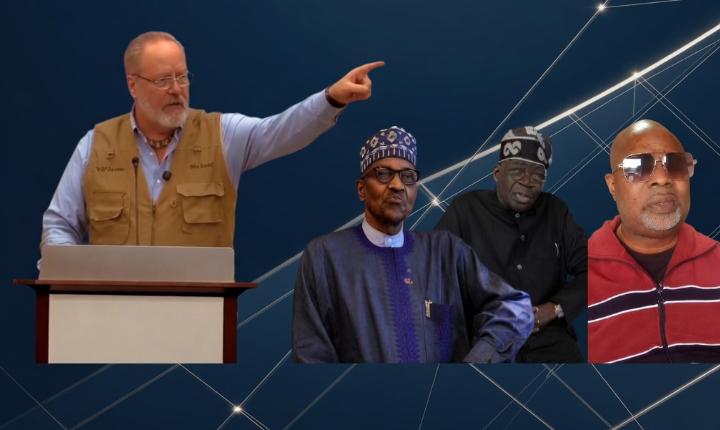
WASHINGTON, D.C — An American activist and former mayor, Mike Arnold, has ignited widespread debate after delivering an extensive presentation accusing Nigerian authorities of failing to adequately address insecurity, displacement, and governance challenges affecting millions of citizens.
Arnold, founder of Africa Arise International, made the remarks during a public policy discussion, where he detailed his experiences from multiple visits to Nigeria, including trips undertaken during high-risk security advisories.
He claimed his organization currently operates informal education programmes for over 600 displaced children, particularly in communities he alleges remain unrecognized in official humanitarian records.
The activist described Nigeria as a country of immense global importance, highlighting its status as Africa’s most populous nation and projecting that it could become the world’s third-largest country by 2050.

He emphasized Nigeria’s economic potential, referencing its vast mineral wealth, energy resources, and strong diaspora presence, particularly in the United States, where Nigerians are widely recognized for educational and professional achievements.
Despite these strengths, Arnold argued that the country faces a critical turning point, warning that its future could shift toward either stability and prosperity or deeper insecurity with wider global implications.
In his address, he cited remarks by Michael Langley of the United States Africa Command, who has previously highlighted parts of West Africa as emerging centers of extremist activity.
Arnold linked these concerns to Nigeria’s northern region, which he described as facing persistent threats from armed groups, although such characterizations remain contested among experts.
He provided a historical overview, referencing the 19th-century Sokoto Caliphate and the legacy of colonial rule, arguing that these factors continue to influence political and social dynamics in modern Nigeria.
The activist also revisited the Nigerian Civil War, suggesting that its aftermath shaped long-standing regional and political tensions within the country.
Arnold made a series of serious allegations concerning governance and security, including claims of corruption, external influence, and inadequate response to violence, though many of these assertions remain unverified and disputed.
He referenced past administrations, including those of Goodluck Jonathan and Muhammadu Buhari, to illustrate what he described as a worsening security trajectory over time.
He also mentioned the current administration of Bola Tinubu, calling for accountability and institutional reforms, while making claims that have not been substantiated by independent investigations.
Arnold drew attention to displacement figures, asserting that millions of Nigerians have been forced from their homes due to violence, and warned that prolonged instability could increase the risk of radicalization among young people.
He emphasized the humanitarian consequences, arguing that displaced populations require greater international recognition, support, and access to education to prevent long-term social breakdown.
The activist cited several high-profile incidents of violence and controversial cases to support his position, presenting them as evidence of broader systemic failures within the country’s governance and security systems.
However, analysts caution that Nigeria’s security challenges are complex and involve multiple overlapping factors, including insurgency, banditry, communal clashes, and economic pressures.
The Nigerian government has consistently rejected accusations of complicity, maintaining that it is actively engaged in counterterrorism operations and working with international partners to address insecurity.
Officials have pointed to ongoing military campaigns, humanitarian initiatives, and policy reforms aimed at restoring stability and protecting citizens.
Experts note that while criticism of governance and security responses remains valid in some areas, sweeping claims require careful verification to avoid misinformation and heightened tensions.
Arnold concluded his presentation by calling for stronger international engagement, improved data collection on displaced populations, and reforms aimed at strengthening democratic institutions.
His remarks have intensified ongoing global discussions about Nigeria’s future, drawing attention to the urgent need for balanced reporting, credible evidence, and sustained efforts to address both security and humanitarian concerns.
Observers say the debate reflects the broader challenge of navigating complex narratives around conflict, governance, and development in one of Africa’s most influential nations.




