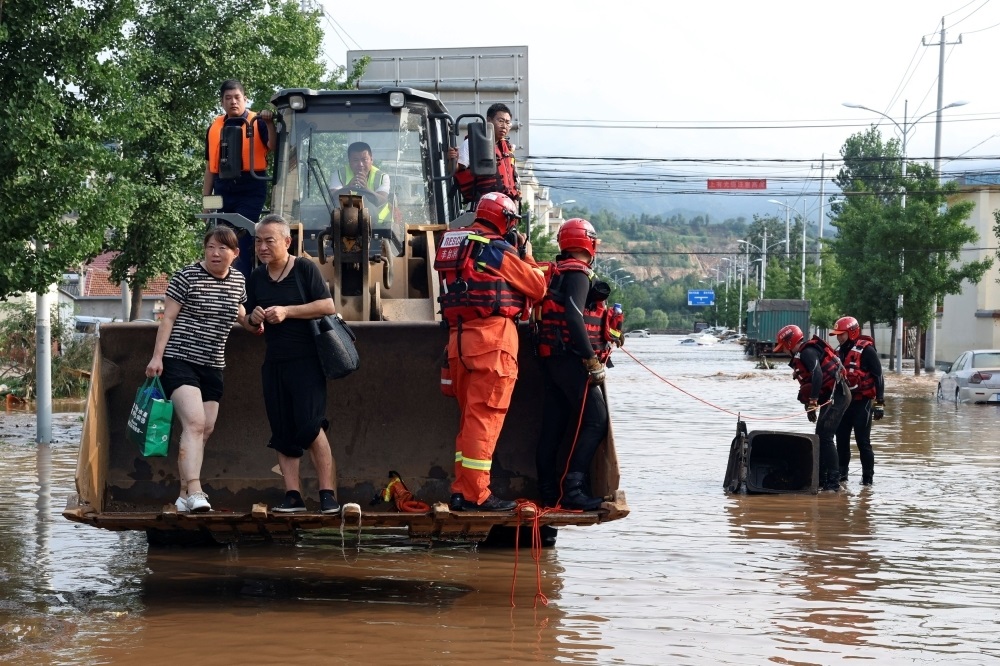
Heavy rainfall has triggered widespread devastation across northern China this week, leading to deadly floods, massive evacuations, and extensive damage to infrastructure.
In Shanxi province, a bus that disappeared during the storm was found with ten people confirmed dead, as announced by state media on Wednesday.
The vehicle had vanished on Sunday morning in the city of Datong amid relentless rainstorms that have battered the region for days.
Efforts to locate survivors continue, with authorities still searching for four individuals who remain unaccounted for.
According to the official Xinhua News Agency, one body was discovered downstream shortly after the incident.

This raised concerns that the missing passengers may have also been swept away by floodwaters.
The tragedy in Shanxi is part of a broader climate disaster unfolding across several provinces.
At least 48 people have died across northern China due to the torrential downpours, which have led to overflowing rivers, road closures, and the submersion of entire communities.
Tens of thousands have been forced to flee their homes as rescue operations ramp up in affected areas.
Beijing, the capital, has experienced one of the deadliest rain-related disasters in recent memory.
At least 30 people have died there, with the highest number of casualties reported in Miyun District, a northeastern suburban area known for its mountainous terrain and reservoirs.
The rainfall has been particularly intense, overwhelming drainage systems and cutting off access to several neighborhoods.
In neighboring Hebei province, which surrounds Beijing, the situation has also turned dire.
A landslide triggered by the heavy rains killed eight residents in one village, and another four people remain missing.
The incident has drawn national attention, with emergency teams deployed to assist with recovery and provide aid to displaced families.
These events highlight the growing vulnerability of parts of China to natural disasters during the summer months.
Flooding and landslides are not uncommon, especially in mountainous or riverine regions where rainfall can accumulate rapidly.
The rainy season often stretches from June to August, but the severity and frequency of such extreme weather events appear to be escalating.
Scientists and environmental experts point to climate change as a key factor contributing to the increased intensity of China’s summer storms.
As global temperatures rise, weather systems have become more volatile, with greater potential for both extended droughts and catastrophic rainfall.
Warmer air holds more moisture, which means storms are capable of releasing significantly more water in a short time, exacerbating flood risks.
China currently stands as the world’s largest emitter of greenhouse gases, primarily due to its dependence on coal and industrial output.
These emissions are widely considered a major driver of global climate change.
Climate Change in turn contributes to the rising incidence of natural disasters both within China and worldwide.
However, China has also taken significant strides to address its environmental impact.
It is now a global leader in renewable energy investment and infrastructure, rapidly expanding its use of solar and wind power.
The country has pledged to reach carbon neutrality by 2060, a goal that involves transitioning its massive economy away from fossil fuels and toward cleaner alternatives.
In the meantime, the country continues to grapple with the immediate effects of climate-induced disasters.
From city streets transformed into rivers to power outages in remote villages, the scope of the destruction is immense.
Emergency crews, including military and civilian responders, are working around the clock to provide relief and restore essential services to affected regions.
Rescue operations persist and floodwaters slowly recede.
On the other hand, the latest series of natural disasters serves as a stark reminder of the urgency surrounding climate preparedness.
Improved early-warning systems, sustainable urban planning, and continued global efforts to reduce emissions will be crucial in minimizing future loss of life and damage.