


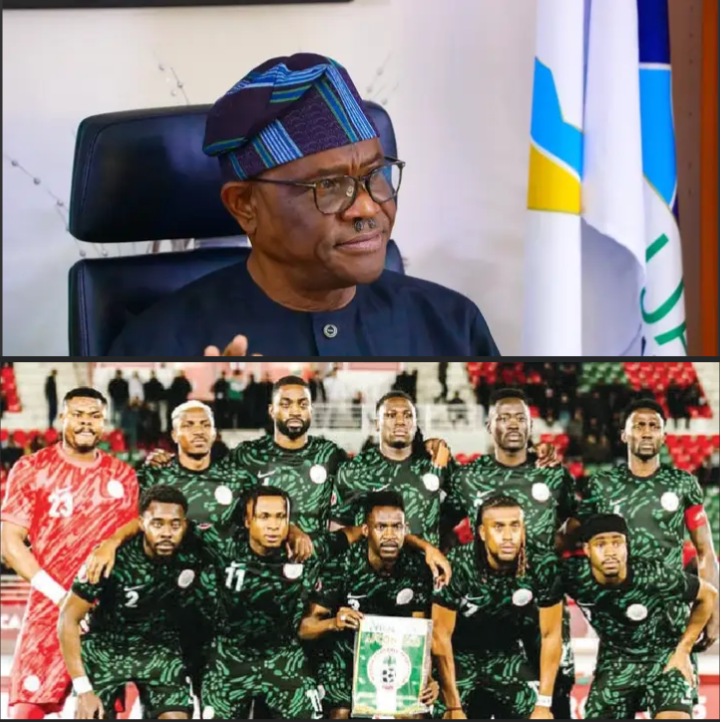
The Minister of the Federal Capital Territory, Nyesom Wike, has openly expressed his disappointment over Nigeria’s failure to qualify for the 2026 FIFA World Cup, describing the absence of the Super Eagles from football’s biggest tournament as a painful experience for millions of Nigerians who passionately follow the national team.
Wike’s comments have resonated across the country, where football remains more than just a sport. For many Nigerians, the Super Eagles symbolize national pride, unity, and international recognition. The inability of the three-time African champions to secure a place at the World Cup has therefore continued to generate frustration among supporters, sports administrators, former players, and football stakeholders.
Speaking during an interaction with former Super Eagles captain Joseph Yobo, the FCT Minister noted that Nigerians were deeply unhappy with the national team’s failure to qualify for the tournament. According to him, a country blessed with Nigeria’s football history, population, and abundance of talent should not be watching the World Cup from the sidelines.

His remarks reflect the sentiments of many football lovers who expected Nigeria to qualify comfortably for the expanded 2026 FIFA World Cup, which features more participating nations than previous editions.
The disappointment is particularly significant because football occupies a unique place in Nigerian society.
Across cities, towns, and villages, football remains the most popular sport in the country. From local viewing centres to major stadiums, the Super Eagles have historically united Nigerians regardless of ethnicity, religion, language, or political affiliation.
For decades, the national team has provided moments of joy and celebration that transcended social divisions.
Nigeria’s football story is one of remarkable achievements and unforgettable memories.
The country first qualified for the FIFA World Cup in 1994 and immediately announced itself on the global stage with a series of impressive performances. The squad that competed in the United States featured some of the finest footballers Africa had produced, including the legendary Rashidi Yekini, Jay-Jay Okocha, and Daniel Amokachi.
Their performances inspired a generation of footballers and established Nigeria as one of Africa’s leading football nations.
Subsequent appearances at the World Cup further strengthened the country’s reputation.
Nigeria reached the Round of 16 at the 1994, 1998, and 2014 tournaments and consistently produced players capable of competing against the world’s best.
Over the years, stars such as Nwankwo Kanu, Vincent Enyeama, John Obi Mikel, and several others helped elevate Nigerian football’s international profile.
Against this rich historical background, missing out on the 2026 World Cup has been particularly difficult for supporters to accept.
Many observers believe the current Super Eagles squad possesses enough talent to compete at the highest level.
The team includes internationally recognized stars such as Victor Osimhen, Ademola Lookman, Alex Iwobi, Wilfred Ndidi, and Calvin Bassey, players who have excelled in some of Europe’s most competitive leagues.
Among them, Osimhen has emerged as the face of modern Nigerian football.
Born in Lagos and raised in challenging circumstances, the striker’s journey from the streets of Nigeria to becoming one of the world’s most feared forwards has inspired countless young footballers.
His rise reflects the depth of talent that continues to exist within Nigerian football.
Despite the presence of such quality players, Nigeria’s qualification campaign was marked by inconsistency and missed opportunities.
A series of disappointing results placed the Super Eagles in a difficult position, ultimately leading to their failure to secure a ticket to the World Cup.
Football analysts have pointed to several factors that contributed to the setback.
Issues such as coaching instability, administrative challenges, inadequate planning, and underperformance in crucial fixtures have all been cited as reasons behind the unsuccessful campaign.
Many experts argue that Nigeria’s football problems extend beyond the national team and require structural reforms.
There have been growing calls for greater investment in grassroots football development, improved coaching education, better management of domestic competitions, and stronger football administration.
Supporters believe such reforms are necessary if Nigeria is to reclaim its position among the world’s elite football nations.
Wike’s intervention adds to the growing demand for accountability and long-term planning within Nigerian football.
His comments highlight the expectation that a nation with over 200 million people and an abundance of football talent should consistently qualify for major international tournaments.
The FCT Minister also emphasized the emotional impact of the World Cup absence on Nigerians.
For many fans, watching other nations compete while the Super Eagles remain absent has been a painful reminder of what could have been.
The expanded format of the 2026 World Cup had raised hopes that Nigeria would secure qualification without difficulty, making the eventual failure even more disappointing.
However, despite the frustration, there remains optimism about the future.
The Super Eagles still possess a talented generation of players capable of achieving success on the continental and international stages.
With proper planning, improved administration, and a renewed commitment to football development, many believe Nigeria can quickly recover from this setback.
As the World Cup continues without Africa’s most populous nation, the challenge for Nigerian football is clear.
Lessons must be learned, structures must be strengthened, and the foundations for future success must be rebuilt.
For Wike and millions of football-loving Nigerians, the hope is that this disappointment will serve as a turning point that ultimately leads to a stronger, more competitive Super Eagles team capable of returning to the global stage where many believe it rightfully belongs.




