


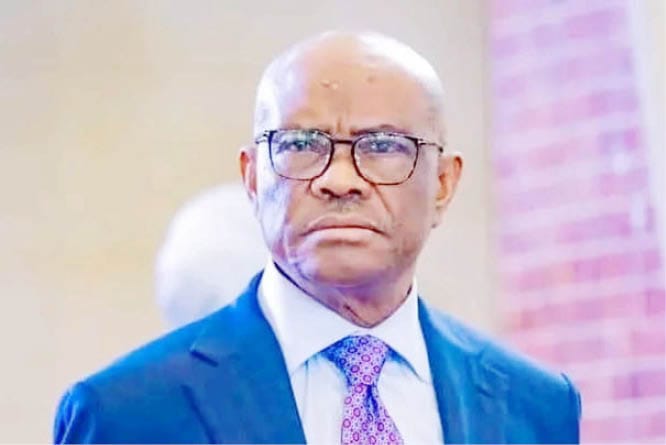
A storm of controversy has erupted across Nigeria’s political and media landscape following remarks attributed to the Minister of the Federal Capital Territory, Nyesom Wike, in which he suggested that he would have “shot” a television presenter during a live broadcast. The comment, directed at Seun Okinbaloye of Channels Television, has triggered widespread condemnation, igniting a national conversation about press freedom, political tolerance, and the responsibilities of public office holders in a democratic society.
The incident traces back to a recent episode of Politics Today, a widely watched current affairs programme on Channels Television, where Okinbaloye offered commentary on Nigeria’s evolving political terrain ahead of the 2027 general elections. In his analysis, the journalist underscored the importance of competitive politics as a cornerstone of democracy, cautioning against a scenario in which a single dominant party overshadows all opposition. He warned that such an imbalance could erode democratic values and weaken the electorate’s ability to make meaningful choices. His remarks reflected growing concerns among analysts and citizens alike about the health of Nigeria’s multi-party system.
However, these comments did not sit well with Nyesom Wike, who responded during his monthly media chat with a statement that has since reverberated across the country. Expressing frustration, the minister accused Okinbaloye of abandoning journalistic neutrality and injecting personal opinions into his role as a moderator. In a moment that has drawn intense scrutiny, Wike stated that if there were a way to break through the television screen, he would have “shot” the presenter. Although he later clarified that the remark was not meant to be taken literally, the damage had already been done, with many interpreting the statement as deeply inappropriate and potentially threatening.
DDM News gathered that the backlash was swift and far-reaching. Media rights organizations, civil society groups, and public commentators were quick to denounce the statement, arguing that such rhetoric—regardless of intent—has serious implications in a country where journalists already operate under significant pressure. A coalition of 14 organizations issued a joint statement condemning the minister’s words and calling for a public apology. They emphasized that even remarks made in jest can contribute to a climate of intimidation, particularly when they come from high-ranking officials with considerable influence.

The coalition further warned that expressions of violence, whether figurative or literal, risk normalizing hostility toward the press and undermining the principles of a free and independent media. In a democracy, they argued, journalists must be able to perform their duties without fear of reprisal, and public officials must exercise restraint in their language, recognizing the power and impact of their words. The statement highlighted the broader challenges facing press freedom in Nigeria, noting that the country ranks relatively low on global indices and that journalists frequently encounter harassment, surveillance, and, in some cases, arrest—especially during politically sensitive periods.
DDM News also observed that the controversy has sparked vigorous debate on social media platforms, where Nigerians have expressed a wide range of reactions. While some defended the minister, suggesting that his comment was taken out of context or exaggerated, many others criticized it as unbecoming of a public official. The reactions ranged from expressions of concern about the state of political discourse to outright condemnation of what was perceived as a reckless and dangerous statement. The incident has, in many ways, become a flashpoint for broader frustrations about governance, accountability, and the tone of public engagement in Nigeria.
For observers, the episode raises important questions about the boundaries between criticism and intimidation, as well as the role of the media in holding power to account. In democratic societies, tension between journalists and political figures is not uncommon, particularly when the media challenges prevailing narratives or highlights uncomfortable truths. However, the manner in which such disagreements are expressed can either strengthen or weaken democratic institutions. In this case, critics argue that the minister’s choice of words crossed a line, shifting the discourse from robust debate to perceived hostility.
The incident also underscores the growing sensitivity around Nigeria’s political future, especially as the 2027 elections draw closer. Discussions about the viability of opposition parties, the balance of power, and the integrity of the electoral process are becoming increasingly prominent. Against this backdrop, the role of journalists like Seun Okinbaloye in facilitating informed public dialogue becomes even more critical. Their ability to ask difficult questions and present diverse perspectives is essential to ensuring that citizens remain engaged and informed.
While Nyesom Wike has attempted to clarify his remarks, the controversy continues to reverberate, serving as a reminder of the delicate interplay between power and responsibility. Public officials, by virtue of their positions, are held to higher standards of conduct, and their words carry weight far beyond the immediate context in which they are spoken. In a nation striving to strengthen its democratic institutions, the need for measured, respectful, and constructive dialogue cannot be overstated.
As the debate unfolds, many are calling for introspection and a renewed commitment to the values that underpin democratic governance. The protection of press freedom, the encouragement of open dialogue, and the accountability of those in power remain central to Nigeria’s democratic journey. Whether this incident will lead to meaningful change or simply fade into the background of Nigeria’s vibrant political discourse remains to be seen, but its impact on public consciousness is undeniable.




