


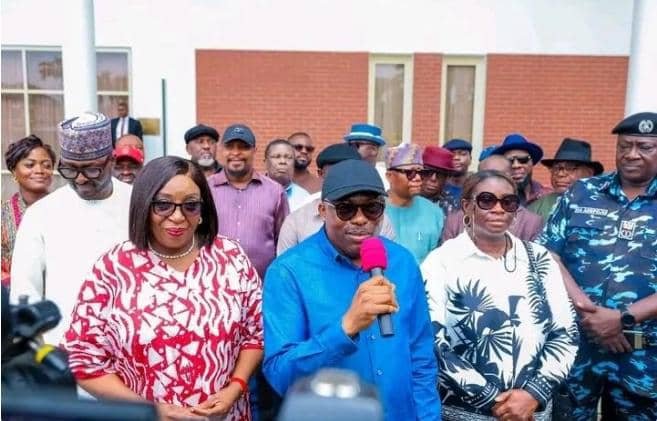
(DDM) – Governor Siminalayi Fubara has officially resumed his duties in Rivers State after six turbulent months under emergency rule, assuring citizens that peace and progress will define his next phase of leadership.
Diaspora Digital Media (DDM) gathered that Fubara made his return with a statewide broadcast, thanking President Bola Ahmed Tinubu for intervening in the prolonged political crisis that rocked the oil-rich state.
He specifically acknowledged Tinubu’s peace efforts, which brought him back into alignment with powerful stakeholders, including his estranged political ally and current Federal Capital Territory (FCT) Minister, Nyesom Wike.
The governor declared that Rivers had emerged from its darkest chapter, promising reconciliation and collective rebuilding across all sectors.

Welcome back to power
Fubara’s return was marked by jubilation as supporters thronged Port Harcourt International Airport to welcome him back.
From there, he proceeded to Government House, where he addressed citizens directly, outlining his fresh development agenda.
He pledged to prioritize infrastructure revival, improved education, healthcare reform, and economic recovery for Rivers State.
The governor also stressed the importance of unity, urging residents to put political conflicts behind them and join hands in rebuilding their state.
According to him, peace and stability had finally returned after months of uncertainty, and his administration was ready to deliver results without distraction.
Background of the crisis
The Rivers crisis had dominated Nigeria’s political headlines for much of the year.
Fubara, who succeeded Wike as governor in 2023 under the Peoples Democratic Party (PDP), soon fell into a bitter power struggle with his predecessor.
The feud split the state’s political structure into rival camps, paralyzing governance and prompting fears of escalating violence.
As tensions worsened, the federal government imposed emergency measures to restore order and prevent a breakdown of law and security in the state.
The intervention drew widespread debate, with some supporting Tinubu’s decisive action while others criticized the federal intrusion into state affairs.
Tinubu’s role in restoring order
President Tinubu played a central role in brokering peace, meeting with both Fubara and Wike in Abuja.
The truce saw both men soften their positions, with commitments made to stabilize the state and refocus on governance.
Tinubu’s mediation was praised by some analysts as a test of his political balancing skills, given Wike’s role as a powerful ally during the 2023 elections.
By restoring Fubara to office, Tinubu effectively signaled his influence in navigating intra-party conflicts that could destabilize governance at state level.
Fubara’s message of reconciliation
In his broadcast, Fubara called on political actors and community leaders to bury differences for the sake of Rivers State’s future.
He emphasized that the time for conflict was over, and the time for rebuilding had arrived.
The governor described peace as the foundation of development, insisting that Rivers people deserved stability after enduring months of political drama.
The road ahead
Observers say Fubara’s biggest challenge will be to balance governance with fragile political alliances.
While his promise of peace and progress has inspired hope, analysts caution that reconciliation with Wike’s camp may remain a delicate affair.
At the same time, citizens expect rapid improvements in infrastructure, job creation, and service delivery to justify his reinstatement.
The coming months will therefore test Fubara’s ability to consolidate power, deliver results, and rebuild trust among the people.
What remains certain is that Rivers, Nigeria’s oil-producing heartbeat, will once again occupy the national spotlight as its governor seeks to stabilize the state after months of political turbulence.




