


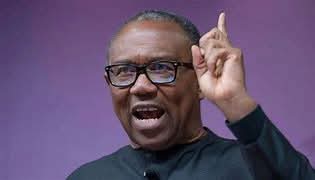
(DDM) – Former presidential candidate Peter Obi has strongly criticised Nigeria’s recurring national grid collapse, describing the country’s roughly 5,000 megawatts power capacity as absurd.
Obi made the remarks while reacting to the latest collapse of the national electricity grid, which plunged several parts of the country into darkness.
He said the incident once again exposed deep and unresolved failures in Nigeria’s leadership and energy planning.
According to Obi, it is unacceptable that Africa’s most populous nation continues to generate power levels that are insignificant by global standards.

He argued that Nigeria’s electricity output is grossly inadequate for a country with over 200 million people and a growing industrial base.
The former Anambra State governor noted that nations with smaller populations and weaker economies generate several times Nigeria’s total power capacity.
He described the situation as a national embarrassment that reflects decades of poor governance and misplaced priorities.
Obi stressed that electricity is the backbone of economic development and social stability.
He warned that no serious industrial growth can occur without reliable and sufficient power supply.
The former vice-presidential candidate said repeated grid collapses show that the power sector remains structurally weak and mismanaged.
He questioned how Nigeria expects to attract foreign investment when basic infrastructure like electricity remains unstable.
Obi argued that the frequent collapse of the grid increases production costs for businesses and worsens unemployment.
He said small and medium-scale enterprises suffer the most, as many cannot afford alternative power sources.
The former governor lamented that households are forced to rely on generators, worsening environmental pollution and living costs.
He linked the persistent power crisis to what he described as leadership failure and lack of long-term planning.
Obi recalled that successive administrations have promised power sector reforms without delivering meaningful results.
He said billions of dollars have been spent on the sector with little improvement in output or reliability.
According to him, the problem is not a lack of resources but a lack of competence, transparency, and accountability.
Obi urged the federal government to treat electricity as a national emergency rather than a political talking point.
He called for urgent investment in transmission infrastructure to prevent repeated system failures.
The former governor also advocated decentralisation of power generation to allow states and regions generate electricity independently.
He argued that over-centralisation has made the national grid fragile and inefficient.
Obi said Nigeria must move aggressively into renewable energy to complement conventional power sources.
He pointed out that countries investing in solar, wind, and hydro power are already enjoying more stable electricity supply.
The national grid has collapsed multiple times in recent years, often without clear explanations or accountability.
Each collapse typically leads to nationwide blackouts, affecting homes, hospitals, schools, and businesses.
Experts have attributed the failures to aging infrastructure, poor maintenance, and weak system management.
Despite repeated assurances from authorities, grid instability has remained a recurring feature of Nigeria’s power sector.
Public frustration has continued to grow as electricity tariffs rise without corresponding improvements in service delivery.
Many Nigerians have questioned why power distribution companies continue to bill consumers amid frequent outages.
DDM gathered that the latest collapse has reignited public debate over the sustainability of Nigeria’s electricity framework.
Civil society groups have also echoed Obi’s concerns, calling for an independent audit of the power sector.
They argue that transparency is needed to understand how funds allocated to electricity development are utilised.
The power crisis has also been linked to broader economic challenges, including inflation and reduced productivity.
Analysts warn that without urgent reforms, Nigeria risks falling further behind its peers in economic competitiveness.
Obi concluded that electricity reform is not optional but essential for national survival and progress.
He maintained that leadership must be judged by outcomes rather than promises.
The latest grid collapse has once again highlighted the urgent need for decisive action in Nigeria’s troubled power sector.




