



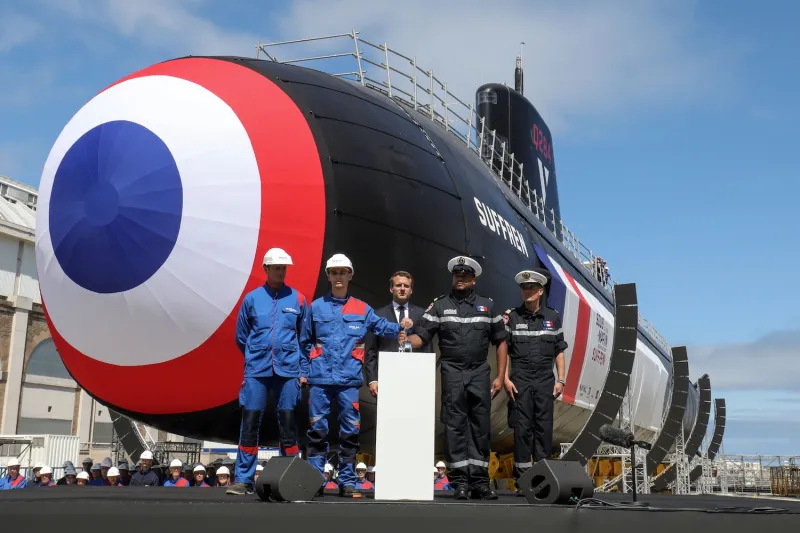
President Emmanuel Macron announced on Monday that France will increase the number of its nuclear warheads and collaborate with eight European nations in a new security initiative aimed at protecting the continent, amid growing concerns over US reliability in Middle East tensions.
Speaking at the Ile Longue Nuclear Submarine Base, Macron warned that the ongoing conflict between the United States, Israel, and Iran poses risks of instability that could spill over into Europe.
“The Middle East conflict brings and will continue to bring instability and a possible conflagration to our borders, with Iran’s nuclear and ballistic capabilities still intact,” he said.
The move comes as Europe watches the Israeli-US offensive in Iran and Russia’s protracted war in Ukraine, prompting a debate among NATO allies about the need for independent deterrence.
France currently holds an estimated 290 nuclear warheads, the fourth-largest arsenal globally after the United States, Russia, and China.
Macron outlined a strategy he described as “advanced deterrence,” which will see French nuclear forces integrated with eight European partners, including Germany, Britain, Poland, the Netherlands, Belgium, Greece, Sweden, and Denmark.
These nations will host French strategic air units, allowing for flexible deployment across Europe to complicate adversaries’ calculations.
The plan could also involve “conventional participation” of allied forces in nuclear exercises, reflecting recent joint drills with British forces.
Macron emphasized that the initiative is designed to “strengthen our nuclear deterrent in the face of multiple threats,” while respecting national sovereignty.
In parallel, France and Germany announced the creation of a “nuclear steering group” to enhance European coordination on nuclear deterrence.
The arrangement, they said, “adds to, not substitutes for, NATO’s nuclear deterrence.”
Immediate steps include German participation in French nuclear exercises, joint visits to strategic sites, and development of conventional capabilities with European partners.
Macron also cited domestic political considerations, noting concerns that a potential victory for the eurosceptic far-right National Rally party in France’s upcoming elections could weaken European cooperation.
“An upgrade of our arsenal is essential,” he said, confirming that France would increase its nuclear stockpile but will no longer disclose specific figures.
The announcement underscores a broader shift in Europe’s defense posture as NATO allies weigh the reliability of traditional security guarantees and the growing instability in the Middle East.


